Vendor spotlight · Exposure management
Part of Cyber Disrupters To Watch
Rival Security: who they are, what they sell and what CISOs should ask
Rival Security sells an agent harness: AI agents that test scanner findings for exploitability, find owners and open fixes. Founded by Omer Horev and Guy Kaplan.
What Rival Security sells
The company's home page calls the product the agent harness for cybersecurity and says it lets teams automate workflows, investigate vulnerabilities, track down owners, and remediate fast[1]. This profile is the first in our series Cyber Disrupters To Watch.
Rival's terms of service name it as Rival Security Inc. and say the terms are governed by the laws of the State of Delaware. The same terms describe the site as one that gives information about Rival's AI-driven vulnerability triage tools[6]. Its research blog opened with a post by Omer Horev dated February 1, 2025, which said: “We're thrilled to announce the launch of the Rival Security research blog today[7].”
Rival's home page names four areas: Vulnerability Management, Code Security, Cloud Security and Threat Hunting. The page says ready-made agents are live in minutes, and yours to customize and extend. Rival's home page says the company offers hyper-tailored agents, custom built for your environment and stack by Rival engineers, at no additional cost. According to Rival's home page, “Easily build any agents … to accelerate any workflow[1].”
Rival's exhibitor page at The Global-Israel Innovation Summit at RSA says Rival autonomously manages vulnerabilities across the entire lifecycle, from scanning and root cause analysis to ownership and remediation, and that the platform eliminates manual triage and prioritizes findings based on business context and the actual likelihood of exploitation[4].
Rival's one-pager argues that the problem is execution, under the heading “The Real Problem isn't Visibility”. According to Rival's one-pager, “We need actions, not dashboards[3].” On our reading, that places Rival beside a team's scanners rather than in place of them: it reads their output and acts on it.
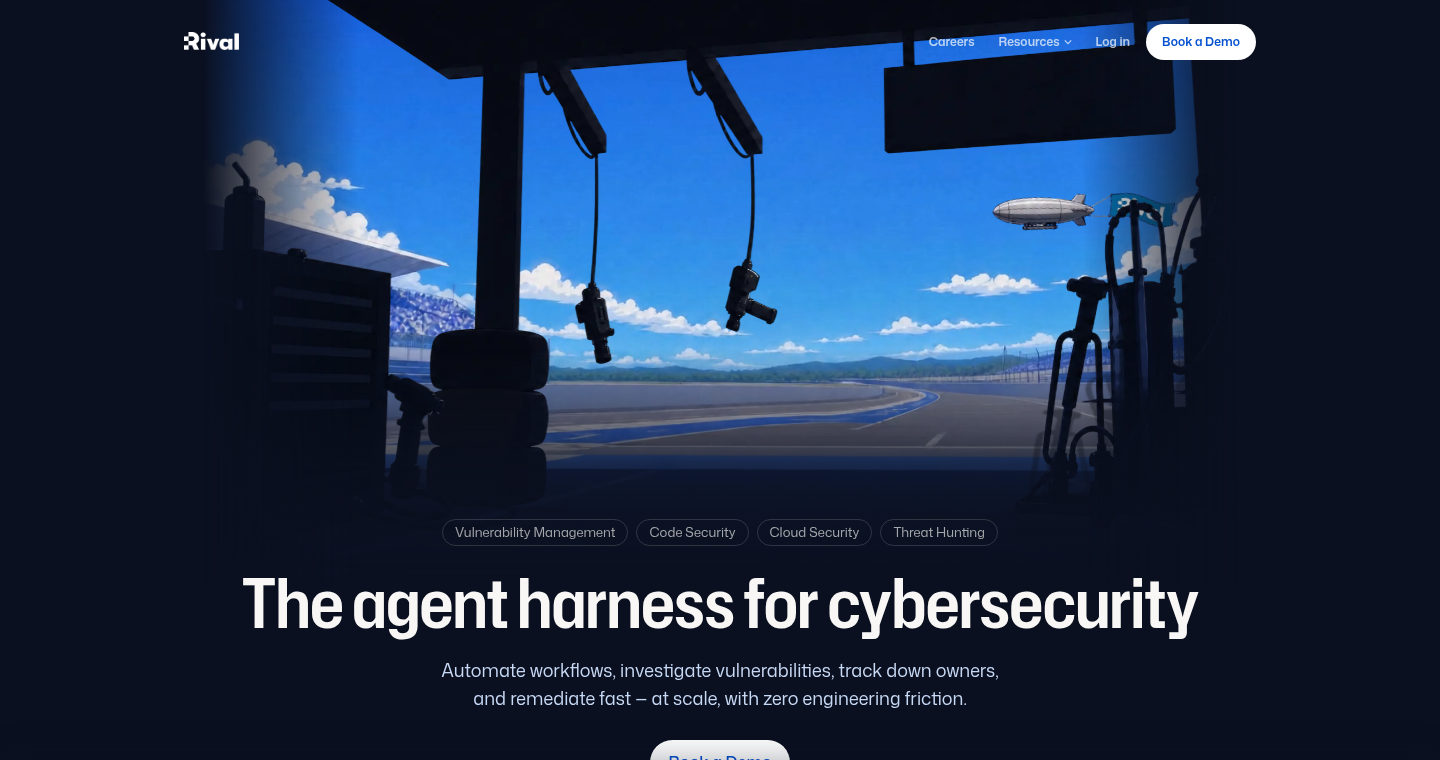
Figure: Rival Security's home page, captured 2026-11-15. Source: Rival Security: The agent harness for cybersecurity[1].
The founders
Under the heading Founders, Rival's one-pager names Omer Horev, CEO, and Guy Kaplan, CTO[3]. The summit's exhibitor page gives Horev's title as Co-Founder & CEO, Rival Security[4].
The one-pager says that “Omer has over a decade of elite cyber operations experience, having led a department of 40 specialists in carrying out highly sophisticated network operations”. It adds that he also held pivotal roles in the Israeli Cyber Command[3]. The listing for a Rival webinar calls him the former leader of an elite nation-state cyber directorate. Rival's webinar listing says that Horev was recognized with the Israel Defense Prize for his contributions. According to Rival's webinar listing, in “An APT's Overview of APTs”, Omer shares insights into the often misunderstood methods and behaviors of the biggest cybercriminals[5].
The one-pager says Kaplan designed military-grade network cryptosystems as an IDF officer and developed counterterrorism toolkits as a cyber research firm's Director of Engineering. Rival's one-pager also says Kaplan patented new vulnerability analysis methods as Oligo's Director of Research and Technology[3]. Oligo Security's report on ShadowRay, titled “ShadowRay: First Known Attack Campaign Targeting AI Workloads Actively Exploited In The Wild”, is dated Mar 26, 2024 and lists Guy Kaplan among its authors[8].
Rival's one-pager says that Vulnerability Management is Broken. Rival's one-pager describes the work as “scan, sift, prioritize, chase, fix, report… then repeat”. The one-pager says: “Our vision is to shift practitioners from being manual operators to[3] strategic supervisors.”
Under the heading Adversaries are getting faster, Rival's home page says AI turns a CVE into a working exploit in hours, and anyone can use it. One item on Rival's home page, credited to Anthropic research, says that An open-weight model turned a public Chrome patch into a working exploit in 8 hours, for $20.40. Rival's home page says of a JFrog Artifactory flaw: “From fix to 400K attacks a day in 5 days.” Rival's home page lists 2026 zero-days in production stacks[1], including PHP2Shell, dated Oct 21, and Fastjson 1.x, dated Jul 21. In a 2024 paper, Richard Fang, Rohan Bindu, Akul Gupta and Daniel Kang reported that, when given the CVE description, a GPT-4 agent exploited 87% of a set of 15 one-day vulnerabilities.
The blog index also lists posts by Ben Gilat, Yotam Cohen, Guy Dar and Jake Feiglin[14].
What the product does
Rival's home page lists agents such as Autonomous Remediation and Triage Exploitability as “A few of the agentic super-powers Rival grants your team on day one”. In the company's words, Autonomous Remediation generates and ships precise, tested fixes and Triage Exploitability proves what's actually exploitable in your environment. The page says Ownership Resolution maps every finding to the team that can fix it, 0-day Fast Response handles new threats from triaging to remediation, and Context Enrichment adds asset, runtime and business context, automatically. According to the page, 64+ more agents are ready to slot into a security programme[1].
The first use case on Rival's use-cases page, cutting through the noise, says Rival reads every finding a customer's scanners raise against the real environment and keeps only the ones that can actually hurt. The second, 0-day rapid response, says that when a zero-day drops, Rival finds where the customer is exposed across code, images and cloud, and claims the work goes from two to four days to minutes. The third, autonomous remediation, says Rival plans the fix, tests it and opens the pull request, so the team reviews instead of digging, and claims three to four weeks becomes minutes.
FIRST's page on the Exploit Prediction Scoring System says: “The Exploit Prediction Scoring System (EPSS) is a data-driven machine-learning model that estimates the probability that a published CVE will be exploited in the wild in the next 30 days[19].” CISA's page for its Known Exploited Vulnerabilities catalog says “CISA maintains the authoritative source of vulnerabilities that have been exploited in the wild”[20]. According to FIRST's page on CVSS, “The Common Vulnerability Scoring System (CVSS) provides a way to capture the principal characteristics of a vulnerability and produce a numerical score reflecting its severity. The numerical score can then be translated into a qualitative representation (such as low, medium, high, and critical) to help organizations properly assess and prioritize their vulnerability management processes[18].” CISA's page also says: “Organizations should use the KEV catalog as an input to their vulnerability management prioritization framework[20].”
Rival's use-cases page lists the remediation run as six steps: gather findings, root cause, remediation plan, PR creation, human follow-up and remediation tracking. On its page of use cases for AI agents for vulnerability triage, Rival says: “Every agent runs on the same harness, so any security work you do by hand can become one.” It also lists further jobs: monthly agentic scanning with cloud, code and business context; weekly asset tagging; alternative remediation that removes a risk without upgrading libraries; blocking only exploitable issues in CI/CD; checking whether a WAF blocks exploitation and adjusting it; mapping code to the cloud resources it runs on; and finding a vulnerability's owner from its root cause, the team structure and past Memories.
Rival's home page says: “Build anything with Rival, or pick a built-in agent to start a workflow.” Rival's home page shows the question “What should we secure today?” Those include triage findings, 0-day response, auto-remediate[1], cloud posture, dependency audit and threat model.
Rival's exhibitor entry for The Global-Israel Innovation Summit at RSA says the Rival team works alongside the agents to validate results and refine logic, and that agents route tickets and PRs to engineering, DevOps or IT with precise fix instructions and risk context[4].
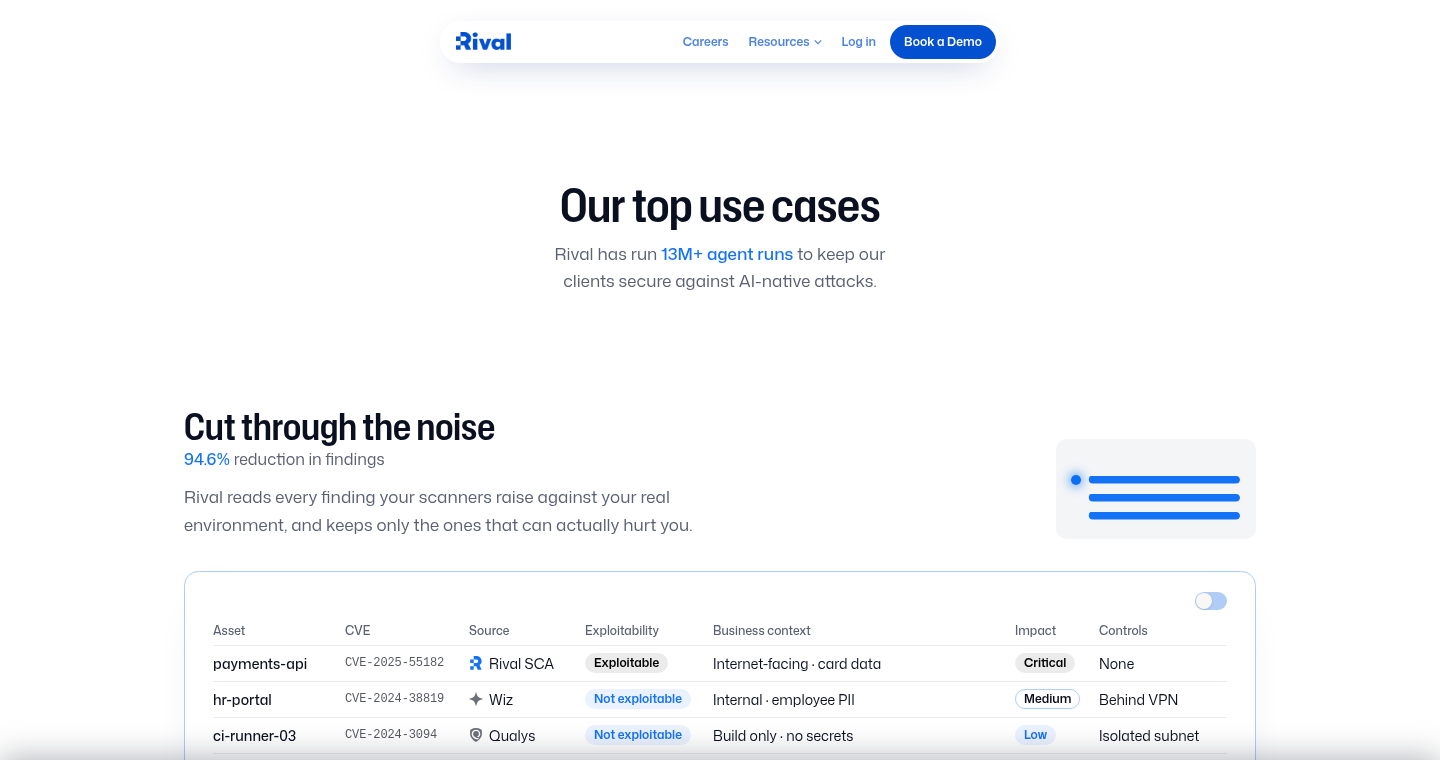
Figure: Rival Security's use-cases page, captured 2026-11-15. Source: Use cases[2].
How it works and what it connects to
The home page says that every agent runs on Rival's Agent Harness, which reads the context of a customer's cloud, code and scanners and hands the work to specialist subagents. The subagents it names cover exploitability, ownership, root cause, red team simulation, PR creation, WAF mitigation[1], human follow-ups, code to cloud, business context and report writing.
- Cloud: AWS, Google Cloud, Microsoft Azure.
- Code: GitHub, GitLab, Bitbucket.
- Infrastructure: Kubernetes, Docker, Terraform.
- Scanners: Wiz, Rapid7, Qualys.
- Controls: Upwind, Cloudflare, CrowdStrike.
- Tasks: Jira, ServiceNow, Linear[1].
Rival's PHP2Shell post says agents run inside a sandbox, either on Rival infrastructure or self-hosted by the customer. It says they combine connected services with the Rival Security Knowledge Graph[15], which holds information about infrastructure, vulnerabilities and security findings. After analysis, the post says, agents can message employees, open pull requests, suggest WAF rules, apply configurations and write vulnerability reports.
A June 30, 2025 post introduced Conductor, which it called Rival Security's reasoning engine. The post says Conductor implements a two-stage process: plan generation and plan orchestration. In plan generation, it says, Conductor breaks down the described problem into discrete logical steps that solve the problem. The post says Conductor can pull pre-defined steps from an existing, vetted library into its plans, and that its structured plans allow easy graph-based observability[9], so prompts can be tuned and errors spotted. For a buyer, that is the part to probe: which steps are fixed code a reviewer can read, and which are left to a model. Rival's post of November 12, 2026 says its agents download the package in a sandbox, read the code, write a PoC, and decide under what conditions the vulnerability is exploitable. That post says: “They run on gpt-6.1-sol[16].” According to the exhibitor entry, the agents maintain persistent memory and technical context[4].
Those are questions for the demo, below.
Where it sits in the market
Source: CISO Tribune vendor record, as of 2026-11-15 · Rival Security included in each count; the record lists vendors alphabetically and never ranks them.
| Label | vendors |
|---|---|
| Exposure prioritisation and CTEM | 27 |
| Vulnerability management | 54 |
| AI SOC analysts | 32 |
Funding, investors and growth
Rival's PHP2Shell post says that more than 80,000 repositories were scanned in mere hours by Rival agents[15]. According to Rival's home page, three figures: 98% Proven unexploitable, 87% Faster remediation and 1.5 hrs To first value[1].
Rival's terms of use are marked Last updated: July 2026 and begin Welcome to rivalsecurity.io[6]. The summit's exhibitor page lists Omer Horev[4] with an email address at the same rivalsecurity.io domain.
Customers, partners and public evidence
The exhibitor page's Prominent Case Study states the problem: “Siloed scanners (Snyk, Wiz, Qualys, Burp, pentest) generated 10,000+ vulnerabilities across code and cloud.” According to the case study, Single library vulnerabilities triggered duplicate Jira tickets for every microservice instance. Rival says its agents correlated code findings with cloud configuration to rule out unexploitable ones and clustered findings into 54 root-cause remediations[4]. The company reports the result as a 90% cut in noise and fixes made ten times faster.
Rival's PHP2Shell post says that For one customer, a triaging agent found 60 repositories containing PHP, out of which 29 were potentially vulnerable. The post says this happened hours before the CVEs could be detected using vulnerability scanners[15], and that agents then ranked services by reachability: internet-exposed services with no authentication first, then IP-restricted public services, then internal ones, then images and code with no running instance.
Research, open source and public work
Source: Rival Security: Digging into OpenAI's cyber security guardrail, 12 Nov 2026[16] · Rival's replays of 27 consistently blocked threads; rows for low reasoning effort, last step removed and reads blanked were run on 7 threads.
| Label | % of replays blocked |
|---|---|
| Unchanged | 70.1 |
| Low reasoning effort | 85.7 |
| Last step removed | 60 |
| Everything the agent read blanked | 57.1 |
| Read-only tools | 34.3 |
| Everything the agent wrote blanked | 25 |
| Note: no new exploit code | 23.3 |
| Report call forced | 14.9 |
| Note: stop testing, report now | 10.4 |
Chart data: Rival Security[16].
Model behaviour. Ben Gilat's post of November 12, 2026 is headed “Digging into OpenAI's cyber security guardrail: what gets blocked and what doesn't”. The chart above is drawn from it. Rival said blocks from the model's safety classifier normally stopped about one agent thread in twenty, until on November 5 that rose to one in five. It found that network-facing packages are blocked 2.6 times as often, that the block lands a median of 27 seconds into a reply, and that with three retries, 84% of blocked requests got through[16].
Rival replayed blocked requests unchanged and reported that 33 of 78 blocked requests were never blocked again. It found that reasoning effort makes no difference, and that one line telling the agent to stop testing and report took blocks from 70% to 10%. Blocked threads were five times as likely to have the word "payload" in the agent's own writing[16], though swapping the word out did not move the block rate.
Benchmarks. Jake Feiglin and Guy Dar's SastBench paper on arXiv, dated January 6, 2026, describes a benchmark for evaluating SAST triage agents that combines real CVEs as true positives with filtered SAST tool findings[11]. OWASP's page on source code analysis tools says: “Source code analysis tools, also known as Static Application Security Testing (SAST) Tools, can help analyze source code or compiled versions of code to help find security flaws.” OWASP's page lists among the weaknesses of such tools “High numbers of false positives”[21]. The abstract of the SastBench paper says of static analysis tools: “Despite their great utility, they generate numerous false positives, requiring costly manual filtering (aka triage)[11].” The company's February 19 blog version says false positives represent ~89% of the findings in its dataset, that it tested seven models, and that an agent built with security reasoning steps saw performance on the benchmark nearly doubled against a simple baseline. The post treated the Matthews Correlation Coefficient as the core evaluation metric because the data are imbalanced, and reported that generic software engineering agents failed to consistently or significantly outperform the simple agent[12]. The post says: “In order to test the flexibility and power of our approach, we created a slimmed-down version of Conductor's core logic.” According to the post, Rival then gave this version of Conductor access to the SQLite portion of the Spider 2.0-lite benchmark[9]. The project page for Spider 2.0 says: “Spider 2.0 is an evaluation framework comprising 632 real-world text-to-SQL workflow problems derived from enterprise-level database use cases[22].” That post says the answers were inspected for correctness programmatically, using a critic LLM, and with a final manual pass. Rival says: “It almost doubles the existing approaches, successfully answering nearly 63% of the challenge successfully.” The post's case for the design was that today's agentic approaches excel at toy examples and trivial problems, but their reasoning falls apart at enterprise scale. According to the post, “However, assuming that a correct workflow has been composed, the same workflow can be run repeatedly to generate up-to-date answers to the same question, without requiring any additional inference[9].”
Incident work. Guy Kaplan's post of November 24, 2025 said: “A new wave of activity consistent with the Shai Hulud supply chain attack pattern is emerging right now[10].” CISA's alert on the npm supply chain compromise says: “CISA is releasing this Alert to provide guidance in response to a widespread software supply chain compromise involving the world's largest JavaScript registry, npmjs.com[23].” A next-day update released a GitHub Action meant to block further infections before npm ci or npm install. The post told readers to “Search your GitHub organization for any repository you did not intentionally create”[10]. Feiglin's post of May 5, 2026 describes CVE-2026-4747 as a remote code execution capability in FreeBSD's networked file system. According to the post, Rival found a 20-year-old bug hiding in plain sight. Rival's post says: “The organizations that will come out ahead are the ones that turn to agentic capabilities before the attackers do[13].” On why PHP2Shell was so severe, Rival's post said that ~70% of websites run PHP, and the flaw is in the engine, so application-level security does not help. It said the patch arrived 17 hours after the leak. It also says the agents helped customers verify that early mitigations, and later patches, landed in code[15].
Agent tooling. Rival's home page says Taxi works by “clustering agent trajectories into a taxonomy we can query, browse, and act on”[1]. The blog index lists two posts on Taxi by Guy Dar: A Sneak Peek at Taxi, dated February 5, 2026, and Taxi: Debugging Agent Trajectories at Scale[14], dated July 19, 2026.
What a CISO should ask in a demo
The questions below are our reading of what a CISO could test in a proof of concept with Rival Security.
- Dropped findings. Rival says it keeps only the findings that can actually hurt you. On your own scanner output, ask for ten findings the agents dropped as not exploitable, with the evidence each decision rests on, and have your team check them.
- The headline figures. Ask how the 94.6% reduction in findings, the 98% proven unexploitable and the 87% faster remediation were measured, on whose data and over what period, then run the same measure during the trial.
- What agents may change. The PHP2Shell post says agents can open pull requests, suggest WAF rules and apply configurations. Ask for the list of actions that need a person's approval in your tenant and where each approval is logged.
- Where it runs. The company says the sandbox runs on Rival infrastructure or self-hosted. Ask what data leaves your environment in each mode, where it is stored, and how one customer's knowledge graph is kept apart from another's.
- Model dependence. Ask what happens to a task when a block lands, whether it retries or falls back to another model, and whether you see that in the record of the run.
- Rival engineers in the loop. The exhibitor page says Rival's team validates agent results. Ask which steps a Rival engineer performs during and after onboarding, what access they hold, and when the agents run without them.
- Custom agents. Ask who owns and maintains those agents, how they are tested before they touch production, and what happens to them if you leave.
- Ownership. Give the Ownership Resolution agent five findings whose owner your team already knows and see how many it gets right, and how it reasons when the code owner and the cloud owner differ.
- Fixes. Ask to see an Autonomous Remediation pull request for a real finding in your code, including the tests it ran and what it does when the safe fix is not a library upgrade.
- References. Ask for two reference customers of your size and stack, and for the date each went live.
- Zero-day drill. Pick a recent one that touches your estate and time how long the agents take to say where you are exposed, against what your scanners report and when.
- CI/CD gate. Rival offers to block only exploitable issues in CI/CD. Ask how the agents decide inside a pipeline run, how long the check adds to a build, and what a developer sees when a build is blocked or let through.
- Data handling. Ask which of your code, findings and credentials the agents store, where, and for how long.
- Audit trail. Ask for the log of one agent run from start to finish, and who on your team can read it.
- Exit. Ask what you keep if the contract ends: the agents built for you, their configuration and the history of their runs.
- Pricing. Ask what the price is based on: agents, runs, findings or seats, and what a month of heavy use would have cost a customer of your size.
- When an agent is wrong. Ask for one case where an agent dropped a finding that later proved exploitable, and what changed afterwards.
Timeline
Source: Milestones cited in this profile; most from Rival Security Research Blog[14] · 14 dated events from Rival's pages, the arXiv listing and the webinar listing, counted on 2026-11-15; a count of what the sources date, not of everything the company did.
| Label | milestones |
|---|---|
| 2025 Q1 | 1 |
| 2025 Q2 | 1 |
| 2025 Q3 | 1 |
| 2025 Q4 | 3 |
| 2026 Q1 | 4 |
| 2026 Q2 | 1 |
| 2026 Q3 | 1 |
| 2026 Q4 | 2 |
Chart data: Rival Security Research Blog[14].
- March 26, 2024: before Rival. Guy Kaplan co-authored Oligo Security's ShadowRay report.
- February 1, 2025: research blog. “Welcome to the Rival Security Research Blog” is dated February 1, 2025.
- June 30, 2025: Conductor. Rival described its reasoning engine and its Spider 2.0-lite result.
- July 23, 2025: Spider 2.0. “Setting the Standard: Our AI Model Outperforms Spider 2” is dated July 23[14], 2025.
- October 29, 2025: webinar. Horev presented "An APT's Overview of APTs" online.
- November 24 and 25, 2025: Shai Hulud. Kaplan's live post on the attack, then a GitHub Action to block it.
- January 6, 2026: SastBench paper. The arXiv listing for the SastBench paper reads “Submitted on 6 Jan 2026”[11].
- February 5 and 19, 2026: Taxi and SASTBench. A first look at Taxi, then the SASTBench blog post.
- March 3, 2026: ClosedCaption. Rival's blog index lists “ClosedCaption: Finding Interpretable Clusters with LLMs” under March 3, 2026.
- May 5, 2026: Mythos. “Mythos 'Discovered' a CVE Already in Its Training Data - and That's Still Worrying” is dated May 5, 2026.
- July 19, 2026: Taxi at scale. Rival's blog index lists “Taxi: Debugging Agent Trajectories at Scale” by Guy Dar under July 19, 2026.
- November 2, 2026: PHP2Shell. “Black October 2026: How Rival's Agents Triaged PHP2Shell” is dated November 2[14], 2026.
- November 12, 2026: classifier study. Gilat's replay study of a model's cyber classifier.
Frequently asked questions
- What does Rival Security do?
- Rival Security sells what it calls an agent harness for cybersecurity: a platform on which AI agents read a customer's cloud, code and scanner data and hand work to specialist subagents. Its built-in agents triage scanner findings down to what is exploitable, find where a new CVE hits a customer's stack, and plan, test and open fixes as pull requests.
- Who founded Rival Security?
- Rival's own one-pager lists two founders: Omer Horev, the chief executive, and Guy Kaplan, the chief technology officer. It describes Horev as having over a decade of elite cyber operations experience and Kaplan as a former IDF officer who was later Oligo's Director of Research and Technology.
- How much funding has Rival Security raised?
- As of November 15, 2026, neither Rival's own pages nor the coverage CISO Tribune found announce a funding round, an amount or a lead investor. The company's terms of service name the operating entity as Rival Security Inc., under Delaware law.
- How does Rival Security work?
- Every agent runs on the Agent Harness, which connects to cloud accounts, code repositories, infrastructure, scanners, security controls and ticketing tools. In its PHP2Shell case study the company says its agents run inside a sandbox, either on Rival's infrastructure or self-hosted by the customer, and draw on a Rival Security Knowledge Graph.
- How is Rival Security different from other exposure management tools?
- CISO Tribune files Rival under exposure prioritisation and CTEM alongside companies such as Brinqa, Seemplicity, XM Cyber and Zafran Security. On our reading, Rival's pages put the weight on agents that act, by proving exploitability, routing findings and opening fixes, where several neighbours describe a unified view of findings or an attack graph.
- What should a CISO ask Rival Security in a demo?
- Ask to see, on your own scanner output, findings the agents dropped as not exploitable with the evidence for each; how the 94.6% reduction figure was measured; what the agents may change without approval; where the sandbox runs and what data leaves it; and what happens when a model provider's safety classifier blocks an agent mid-task.
Sources
- [1]Rival Security: The agent harness for cybersecurity · Rival Security, November 15, 2026
- [2]Use cases · Rival Security, November 15, 2026
- [3]Vulnerability management will never look the same (Rival Security one-pager) · Rival Security, November 15, 2026
- [4]Rival Security exhibitor page, The Global-Israel Innovation Summit at RSA · Global-Israel Innovation Summit at RSA, November 15, 2026
- [5]An APT's Overview of APTs (webinar presented by Rival Security) · Luma, October 29, 2025
- [6]Terms of Service · Rival Security, July 1, 2026
- [7]Welcome to the Rival Security Research Blog · Rival Security, February 1, 2025
- [8]ShadowRay: First Known Attack Campaign Targeting AI Workloads Actively Exploited In The Wild · Oligo Security, March 26, 2024
- [9]How to Scale Agentic Reasoning Without Breaking · Rival Security, June 30, 2025
- [10]Shai Hulud Returns: A Live Supply Chain Attack Unfolding · Rival Security, November 24, 2025
- [11]SastBench: A Benchmark for Testing Agentic SAST Triage · arXiv, January 6, 2026
- [12]SASTBench: Measuring AI's Path to Practical Security Automation · Rival Security, February 19, 2026
- [13]Mythos 'Discovered' a CVE Already in Its Training Data, and That's Still Worrying · Rival Security, May 5, 2026
- [14]Rival Security Research Blog · Rival Security, November 15, 2026
- [15]Black October 2026: How Rival's Agents Triaged PHP2Shell · Rival Security, November 2, 2026
- [16]Digging into OpenAI's cyber security guardrail: what gets blocked and what doesn't · Rival Security, November 12, 2026
- [17]LLM Agents can Autonomously Exploit One-day Vulnerabilities · arXiv, April 11, 2024
- [18]Common Vulnerability Scoring System SIG · FIRST, November 15, 2026
- [19]Exploit Prediction Scoring System (EPSS) · FIRST, November 15, 2026
- [20]Known Exploited Vulnerabilities Catalog · CISA, November 15, 2026
- [21]Source Code Analysis Tools · OWASP Foundation, November 15, 2026
- [22]Spider 2.0 · Spider 2.0 team, November 15, 2026
- [23]Widespread Supply Chain Compromise Impacting npm Ecosystem · CISA, September 23, 2025
Writer
Hadass Liza Bitton is a writer at CISO Tribune covering security leadership: the people who take the top security seat, the ones who leave it, and what each move signals. Reach her at hadass@cisotribune.com.