Vendor spotlight · Exposure management
Axonius: who they are, what they sell and what CISOs should ask
Axonius sells asset inventory software to security, IT and GRC teams. It was co-founded by Dean Sysman, Ofri Shur and Avidor Bartov.
What Axonius sells
Axonius sells software that gathers asset data from the tools an organisation already runs and builds one inventory from it, sold to security and IT staff. The company came out of stealth in 2017 and is venture-funded. Its funding release was datelined New York, March 5, 2024, and in it the company announced a $200 million Series E extension led by Accel and Lightspeed Venture Partners, with Stripes also taking part. Its company page says the platform serves "Security, IT, and GRC teams" (Axonius). On CISO Tribune's record it sits in cyber asset inventory, or CAASM.
The company sells the platform as the Axonius Asset Cloud, split into product lines on its platform page:
- Cyber Assets, the core inventory of devices and infrastructure.
- Exposures, which the page says unifies "security findings across every tool" and ranks fixes by exploitability, asset criticality and attack path.
- Software Assets, which the company says inventories software, including AI clients, "across every managed and unmanaged device".
- SaaS Applications, which links each app in use to the devices, identities and exposures it touches.
- Identities, covering service accounts, API keys and AI agents.
- Cyber-Physical Assets, which the page describes as passive OT and IoT discovery and exposure management. The company later announced general availability of this line.
- AI for Security, an assistant, AI Workforce and an MCP Server that, the page states, brings asset data "to Claude, your IDE, or custom agents".
The company's October 2026 announcement said AI Workforce delivers "50+ types of Virtual Workers". Part of the medical device and OT work came by purchase: Industrial Cyber reported in July 2025 that Axonius bought Cynerio, a medical device security company, for more than US$100 million in cash and stock, and that Cynerio's chief executive, Leon Lerman, joined Axonius as senior vice president.
Delivery runs through connectors the company calls adapters. Its platform page claims "over 1200 adapters and counting", and its 2024 boilerplate said the product "is deployed in minutes". For U.S. government buyers, a separate unit, Axonius Federal Systems, said it had begun a FedRAMP Class D (High) certification process.
The company's own pages define the product partly by what it is not. A company blog post argues that "CMDBs were built for ITSM, not security" and presents Axonius as the layer that "consolidates, deduplicates, and correlates" existing data sources rather than another source. The platform page offers to "Enrich your CMDB", not to replace it. Contrary Research describes it the same way: Axonius does not replace endpoint protection, firewalls or vulnerability scanners, it sits above them.
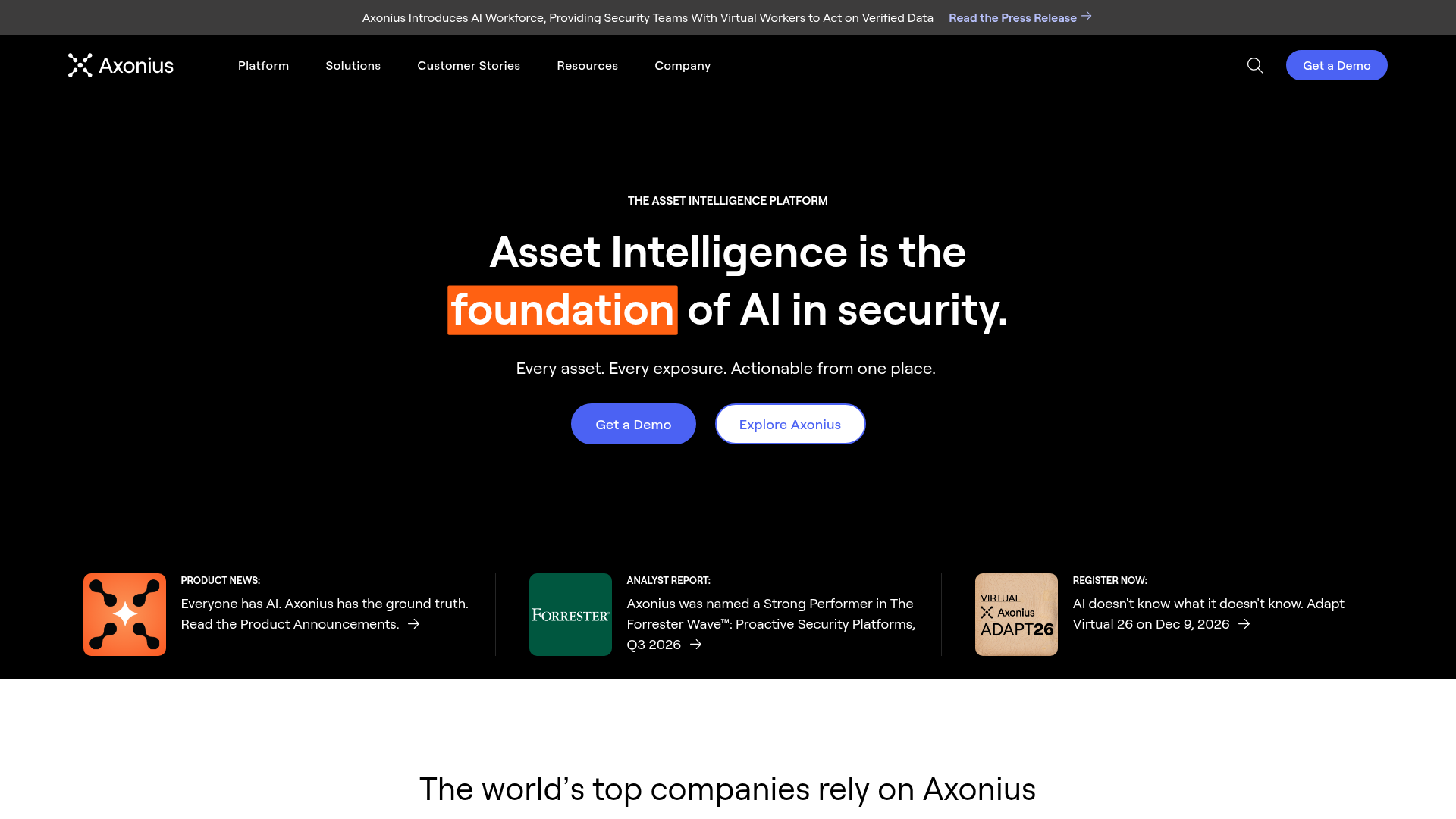
Figure: Axonius's home page, captured 2026-11-05. Source: The Asset Intelligence Platform | Axonius.com.
The founders
Axonius has three co-founders on our record: Dean Sysman, Ofri Shur, who is CTO, and Avidor Bartov, who is Chief Architect. A Contrary Research profile states that "The three longtime collaborators first worked together in the Israeli military." The background details below come from that profile, which draws on the company's own leadership pages.
It says he co-founded Cymmetria, a YC-backed cyber deception company, and served there as CTO. The same profile notes that he was featured in Forbes 30 Under 30 Israel in 2017. In the 2024 funding release mentioned above, the company quoted him as CEO and Co-founder. The company's newsroom later announced that it had appointed Joe Diamond as Chief Executive Officer.
He served eight years in the IDF intelligence corps, where he led an R&D section, and then became CTO of Kayhut, a cybersecurity provider. He holds a BSc in Physics and Mathematics.
It says he was working as a penetration tester at BugSec by 17 and later served as a researcher and team lead in Unit 8200. He and Sysman hold B.Sc. degrees in Computer Science.
Why they started it. Contrary reports that early money came from YL Ventures, "with Sysman convincing investors that every connected device posed a security risk, yet organizations lacked visibility into their total inventory." Sysman returned to that problem in a 2021 release about the CAASM category. There he said that "Companies of all sizes and across all industries face the same growing problem" and that "the increasing complexity of IT environments makes it impossible to account for all assets with manual processes alone." He framed the goal this way: "Our mission is to continue solving this pervasive problem and reducing manual work so security and IT teams can focus on what’s important."
By 2024 his description of the product had widened. In the Series E extension release he said: "We provide a system of record for all their digital infrastructure so they can quickly mitigate threats, navigate risk, automate action, and inform business-level strategy." In our reading, the two statements describe the same starting problem, an incomplete asset inventory, applied to a larger set of uses.
Other security leaders and executive changes appear on our people and moves pages.
What the product does
Axonius groups what it sells under the name Axonius Asset Cloud, a set of modules that sit on one asset data model. The adapter network described earlier feeds that model. In a 2021 release the company described itself as the cybersecurity asset management platform that gives organisations an asset inventory, finds coverage gaps and enforces security policies (Axonius, 2021). The module list has grown since then.
The modules. Its platform page describes each one in turn.
- Cyber Assets is pitched as a "system of record for all digital infrastructure", with AI tools counted as assets.
- Exposures pulls findings from every tool into one view and ranks them by exploitability, asset criticality and attack path. In April 2026 the company said it extended exposure management to 45 asset types.
- Software Assets inventories installed software and records versions, risk, ownership and lifecycle status.
- SaaS Applications finds apps in use and connects each one "to the devices, identities, and exposures it touches." It also flags unused and redundant apps so spend can be cut.
- Identities covers service accounts, API keys and AI agents as well as people. It surfaces posture problems such as admins with no MFA.
- Cyber-Physical Assets adds passive OT and IoT discovery, continuous inventory and exposure management for those environments.
- AI for Security includes an AI Companion that takes plain-language questions. It also includes the Virtual Workers and MCP Server noted earlier.
The workflow. The company describes three steps under the label Axonius Verified (platform page).
- Each asset is "correlated and deduplicated into one verified record".
- Findings are ranked by exploitability, exposure and business context.
- A finding becomes "a ticket, notification, or automated workflow". A human or an agent carries it out, and the step is logged.
The output a team works from is the asset record, a ranked list of findings and the tickets or automations that follow. Its company page adds customisable dashboards, reports and workflows aimed at executive reporting.
The controls a person keeps. The company says its AI acts on an answer only "with your approval" (platform page). It also says every action is logged, whether a person or an agent ran it. Read together, these claims describe a design in which the platform proposes and a person signs off. That is our reading of the company's wording; the company has not published a control model that says so directly.
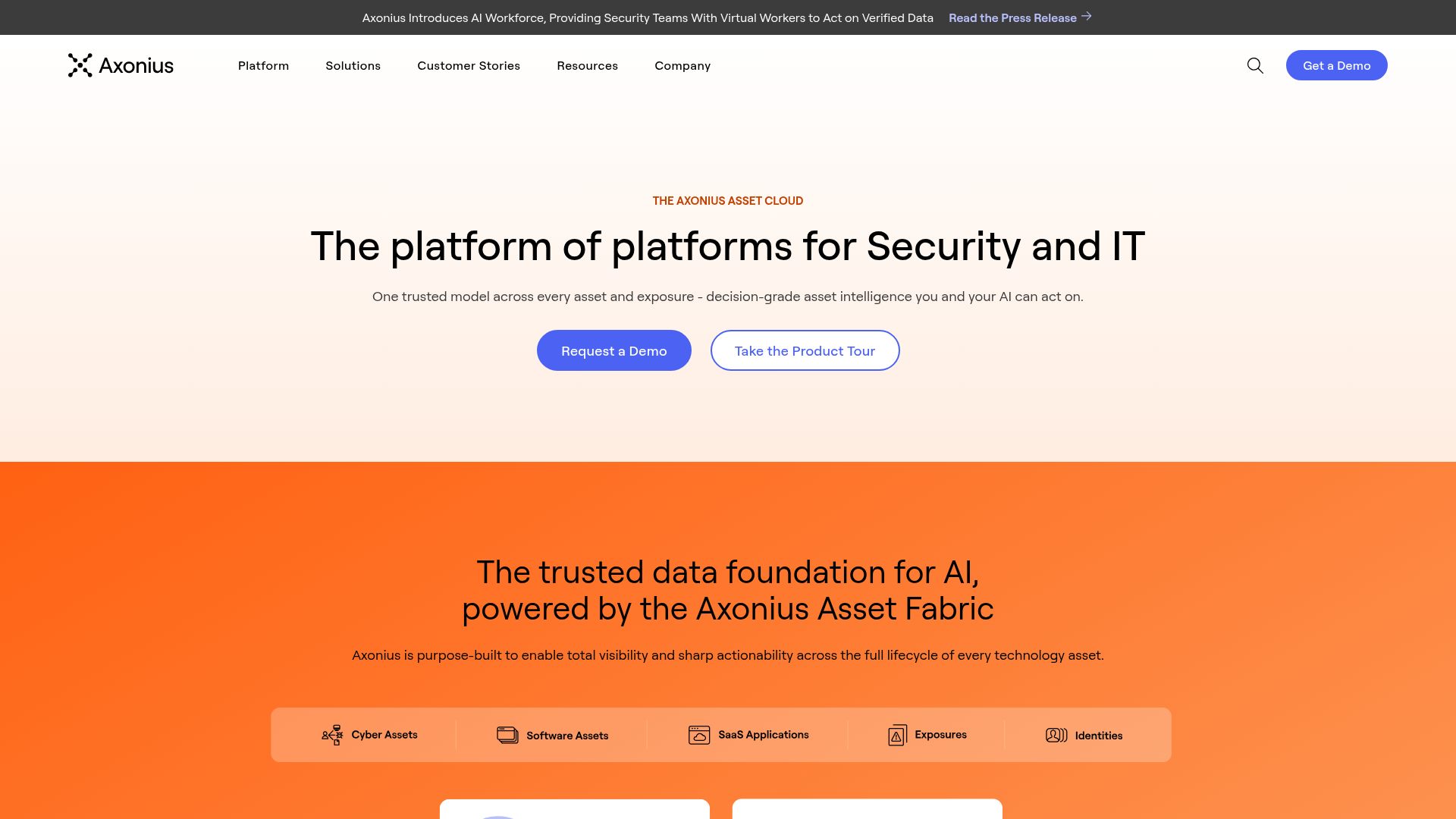
Figure: Axonius's product page, captured 2026-11-05. Source: Platform | The Axonius Asset Cloud.
How it works and what it connects to
Axonius builds its inventory from connectors it calls adapters. Contrary Research describes an adapter as a connector that "integrates with third-party solutions to pull asset and configuration data". The company's own count has grown. In 2021 it said its platform connected to nearly 350 security and technology products. In 2024 it said it offered over 1,000 platform integrations. Its platform page now lists "over 1200 adapters and counting".
The company describes its integrations as "bidirectional". We read this to mean that adapters can send actions back to connected tools as well as read from them. Contrary Research cited integrations with partners like Palo Alto Networks Cortex XDR as an example. The same report said Axonius complements specialised tools such as endpoint protection, firewalls and vulnerability scanners rather than replacing them. For cloud environments, it said the product assesses asset configurations across public, multi-cloud and hybrid environments and benchmarks them against standards such as those of the Center for Internet Security.
The AI methods named in the sources sit on top of that data. Contrary Research noted a Query Wizard that lets users create queries in natural language. The company has since announced an AI Agent and an MCP Server. Its platform page says the MCP Server lets customers bring their asset data to Claude, an IDE or custom agents. The newsroom also lists an integration with Anthropic that brings Claude Enterprise assets into the Asset Cloud, and an AI Workforce that the company says delivers 50+ types of Virtual Workers. A separate agreement with AWS was announced to help customers safeguard their use of agentic AI.
On connected devices, Industrial Cyber reported that Axonius bought the medical device security company Cynerio for more than US$100 million in a cash and stock transaction. The company later announced general availability of Cyber-Physical Assets, bringing IoT and OT context to the Asset Cloud.
On deployment, the company said in 2024 that Axonius is deployed in minutes. For government buyers, its federal arm initiated a FedRAMP Class D (High) certification process.
Where it sits in the market
CISO Tribune's record files Axonius under one category, cyber asset inventory (CAASM), defined on the record as the aggregation of asset data from existing tools to build an inventory and find coverage gaps. The term is explained in the glossary. Three neighbours on the record sell into the same category. In alphabetical order they are Brinqa, Guardare and runZero. Each has its own entry among the vendors, and this profile does not compare them.
The company has tied itself to the category label for years. In a July 2021 release, Axonius said it had been identified as a Sample Vendor for CAASM in the Gartner Hype Cycle for Network Security. The same release quoted Gartner's definition of CAASM as "an emerging technology focused on enabling security teams to solve persistent asset visibility and vulnerability challenges." The company's March 2024 funding release described Axonius as "Recognized as creators of the Cyber Asset Attack Surface Management (CAASM) category". By May 2026 the wording had changed. A newsroom item referred to "the asset intelligence category it created".
The company's pages separate Axonius from adjacent products in three ways. The first is scope. The 2024 release claimed that Axonius was the only company offering a combined solution for CAASM, SaaS Security Posture Management and SaaS Management Platforms. Its company page now describes a single platform covering cyber assets, software assets, SaaS applications, identities and infrastructure for Security, IT and GRC teams.
The second is the CMDB. A company blog post argued that "CMDBs were built for ITSM, not security" and described a CMDB as "a system of record for what IT thinks should be in the environment, not a real-time picture of what actually is."
The third is a case against adding more point tools. The same post said each new tool adds its own partial view and its own integration burden, and it positioned Axonius as the layer that consolidates and correlates them. This fits the complementary role noted earlier.
One outside view draws a similar line. Contrary Research contrasted Axonius with Tanium: it wrote that Tanium targets large enterprises with high-scale endpoint control, while Axonius specializes in integrating endpoint and security solutions to cover all assets.
The newest launches go past the record's category definition. That is our reading of the announcements, not a statement the company makes. In October 2026 the company announced capabilities turning AI into an asset class for security and IT to see and govern. Its platform now lists exposures, identities and cyber-physical assets alongside the inventory.
Funding, investors and growth
Contrary Research put Axonius's total funding at $865 million across eight rounds as of February 2025. Of those rounds, Contrary itemises a $100 million Series D in 2021 and a $200 million Series E in 2022 before the 2024 extension. It names YL Ventures as the source of early funding. It lists Stripes Group, ICONIQ Growth, Alkeon, Owl Rock and DTCP among the other investors.
The chart below shows the two pre-2024 rounds Contrary Research itemises, in millions of US dollars.
Source: research.contrary.com: Report: Axonius Business Breakdown & Founding Story | Contrary Research
| Label | USD million |
|---|---|
| Series D 2021 | 100 |
| Series E 2022 | 200 |
Chart data: research.contrary.com.
The same release said Axonius had doubled its staff during the pandemic and achieved triple-digit annual recurring revenue growth in 2020.
Axonius announced that it had secured $200 million in a Series E extension led by Accel and Lightspeed Venture Partners, with existing investor Stripes also participating. Contrary dates the extension to March 2024 and puts the valuation at $2.6 billion. The company's own release does not state a valuation. On the use of the money, the release said the round was "intended to accelerate innovation and scale across the globe as demand for the Axonius Platform continues to grow."
That release also gave the company's revenue and customer figures at the time. Axonius said it crossed $100 million in annual recurring revenue in 2023. It said its customers included more than a dozen of the Fortune 500, and that it supports four of the five major U.S. Department of Defense service agencies. Dean Sysman, then CEO, said the company had "gone from zero revenue to exceeding $100 million in ARR in just 4.5 years".
The next revenue figure came in 2026. The company's newsroom carried a release headed "Axonius Surpasses $200M ARR, Appoints Joe Diamond as Chief Executive Officer". The leadership changes that followed are tracked on our moves page.
None of the sources we hold records a priced round after the March 2024 extension. In our reading, the company's growth since then has been reported through revenue milestones rather than new capital.
Customers, partners and public evidence
Most of the public customer evidence comes from Axonius itself. Its customer stories page listed 34 case studies, spanning retail, financial services, government, healthcare and education. Named accounts include Western Union, Tokio Marine HCC and the City of Los Angeles. A 2024 funding release also named Schneider Electric, News Corp and Anheuser-Busch InBev as customers.
The quotes the company publishes come from working security staff. Alyssa Miller, CISO of Epiq, is quoted on the company page saying that "my IT team loves the platform." Avishai Avivi, CISO of SafeBreach, is quoted there as well: "Native tools just aren't enough." In its own business case post, Axonius says Western Union raised asset coverage from 92% to 99% and that a biotech customer cut SaaS license spend by 50%. These are customer results as the vendor reports them.
The headline return figures come from a Forrester Total Economic Impact study commissioned by Axonius in March 2025. According to the company's summary, the study found a 60% reduction in time spent maintaining asset inventories and 150% more assets identified than in the pre-Axonius inventory. The home page cites a payback period under six months. Because Axonius paid for the study, these are best read as commissioned findings rather than an independent benchmark.
On analyst recognition, Axonius said it was a Gartner Cool Vendor in Security Operations and Threat Intelligence in 2020. In July 2021 it said it was a Sample Vendor for CAASM in the Gartner Hype Cycle for Network Security. The same release cited a 4.7 rating from 17 reviews on Gartner Peer Insights as of July 21, 2021. In September 2026 its newsroom announced it had been named a Strong Performer in proactive security platforms by an independent research firm.
The partner record is recent. In June 2026 Axonius announced an integration with Anthropic that brought Claude Enterprise assets into its platform. In September 2026 it announced a strategic collaboration agreement with AWS. That same month its newsroom linked to an interview with its new channel head headlined "We Can't Do It Without Partners". One NHS case study, for the Isle of Wight NHS Trust, credits the reseller ITHealth alongside Axonius.
On certification, Axonius Federal Systems said in May 2026 that it had initiated the FedRAMP Class D (High) process. That was a start, not an authorization. The company's other public claims run larger. In 2024 its then-CEO said customers had given it "the highest net promoter score known by any cybersecurity or IT vendor in history". No source here shows how that figure was measured.
Research, open source and public work
Axonius's public work, in the material we reviewed, runs through a research division, company-written reports, its own events and press commentary. None of the sources lists open-source tools, public benchmarks or vulnerability disclosures from the company, so this section covers what is on the record.
The research division came first. Contrary Research reported that in 2021 Axonius launched AxoniusX, a research arm led by Amir Ofek as CEO of the division, set up to work on complex IT and security problems. The sources do not say what AxoniusX has published since.
The company's most detailed recent paper is a blog post titled The business case for asset intelligence: real numbers from real deployments, dated May 13, 2026. The post says it drew on customer interviews, analyst reports and hundreds of deep-dives a year with users. Its main claim concerns control coverage: "Many organizations have between 10% and 25% of their assets missing at least one required security control." The post gives no sample size or method for that range. It also restates the Forrester study noted earlier and adds figures not covered above: 70% faster vulnerability investigation and prioritization, and 90% savings on other vulnerability management activities. For the inventory-time finding, it estimates roughly 625 hours a year recovered for a team that spent twenty hours a week on upkeep. These are the company's own presentation of a study it commissioned.
On the event side, Axonius Federal Systems announced CISA Acting Director Nick Andersen as government keynote at Axonius Adapt in Action D.C. 2026, where he was scheduled to speak on federal cyber defense and asset intelligence at a June 9 event. The company's marketing campaign, which it says "trades buzzwords for evidence", was timed with a full debut at Black Hat USA 2026. Its homepage lists Adapt Virtual 26 on Dec 9, 2026, framed around the line "AI doesn't know what it doesn't know." Readers following practitioner talks can find more under speaking.
The company's public commentary in 2026 centred on AI and asset visibility. A company release on the same theme was headlined "Axonius Takes on Shadow AI, Turning AI Into an Asset Class for Security and IT to Finally See and Govern". In our reading, this body of work reads as positioning for the product's AI features more than as independent research: the figures come from the company or from a study it paid for, and none of the material describes data or tools released for others to test.
What a CISO should ask before buying
What follows is our reading: questions a CISO could put to Axonius during a proof of concept, each tied to something the company says about its product.
-
Which of our tools are covered, and how? The platform page claims "over 1200 adapters and counting". Ask for a line-by-line match against your own stack, and ask how a failing adapter is detected and reported.
-
What can it write back? The company page claims a breadth of "bidirectional integrations". Ask which of your tools accept actions from Axonius, then run one write-back during the trial.
-
How does correlation handle conflicts? The platform page says every asset is "correlated and deduplicated into one verified record". Pick a device that appears with different names in EDR, MDM and the directory. Ask to see the merge logic and how an analyst corrects a bad merge.
-
How fresh is the data? The company's blog argues that CMDB integrations run "on a schedule slow enough to miss the assets that matter most". Ask how often each adapter polls in your deployment. The same post quoted Western Union on ephemeral AWS instances, so test whether short-lived cloud workloads appear.
-
What drives the risk ranking? The company says findings are ranked by "exploitability, exposure, and business context". Ask which inputs set the order and whether you can change the weights. Then rerun the ranking on your own scanner output.
-
What does "with your approval" mean in practice? Axonius says its AI acts on answers "with your approval". Ask who can grant approval, whether any action runs without it, and what permissions the AI holds in connected systems.
-
Can we see the audit trail? The company says actions are "executed by a human or an agent and fully logged". Ask to export the log of an agent-run action into your SIEM.
-
Which Virtual Workers would we run? The October 2026 release said AI Workforce "delivers 50+ types of Virtual Workers". Ask which types fit your environment, which act without a human step, and how you would switch one off.
-
What leaves the platform through the MCP Server? Axonius says customers can bring asset data to Claude, an IDE or custom agents. Ask what data an external agent can read, how access is scoped, and how it is revoked.
-
Is OT discovery passive? The company describes passive OT and IoT asset discovery. Ask to show this on a live segment, and ask what any remediation step actually touches on operational devices.
-
How long until the inventory is useful? A 2024 release said Axonius is "deployed in minutes". Ask for the realistic time to a reconciled inventory at your scale, and have the vendor commit to it in the trial plan.
For terms used above, see the glossary.
Timeline
This timeline draws on Axonius's own press releases and newsroom, with one outside news report for the 2025 acquisition. Entries are oldest first. The earlier years are thin and 2026 is crowded: the company put out product, partnership and executive announcements most months that year. Leadership changes listed here are also tracked on /moves.
The chart counts the milestones this profile cites for each year before 2026, with most drawn from Contrary Research.
Source: Milestones cited in this profile; most from research.contrary.com: Report: Axonius Business Breakdown & Founding Story | Contrary Research · 6 dated events on the pages read for this profile, counted by the desk; a count of what the sources date, not of everything the company did.
| Label | milestones |
|---|---|
| 2017 | 2 |
| 2021 | 2 |
| 2023 | 1 |
| 2025 | 1 |
- 2017: Axonius emerged from stealth. Its 2021 release said that by then it had reached a $1.2B valuation (Axonius).
- 2021: The company announced that Gartner had named it a Sample Vendor for Cyber Asset Attack Surface Management in the Hype Cycle for Network Security (Axonius).
- 2023: Axonius said it crossed $100 million in annual recurring revenue (Axonius).
- March 5, 2024: The company announced a $200 million Series E extension led by Accel and Lightspeed Venture Partners (Axonius).
- July 2025: Axonius acquired Cynerio, a medical device security company, for more than US$100 million in cash and stock. Cynerio's co-founder and CEO, Leon Lerman, joined Axonius as senior vice president (Industrial Cyber).
The October 2026 AI Workforce and shadow AI releases were covered in earlier sections and are not repeated here. Read together, the 2026 entries show the company moving into federal certification, OT and IoT coverage and AI tooling in the same year. That is our reading of the dates, not a claim any single release makes.
Frequently asked questions
- What does Axonius do?
- Axonius sells software that gathers asset data from the tools an organisation already runs and builds one inventory from it. It sells the platform as the Axonius Asset Cloud, with product lines for cyber assets, exposures, software assets, SaaS applications, identities, cyber-physical assets and AI for security. Its company page says the platform serves Security, IT and GRC teams.
- Who founded Axonius?
- Axonius has three co-founders: Dean Sysman, Ofri Shur, who is CTO, and Avidor Bartov, who is Chief Architect. A Contrary Research profile states that the three first worked together in the Israeli military. In the 2024 funding release the company quoted Sysman as CEO and co-founder, and its newsroom later announced that it had appointed Joe Diamond as Chief Executive Officer.
- How much funding has Axonius raised?
- Contrary Research put Axonius's total funding at $865 million across eight rounds as of February 2025. In March 2024 the company announced a $200 million Series E extension led by Accel and Lightspeed Venture Partners, with Stripes also taking part. Contrary put the valuation at $2.6 billion, a figure the company's own release did not state.
- How does Axonius work?
- Axonius builds its inventory from connectors it calls adapters, and its platform page claims over 1200 of them. The company says each asset is correlated and deduplicated into one verified record, findings are ranked by exploitability, exposure and business context, and a finding then becomes a ticket, notification or automated workflow. It says every action is logged, whether a person or an agent ran it.
- How is Axonius different from a CMDB or security point tools?
- A company blog post argued that CMDBs were built for ITSM, not security, and the platform page offers to enrich a CMDB rather than replace it. Contrary Research wrote that Axonius complements endpoint protection, firewalls and vulnerability scanners rather than replacing them. The company presents its product as the layer that consolidates, deduplicates and correlates existing data sources.
- What should a CISO ask Axonius before buying?
- Ask for a line-by-line match of the claimed adapters against your own stack and how a failing adapter is reported. Ask which tools accept write-back actions, how often each adapter polls, and how the platform merges a device that appears under different names. Ask what the company's phrase "with your approval" means for its AI actions, what data its MCP Server exposes to external agents, and how long a reconciled inventory takes at your scale.
Sources
- Axonius Named CAASM Vendor in 2021 Gartner® Hype Cycle™ · Axonius, November 5, 2026
- Axonius Secures $200 Million Series E Extension Amid Explosive Growth · Axonius, November 5, 2026
- Who We Are · Axonius, November 5, 2026
- Newsroom · Axonius, November 5, 2026
- Axonius acquires Cynerio for over $100 million to tackle growing medical device cyber risks - Industrial Cyber · Industrial Cyber, July 31, 2025
- Business case for asset intelligence: by the numbers · Axonius, November 5, 2026
- Report: Axonius Business Breakdown & Founding Story | Contrary Research · research.contrary.com, November 5, 2026
- The Asset Intelligence Platform | Axonius.com · Axonius, November 5, 2026
- Platform | The Axonius Asset Cloud · Axonius, November 5, 2026
- Axonius Customer Stories | Successes in Cybersecurity & Asset Management · Axonius, November 5, 2026
Writer
Hadass Liza Bitton is a writer at CISO Tribune covering security leadership: the people who take the top security seat, the ones who leave it, and what each move signals. Reach her at hadass@cisotribune.com.