Vendor spotlight · Network security
Cato Networks: who they are, what they sell and what CISOs should ask
Cato Networks sells enterprises a cloud-delivered networking and security service. It is based in Tel Aviv and was founded by Shlomo Kramer and Gur Shatz.
What Cato Networks sells
Cato Networks sells enterprises a cloud-delivered networking and security service, which it calls the Cato SASE Cloud Platform. The company says it "delivers enterprise-grade security and networking as a single, cloud-native platform". Shlomo Kramer and Gur Shatz founded Cato in January 2015, and the company is based in Tel Aviv. It is privately held and backed by venture investors. In June 2025 its Series G round raised $359 million, led by new investors including Vitruvian Partners and ION Crossover Partners. The company said the round put its valuation at more than $4.8 billion. In September 2025 another $50 million in a private funding round took the round to $409 million. Cato also said it had passed $300 million in annual recurring revenue.
The company's site describes the full bundle, SASE Convergence, as one of five converged solutions that can be bought separately:
- Zero Trust Security (SSE): threat prevention, application and data security and access control. Its page states this can be deployed independently of existing networking infrastructure.
- Next Gen Networking: SD-WAN and site connectivity over Cato's own backbone. The company says it coexists with existing security and access infrastructure.
- AI Security: control of employees' use of third-party AI tools and runtime protection of a customer's own AI applications and agents, as the company describes it. This line came largely from Aim Security, Cato's first acquisition, made in September 2025. Cato said at the time it would fold Aim capabilities into the platform in early 2026.
Cato delivers these services from its own cloud. Its architecture page states that its Single Pass Cloud Engine (SPACE) converges NGFW, threat prevention, and CASB/DLP/ZTNA into one cloud-native stack. It says thousands of these engines run on bare-metal compute across worldwide PoPs, linked by multiple tier-1 carriers, with no hyperscaler dependency. Customers connect physical sites through zero-touch SD-WAN and roll out client software via self-service or MDM. New detection features ship inside the same service. Dynamic Prevention, announced in March 2026, was built into the Cato SASE Platform, SiliconANGLE reported.
The company also says what the product is not. Its funding release contrasted the platform with a legacy patchwork of firewalls, routers, cloud proxies, and point solutions. Its pages also say adoption need not be wholesale. Customers can start with a specific capability such as SD-WAN, SSE, or ZTNA and keep their existing routers, firewalls, and cloud security in place. Our glossary defines the category terms used here, and other companies on our record appear under vendors.
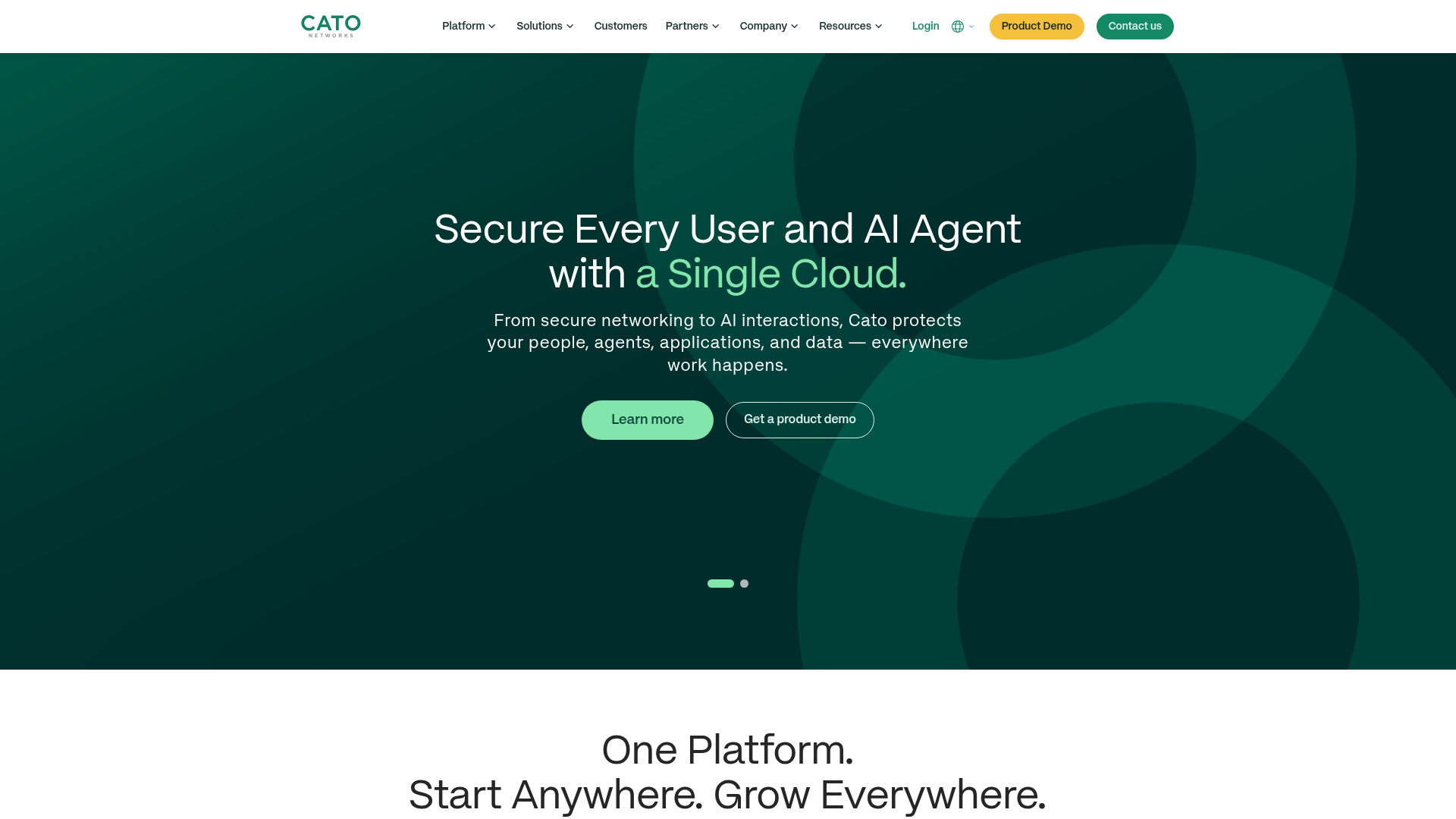
Figure: Cato Networks's home page, captured 2026-11-03. Source: Cato Networks | SASE, SSE, ZTNA, SD-WAN: Your Journey, Your Way.
The founders
Cato Networks has two founders on our record: Shlomo Kramer, its co-founder and CEO, and Gur Shatz, its co-founder. Both came to the company from earlier security businesses, and the company's own launch-era material presented that history as part of its pitch.
Kramer had started security companies before Cato. A 2016 company news post stated that he "helped found Check Point and Imperva". CRN, covering the launch, described him as a "respected security investor" and called Cato "the newest startup from security investor Shlomo Kramer". Check Point Software Technologies now sits among Cato's neighbours on our vendor record.
Gur Shatz's background, according to the same company post, was in cloud security: he "was the CEO of cloud-based security provider Incapsula". The post grouped the pair as founders who "have deep security roots". The sources given here say nothing more about Shatz's later role.
The founders explained the company's purpose at launch. When Cato came out of stealth, it introduced Cato Cloud, which it called a "network security-as-a-service" platform aimed at distributed, cloud-centric and mobile-first companies. CRN reported the company said the platform would "shake up the perception that security has to be complicated". In a launch statement, Kramer said "Cato is creating the next chapter in the evolution of network security by unifying the network and security stack in the Cloud". At that point, CRN reported, the company sold two SKUs, Cato Cloud Network and Cato Network Security Services.
The founders also brought in early backers. CRN reported that the company took $20 million in Series A funding in October from Steve Krausz of U.S. Venture Partners and Theresia Gouw of Aspect Ventures, ahead of the launch.
A decade later, Kramer was still framing the company against older vendors. In the Series G announcement mentioned earlier, he said "Our true SASE platform and decade of AI innovation differentiates Cato from legacy vendors that favor a portfolio of point solutions." The same release traced the company's work back to what it called "the creation of SASE with the convergence of security and networking in 2015". That is the company's account of its own origin. Kramer also described an AI direction for the platform: "We're embedding AI into the DNA of infrastructure itself."
When the Aim deal was announced, he set out the view behind it. Kramer said "AI transformation will eclipse digital transformation as the main force that will shape enterprises over the next decade". Our reading is that this marks a shift in emphasis from the network-and-security framing of the 2016 launch toward AI.
What the product does
Cato describes what it sells as a single-vendor SASE platform: one cloud service that carries an organisation's traffic, inspects it and applies security policy, all run from one console. The parts a security team works with fall into five groups.
Inspection. The single-pass engine noted earlier groups three sets of functions. The architecture page lists firewall flow control and network segmentation; threat prevention through secure web gateway, intrusion prevention, NGAM and remote browser isolation; and CASB, DLP and ZTNA for application and data protection. Terms such as CASB and DLP are defined in our glossary.
Policy. The company says every capability, including NGFW, CASB, DLP, ZTNA, threat prevention and AI controls, runs on a single policy engine, and that policies are distributed to all PoPs, SPACEs and clients (architecture page). Its page states that "One policy definition enforces consistently across every user, site, application, and location."
Data and management. According to Cato, every inspected flow feeds network, device, user, app and data context, along with hundreds of third-party feeds, into one open data lake that customers can query through the Cato API. Administrators configure, troubleshoot and analyse each capability through one console, with one universal API to reach all platform data (architecture page).
Access and onboarding. Physical sites connect through zero-touch SD-WAN (architecture page). For private applications, the homepage lists four Universal ZTNA access methods: ZTNA Client, Enterprise Browser, Browser Extension and Clientless Portal. The company says a customer can deploy them selectively, for some or all application access, alongside the access tools it already runs. For workforce AI use, the same page describes a starting sequence: discover AI use, enforce policies, and prevent sensitive data exposure from public AI tools and connected agents.
Automation, and what stays with people. Cato says it simulates new protection rules on real traffic and then deploys them within 24 to 48 hours, with "No IT involvement, no end-user impact" (architecture page). The same page lists AI functions for analysts: root-cause analysis and response recommendations, a policy advisor aligned to organizational intent, and classification of AI services along with governance of the data shared with them. Dynamic Prevention, described above, goes further. SiliconANGLE reported in March 2026 that once malicious behaviour is identified, Cato enforces restrictions automatically, without requiring IT or SOC intervention.
Our reading of these pages is that the work is split. The vendor maintains rule updates and a layer of automatic blocking. The customer's team writes policy, investigates through the console and data lake, and decides whether to act on the advisor's recommendations.
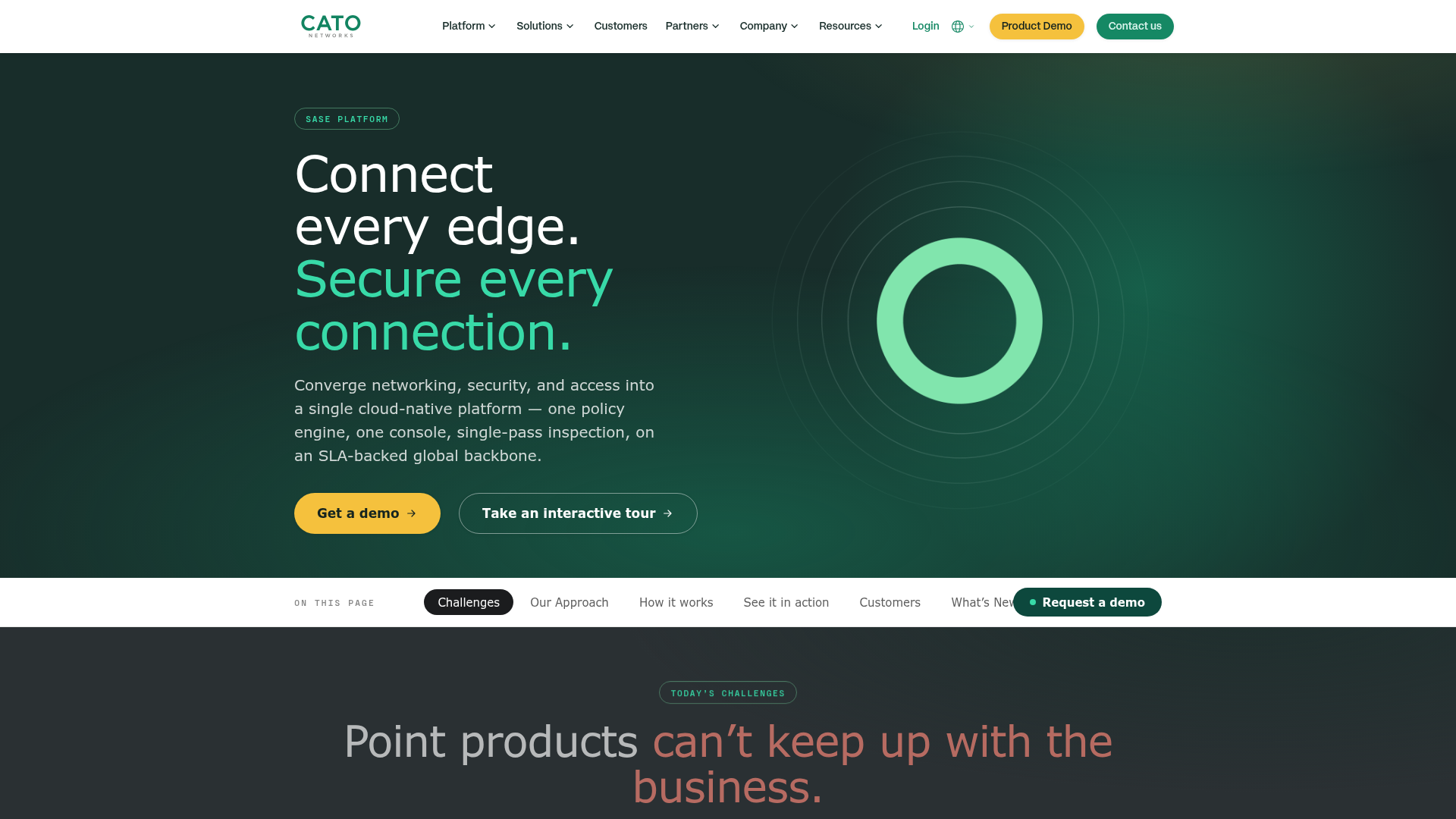
Figure: Cato Networks's product page, captured 2026-11-03. Source: SASE Platform.
How it works and what it connects to
Cato describes its platform as a cloud service that customers connect to, not software they host. The engine described earlier runs as many instances spread across the company's own network. The architecture page states that "Thousands of SPACEs run on bare-metal compute across worldwide PoPs, interconnected by multiple tier-1 carriers". The same page lists "no hyperscaler dependency" among the backbone's properties. The company says the engine enforces policy "for inline and out-of-band traffic". It also says that, as the network grows, "new PoPs serve nearby users automatically".
Customers reach that network in a few ways. An undated customer story page describes connecting a location as installing a Cato Socket appliance that links automatically to one of Cato's 70+ Points of Presence. For users, the architecture page says customers can deploy clients via self-service or MDM. It also says the platform can co-exist with existing routers, firewalls, and cloud security. The home page states that the security service edge product can be deployed independently of existing networking infrastructure, so a buyer need not replace its WAN to use the security layer.
Threat intelligence reaches the engine through a separate pipeline from the data lake mentioned earlier. The company says hundreds of Cato and third-party feeds are distributed to every SPACE in near-real-time, with AI/ML validating feed quality. It names three further jobs for its models: the platform, it says, self-heals infrastructure, auto-classifies apps and devices, and guides safe TLS inspection. For Dynamic Prevention, covered above, SiliconANGLE reported the detection method behind the automatic blocking: the service correlates months of security and networking activity in real time across the company's inline sensors.
Part of the AI security product came from outside. SecurityWeek reported that the acquired Aim Security product covered three AI security use cases: employee use of public AI applications, private AI applications and agents, and the agentic AI development lifecycle. At the time, Cato said it would offer Aim capabilities as part of the Cato SASE Cloud Platform in early 2026. The sources given here do not say whether that integration was completed on that schedule.
The sources are silent on where customer data and logs are stored, how long they are kept, whether customers can choose a region, and any limits the company itself states for the platform.
Where it sits in the market
CISO Tribune's record files Cato Networks under three categories. SASE and SSE covers cloud-delivered bundles of secure web gateway, cloud access security broker and private access services, with or without SD-WAN networking. Zero trust network access covers standalone services that grant users access to specific private applications after checking identity and device, in place of a network-level VPN. Workforce AI usage security covers the discovery and control of employees' use of third-party AI tools, including the data sent to them.
How many vendors CISO Tribune's record files under each of Cato Networks's categories, as of 2026-11-03; the record lists them alphabetically and never ranks them.
Source: CISO Tribune vendor record, as of 2026-11-03
| Label | vendors |
|---|---|
| SASE and SSE | 17 |
| Zero trust network access | 12 |
| Workforce AI usage security | 20 |
The other vendors on the record in one or more of those categories are, in alphabetical order: Abnormal AI, Appgate, Arexdata, Aryaka, Asymptote Labs, AT&T, Aurascape, Check Point Software Technologies, Cisco, Cloudflare, Concentric AI, Dispel, Dispersive Stealth Networking, Ecessa Corporation, Fasoo, Forcepoint, Fortinet, Gigamon, Grip Security, Harmonic Security, Hewlett Packard Enterprise, Ivanti, Juniper Networks, Keep Aware, Lakera, Lasso Security, Netskope, Next DLP, Onyx Security, Pluto Security, Polymer, Prompt Security, Skyhigh Security, SonicWall, Symmetry Systems, Versa Networks, WitnessAI, Xage Security, Xcitium and Zero Networks. The list mixes networking companies, security suites and AI-focused specialists.
Cato's own pages set it apart from that field mainly on architecture. Its architecture page says the platform was "built from the ground up, not stitched together" (Cato Networks). The same page states that NGFW, CASB, DLP, ZTNA, threat prevention and AI controls all run on a single policy engine (Cato Networks). Its SASE platform page tells buyers to replace point products with one converged platform that runs on an "SLA-backed global backbone" (Cato Networks).
The company also draws the contrast in its own words. In a funding announcement, Shlomo Kramer, co-founder and CEO, said its platform "differentiates Cato from legacy vendors that favor a portfolio of point solutions" (Cato Networks). The same release said that legacy vendors offer bundles of point solutions while Cato delivers a single cloud-native platform (Cato Networks).
The company presents that convergence as something a buyer can take in parts. The SASE platform page describes SASE Convergence as one of five converged solutions on the Cato SASE Cloud (Cato Networks). Its homepage says organisations can start with SD-WAN, SSE or ZTNA "and expand over time without rearchitecting the environment" (Cato Networks). This is how Cato addresses buyers in the standalone access category.
On AI, the homepage says Cato AI Security covers interactions "from safe and sanctioned third-party AI usage to runtime protection of homegrown AI applications and AI agents" (Cato Networks). In our reading, that scope reaches past the workforce usage our record's category defines and into the protection of applications a company builds itself.
Funding, investors and growth
The company also said the investment took its valuation to more than $4.8 billion and its total funding to more than $1 billion. On September 3, 2025, Cato said it was raising another $50 million (Reuters). That money came from Acrew Capital and brought the Series G total to $409 million (SecurityWeek). Reuters reported the company said the extension was made on the same terms and valuation (Reuters).
The chart shows the two Series G tranches, in millions of US dollars: the June 2025 round and the September 2025 extension.
Source: SecurityWeek: Cato Networks Acquires AI Security Firm Aim Security
| Label | USD million |
|---|---|
| Series G 2025-06 | 359 |
| Series G extension 2025-09 | 50 |
Chart data: prnewswire.com; SecurityWeek.
The June release set out what the money was for under three headings. The second was research and development. It said it would increase R&D investment across DEM, LAN security, IoT/OT security, SD-WAN, SSE, XDR and ZTNA. The third was reach: the company said it would grow its partner ecosystem and customer-facing teams.
The extension was announced on the same day as Cato's first acquisition, Aim Security, covered earlier in this profile. Cato did not disclose the price. Reuters reported that sources close to the deal put it at around $350 million (Reuters). Our reading is that the deal used a share of the year's new capital, though no source here ties the two.
The earliest round in these sources is a $20 million Series A. A company launch announcement said Cato, founded in January 2015, had recently secured it (Cato Networks). CRN reported the round came from Steve Krausz of U.S. Venture Partners and Theresia Gouw of Aspect Ventures (CRN). The sources given here carry no detail on the rounds between the Series A and the Series G.
In the same release Kramer cited "more than 3,500 enterprise customers". By September 2025 Cato said it had passed $300 million in annual recurring revenue (Reuters). The company's homepage now states it serves over 4,800 customers (Cato Networks). Read together, those figures suggest the customer base grew after the round, but that is our reading of two differently worded company counts.
Customers, partners and public evidence
Every named customer below comes from Cato's own pages, so the selection and the wording are the company's. Its homepage quoted Richard Thorp, CTO of Swissport, saying "Cato future proofs Swissport’s IT infrastructure." It also quoted Tal Arad, chief information security officer of Carlsberg Group, saying "I would definitely recommend the Cato SASE platform to other companies." The same page carried quotes from O-I, Redner's Markets, Fiskars Group and Komax.
The SASE platform page added two more names. David Daniels, director of enterprise technology at Darling Ingredients, said "Agility is our single biggest win." Douglas Arnn, director of IT infrastructure at Trimark, said "We’re 80% of the way to full Zero Trust, costs are down". That 80% is his own estimate in a vendor testimonial, not a measured result. On the architecture page, Joel Jacobson, global WAN manager at Vitesco Technologies, said "What would have taken us days in the past to do with other solutions, we could now do in minutes."
Some case studies in the customer archive named the integrators involved. Eric Tavidian, a co-founder of Selceon, said "We were the first provider in France to deploy Cato Networks for one of our customers." A customer IT lead quoted only as Bonnaventure credited both firms: "We deployed Cato to 90 sites in less than a year, thanks to Selceon and Cato." Another story said Hoyer came to Cato after Secher Security approached its team offering the product.
The channel goes back to the 2016 launch. CRN reported that Glenn Esposito, previously senior vice president of sales for the Americas at Barracuda Networks, joined to help lead sales and channel. He said he would drive "a 100 percent channel-focused model" and would recruit managed security service providers and network security resellers. The company planned a partner program with a three-tier discount structure.
Third-party evidence on Cato's site is mostly paid for or chosen by the company. Its homepage linked a commissioned Forrester Consulting Total Economic Impact study of the platform, along with GigaOm Radar reports on SASE for 2026 and on security service edge. Other vendors in these categories appear in our vendor pages.
Research, open source and public work
The most widely reported piece of security research tied to Cato came with an acquisition. Cato said in September 2025 that it was buying Aim Security, its first acquisition, Reuters reported. Before the deal, Aim's research team had found what SecurityWeek called "the first reported CVE of a zero-click AI vulnerability in Microsoft 365 Copilot". The flaw was dubbed EchoLeak and tracked as CVE-2025-32711. Aim's founders, Matan Getz and Adir Gruss, are alumni of the IDF intelligence Unit 8200, where, according to SecurityWeek, they "broke and built AI systems". In our reading, EchoLeak concerned the kind of workplace AI use that Cato's AI security category on our record covers; no source draws that link.
Cato also runs its own research output. Its site lists a Security Research section that includes the CATO Cyber Threats Research Lab, Threat Research Reports, a Cybersecurity Masterclass and a Rapid CVE Mitigation page (Cato Networks).
On vulnerability response, the company describes how it says it turns new threat intelligence into protection. Its architecture page states that new rules are simulated on real traffic and then deployed within 24 to 48 hours, with "No IT involvement, no end-user impact" (Cato Networks). That timing is the company's own claim. Its homepage also carries a blog post titled "Reducing Time-to-Protect with Cato’s Self-Evolving Vulnerability Protection Agent" (Cato Networks).
The company has set out its view of how attackers behave. When it launched Cato Dynamic Prevention in March 2026, Lior Cohen, its vice president of product management for security and management, said: "Threat actors abuse trusted tools and valid credentials, knowing most defenses still analyze isolated events and rely on humans to connect the dots for more complex attack chains" (SiliconANGLE).
Cato staff also speak in public. SiliconANGLE reported in March 2026 that Daniela Rosenstein, Cato's agentic AI and RPA lead, had appeared on theCUBE the previous October with Taqi Jaffri of UiPath. The two discussed how agentic AI delivers return on investment through focused use cases (SiliconANGLE). More talks by security practitioners and vendors are collected under speaking.
The company's own webinars cover some of the same subjects. They include "Defending Against the Next Generation of Agentic Attacks" on its homepage, "Implementing a Zero Trust Security Model for the Enterprise" on its SASE platform page and "The Platform Makes All the SASE Difference" on its architecture page. The architecture page also links to a Frost & Sullivan report on the Cato SASE Cloud Platform. These are vendor-hosted materials, not independent studies.
What a CISO should ask before buying
The questions below are our reading of what a proof of concept should test. Each one is tied to a claim Cato makes about its own design.
-
Single-pass inspection under load. The homepage describes an engine that "Inspects, optimizes, and secures traffic once to reduce latency and enforce policy consistently" (Cato homepage). Ask for latency measured from your own sites with TLS inspection, IPS and DLP all switched on, compared with your current path.
-
One policy across every edge. The architecture page states that "One policy definition enforces consistently across every user, site, application, and location" (architecture page). Write one rule during the trial, then check that it behaves the same for a branch user, a remote client and a clientless session.
-
The backbone and its commitments. Cato lists "Multiple tier-1 carriers, no hyperscaler dependency" (architecture page) and describes an SLA-backed global backbone. Ask which points of presence will serve your regions, what happens when one fails, and what the SLA covers in writing.
-
Running beside the old stack. The company says the platform can "Co-exist with existing routers, firewalls, and cloud security" (architecture page). Run the pilot alongside current tools and ask how traffic-steering conflicts are found and resolved.
-
TLS inspection choices. The platform, Cato says, guides safe TLS inspection. Ask what it bypasses by default, who can change the bypass list, and how those changes are logged.
-
Getting your data out. Cato describes one universal API to access all platform data. Pull flow and event data into your SIEM during the trial, and ask about retention periods and export limits.
-
Automatic rule updates. Feeds reach every engine with AI/ML validating feed quality, on top of the simulate-then-deploy process covered earlier. Ask how a customer sees a new rule before it takes effect and how to roll one back.
-
Automated blocking. Of Dynamic Prevention, SiliconANGLE reported that "Once identified, Cato dynamically applies adaptive rules, blocking high-risk activity in real time" (SiliconANGLE). Ask for every block raised in the trial, the evidence behind each, and the override path when a legitimate admin tool is caught.
-
Access methods. Cato offers a ZTNA client, enterprise browser, browser extension and clientless portal. Ask which controls differ by method, and test a contractor on an unmanaged device.
-
AI usage controls. The company says AI security can be deployed independently and that the platform can classify AI services and govern data shared with them. Run discovery on your own traffic and send a test prompt containing seeded sensitive data.
-
The Aim integration. At the acquisition, Cato said it would offer Aim capabilities as part of the platform in early 2026. Ask whether that happened, and which Aim functions now sit in the same console and policy engine and which remain separate.
Timeline
The record below draws on Cato's own releases and on news coverage of them. Most dated entries fall in 2025, the year of the Series G round and the company's first acquisition. The earlier entries rest largely on the company's account of its own history. In our reading, a CISO should treat that account as the company's framing, not as an independent chronology.
The chart counts the dated milestones in this timeline by year.
Source: Milestones cited in this profile; most from prnewswire.com: Cato Networks Raises $359 Million at a Valuation of More Than $4.8 Billion · 9 dated events on the pages read for this profile, counted by the desk; a count of what the sources date, not of everything the company did.
| Label | milestones |
|---|---|
| 2015 | 1 |
| 2019 | 1 |
| 2024 | 1 |
| 2025 | 4 |
| 2026 | 2 |
- January 2015: Cato was founded, according to a company news page that reproduces Channel Partners coverage. Our record lists Shlomo Kramer and Gur Shatz as the founders.
- 3 September 2025: Cato said it was buying Aim Security, its first acquisition (Reuters). It did not disclose the price. Reuters reported that sources close to the deal put it at around $350 million.
- 3 September 2025: On the same day, Cato extended the Series G with $50 million from Acrew Capital, bringing the round to $409 million (SecurityWeek). Reuters reported the company as saying the extension took place on the same terms and valuation.
- 3 September 2025: Cato also said it had passed $300 million in annual recurring revenue (Reuters).
- Early 2026: This was the window Cato had set for offering Aim's capabilities inside its platform, as noted earlier in this profile.
- March 2026: Cato launched Dynamic Prevention, the threat prevention engine covered in the product sections above.
Leadership changes at the company are tracked separately on /moves.
Frequently asked questions
- What does Cato Networks do?
- Cato Networks sells enterprises a cloud-delivered networking and security service, which it calls the Cato SASE Cloud Platform. Its site describes five converged solutions that can be bought separately, among them Zero Trust Security (SSE), Next Gen Networking and AI Security. The company says customers can start with one capability, such as SD-WAN, SSE or ZTNA, and keep their existing routers, firewalls and cloud security in place.
- Who founded Cato Networks?
- Shlomo Kramer and Gur Shatz founded Cato in January 2015, and the company is based in Tel Aviv. Kramer is its co-founder and CEO, and a 2016 company news post stated that he helped found Check Point and Imperva. The same post said Shatz was the CEO of cloud-based security provider Incapsula.
- How much funding has Cato Networks raised?
- In June 2025 Cato raised $359 million in a Series G round led by new investors including Vitruvian Partners and ION Crossover Partners, and the company said the round put its valuation at more than $4.8 billion. In September 2025 it added $50 million from Acrew Capital, which took the round to $409 million, and Reuters reported the company said the extension was made on the same terms and valuation. The company said its total funding had passed $1 billion. Its earliest round in the record was a $20 million Series A from Steve Krausz of U.S. Venture Partners and Theresia Gouw of Aspect Ventures.
- How does the Cato SASE Cloud Platform work?
- Cato runs the service from its own cloud, not as software the customer hosts. Its architecture page states that thousands of Single Pass Cloud Engines (SPACEs) run on bare-metal compute across worldwide PoPs, linked by multiple tier-1 carriers with no hyperscaler dependency. Sites connect through zero-touch SD-WAN, and a customer story page describes installing a Cato Socket appliance that links to one of Cato's 70+ Points of Presence. Client software is rolled out via self-service or MDM, the company says.
- How does Cato Networks say it differs from other vendors?
- Cato's architecture page says the platform was built from the ground up, not stitched together, and that NGFW, CASB, DLP, ZTNA, threat prevention and AI controls all run on a single policy engine. Its funding release contrasted the platform with a legacy patchwork of firewalls, routers, cloud proxies and point solutions. Kramer said its platform differentiates Cato from legacy vendors that favor a portfolio of point solutions. These are the company's own claims.
- What should a CISO ask Cato Networks before buying?
- Ask for latency measured from your own sites with TLS inspection, IPS and DLP all switched on, and test whether one policy rule behaves the same for a branch user, a remote client and a clientless session. Ask which points of presence will serve your regions, what happens when one fails and what the SLA covers in writing. Pull flow and event data into your SIEM during the trial, ask about retention and export limits, and ask how automatic blocks and rule updates can be reviewed and rolled back. Ask whether the Aim Security capabilities Cato said it would add in early 2026 now sit in the same console and policy engine.
Sources
- Cato Networks Raises $359 Million at a Valuation of More Than $4.8 Billion · Cato Networks, July 9, 2025
- Cato Networks Exits Stealth, Snaps up Barracuda's Esposito as Channel Chief · Cato Networks, July 11, 2022
- Cato Networks Launches Network Security-As-A-Service Platform To Channel | CRN · crn.com, November 3, 2026
- Israel's Cato Networks buys Aim Security, raises another $50 million · Reuters, September 3, 2025
- Cato Networks | SASE, SSE, ZTNA, SD-WAN: Your Journey, Your Way · Cato Networks, October 21, 2026
- Cato Networks Acquires AI Security Firm Aim Security · SecurityWeek, September 3, 2025
- Platform Architecture · Cato Networks, October 30, 2026
- Cato Networks unveils Dynamic Prevention to stop stealthy, long-running cyberattacks - SiliconANGLE · SiliconANGLE, March 3, 2026
- Cato Networks Raises $359 Million at a Valuation of More Than $4.8 Billion · prnewswire.com, June 30, 2025
- SASE Platform · Cato Networks, October 27, 2026
- Customers Archive · Cato Networks, November 3, 2026
Writer
Hadass Liza Bitton is a writer at CISO Tribune covering security leadership: the people who take the top security seat, the ones who leave it, and what each move signals. Reach her at hadass@cisotribune.com.