Vendor spotlight · Exposure management
IONIX: who they are, what they sell and what CISOs should ask
IONIX, formerly Cyberpion, sells external exposure management: discovery of internet-facing assets, exploitability tests and mitigation. Co-founded by Nethanel Gelernter.
What IONIX sells
IONIX sells external exposure management software. IONIX's home page says: “Continuous, Machine speed detection and mitigation of your external attack surface exposures[1].”
The company has used two names. IONIX's release dated March 21, 2023 says that Cyberpion has rebranded as IONIX (pronounced ‘eye on x’)[2]. The Series A release placed the company in KIRKLAND, Wash, and TEL AVIV Israel and said it had an R&D team based in Israel[5]; its July 2026 release on Akamai carries the dateline New York, NY, July 31, 2026[12]. SecurityWeek reported in 2024 that the company has raised north of $50 million since emerging from stealth in 2020[7].
What it sells today is one platform with several named parts. Among the uses IONIX's home page lists are Continuous Threat Exposure Management (CTEM) that detects and acts in real time, Rapid Zero-Day Exposure Detection and Response, Shadow IT Visibility and Governance to remediate your unknown unknowns, Digital Supply Chain Exposure Management, M&A and Subsidiary Cyber Risk Management that protects against inherited exposure and External AI Asset Exposure Management[1].
The E.ON case study says that the IONIX SaaS platform required no installation, configuration, or modification to E.ON’s existing IT[13].
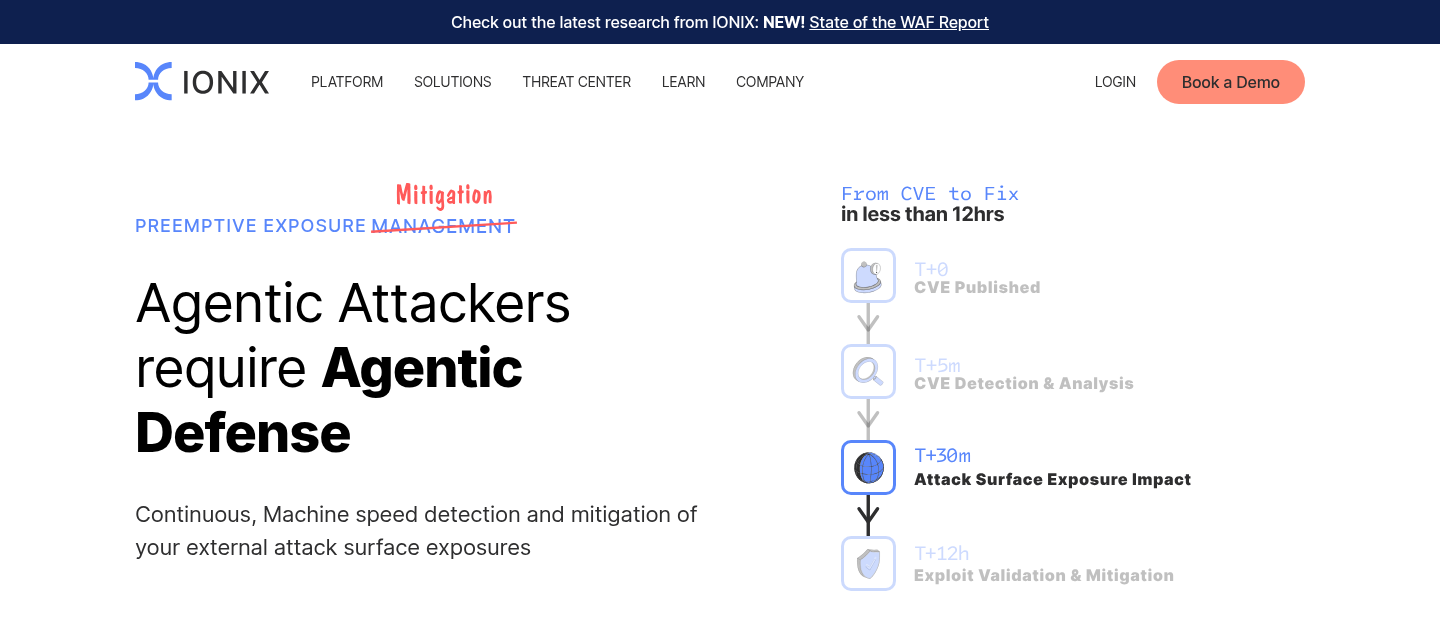
Figure: IONIX's home page, captured 2026-11-15. Source: Preemptive Exposure Mitigation - IONIX[1].
The founders and the people who run it
TechCrunch's report on the 2020 seed round names two co-founders: Cyberpion was co-founded by Nethanel Gelernter, the company’s CEO, who previously spent time at Microsoft and as a security researcher, and its CBO Ran Nahmias, the former head of cloud security at Check Point. The same article says Nahmias had also spent time at Aqua Security and as director of enterprise strategy at Microsoft[4]. The Series A release quotes Dr. Nethanel Gelernter, Founder and CEO, IONIX and Ran Nahmias, Co-founder and Chief Business Officer, IONIX[5].
IONIX's about page quotes Dr. Nethanel Gelernter, whom it calls Co-Founder & CTO: “We saw the volume and scale of cyber attacks against external enterprise assets – in governments, enterprises and SMBs. The targeted organization often had little or no awareness of the attack. We founded IONIX to do something about it[3].” In the 2020 interview, Nahmias said that most companies focus on protecting and defending the environment that is directly owned and managed by them[4].
The rebrand release says that in January 2023, IONIX announced that Marc Gaffan had been named CEO. It says that Co-founder Nethanel Gelernter moved from CEO to Chief Technology Officer. The same release recorded the appointments of Doron Gill as Vice President of Engineering, and Ido Samson as Chief Revenue Officer[2].
IONIX's about page names Marc Gaffan as CEO, Tal Zamir as CTO, Dana Daniel as CFO and COO, Ido Samson as CRO, Matt MacKinnon as VP of Strategic Alliances, Hila Pinto as VP of HR, Roi Sharon as VP Product and Ilya Kleyman as CMO. The board members it lists are Liran Grinberg, Nathan Shuchami, Jacques Benkoski and Chad Kinzelberg. The page gives Tal Zamir the CTO title in its management list, and the founder quotation on the same page still calls Gelernter Co-Founder & CTO[3].
The Series A release says Jacques Benkoski, General Partner at U.S. Venture Partners joins IONIX’s Board of Directors following investment[5]. TechCrunch's seed report quoted Hyperwise Ventures’ managing partner, Nathan Shuchami[4].
What the product does
IONIX's home page lists the platform's steps, including “Discovery and mapping of all external assets including vendor-managed and digital dependencies” and “Perform non-disruptive active exploitability testing, validating actual exposures”[1].
Discovery. An IONIX page on alternatives to CrowdStrike's Falcon Exposure Management says: “Before scanning a single asset, IONIX maps every subsidiary, acquisition, affiliated brand, and digital supply chain dependency using corporate registrations, M&A records, and subsidiary filings.” IONIX says it uses nine independent discovery methods, including WHOIS records, DNS chains, TLS certificates, and metadata fingerprinting. It says that an ML-based confidence scoring model weighs signals from all nine methods to determine attribution[10]. In our view, attribution is where a trial of any tool in this category should start. CISA's Binding Operational Directive 23-01 says that asset discovery is a building block of operational visibility. The directive requires the agencies in its scope to perform automated asset discovery every 7 days[20].
Connective Intelligence and the digital supply chain. IONIX calls its underlying technology Connective Intelligence. Its why-IONIX page says IONIX Connective Intelligence is the underlying technology powering our Attack Surface Management (ASM) platform and calls it patented. The page claims that 20% of exploitable attack surface risks originate in the digital supply chain[8]. The E.ON case study describes an attack surface that includes the third-party IT assets that are owned and managed by vendors and partners. The E.ON case study also describes discovery of internet-facing assets and their web of external third, fourth, fifth, and Nth connections and dependencies[13]. The abstract of NIST's guidance on cybersecurity supply chain risk management says: “Organizations are concerned about the risks associated with products and services that may potentially contain malicious functionality, are counterfeit, or are vulnerable due to poor manufacturing and development practices within the supply chain[21].”
Exploitability testing. MITRE's ATT&CK knowledge base lists Exploit Public-Facing Application as technique T1190: adversaries attempting to exploit a weakness in an internet-facing host or system to get initial access to a network.
Mitigation. IONIX sells a feature it calls Active Protection. Its comparison page says IONIX’s Active Protection freezes vulnerable assets to halt exploitation before the responsible team applies a fix, and that coverage extends to DNS hijacking, dangling asset takeover, and exposed services[10]. OWASP's testing guide, under subdomain takeover, tells testers to identify links and resources that point to external domains, buckets, or accounts that no longer exist and could be claimed[22]. The same IONIX page says that IONIX integrates with JIRA, ServiceNow, SIEM platforms, and CDN/WAF providers[10].
IONIX's page on Continuous Threat Exposure Management says that the product “helps to prioritize, and validate external, internet facing threats”.
Live Exposure Defense and the 12-hour promise
IONIX's release on its Akamai partnership names Live Exposure Defense as one of two recent additions to the IONIX platform[12]. Its page makes a specific commitment: “We put a hard SLA on the path from CVE publication to validated, exploitable exposure plus mitigation where applicable across your external attack surface[9].” IONIX's release on the Akamai partnership says that IONIX Live Exposure Defense delivers a 12-hour SLA from CVE publication to validated exposure[12]. The page says that as a new CVE is published, IONIX determines if it’s within the scope of an external attack surface exposure, and that all potentially affected assets are pinpointed[9].
The page describes how the work is done. It says the service operates a continuous CVE Pipeline that ingests every newly published CVE, correlates it against your IONIX-mapped external attack surface, and that agentic analysis filters the daily volume of hundreds of CVEs down to the small number that actually matter to your environment. The tests themselves, it says, are safe, non-intrusive validation tests built from public proof-of-concept exploits, and validation evidence is captured for audit, reporting, and post-incident review. For a confirmed exploitable web asset, the page says, the platform creates a specific WAF rule you can deploy through Akamai, Cloudflare, and other supported vendors[9].
The page's line on control is “Humans govern, agents operate”, and it says every recommendation can also feed into your existing JIRA or ServiceNow workflow. The same page says that where Active Protection applies, IONIX defends dangling assets and DNS hijacking targets automatically[9]. We would ask, in a demo, which actions run without a person's approval in a given tenant.
The Live Exposure Defense page says that "Are we exposed to the latest CVE?" is the most predictable board question in cybersecurity. It says the platform keeps “a single, dated, auditable record of every disclosed CVE that touched the organization’s attack surface[9].”
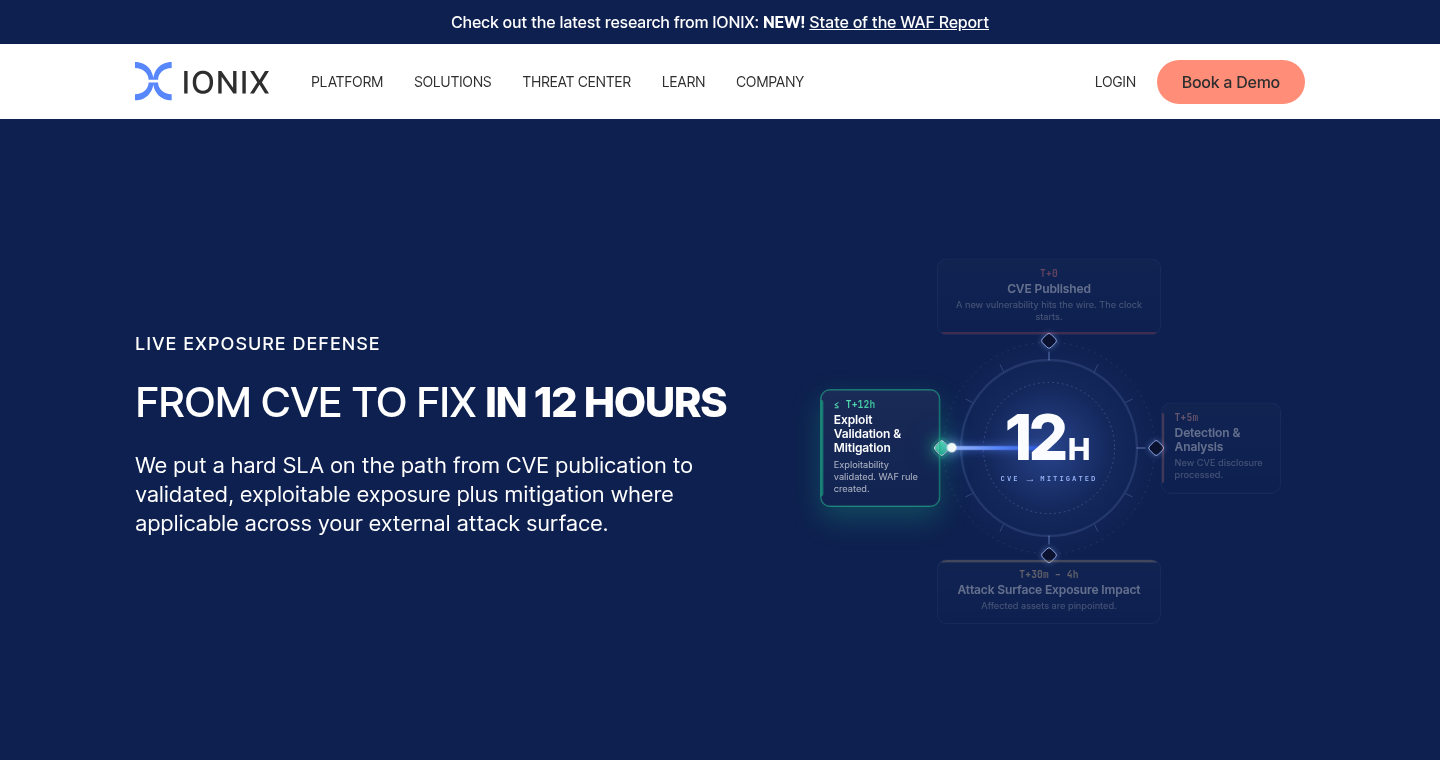
Figure: IONIX's Live Exposure Defense page, captured 2026-11-15. Source: Live Exposure Defense[9].
Where it fits next to vulnerability management and CTEM
FIRST says the Common Vulnerability Scoring System, CVSS, provides a way to capture the principal characteristics of a vulnerability and produce a numerical score reflecting its severity[24]. FIRST says its Exploit Prediction Scoring System estimates the probability that a published CVE will be exploited in the wild in the next 30 days[25]. CISA's page on its Known Exploited Vulnerabilities catalog says that CISA maintains the authoritative source of vulnerabilities that have been exploited in the wild[26].
IONIX's Live Exposure Defense page says the harder question is whether a vulnerability is actually exploitable on the specific asset you own, in the configuration it runs today[9]. In the words of its comparison page, “Validated findings replace theoretical risk scores[10].” In our view, a buyer should hold that claim to a test: compare IONIX's order with a list sorted by CVSS, EPSS and KEV on the buyer's own findings.
IONIX also places itself in continuous threat exposure management. The buyer profile on IONIX's comparison page includes Organizations running Validated CTEM programs or building toward Gartner’s five-stage framework[10]. In our view, a programme that also runs internal scanners and cloud posture tools should ask how IONIX's findings reach the place where it ranks everything else.
Where it sits in the market
SecurityWeek wrote: “Ionix, an Israeli startup in the crowded attack surface management category, has attracted $15 million in new capital to complete a $42 million Series A funding round”[7].
IONIX's own guide to alternatives to CrowdStrike's Falcon Exposure Management lists CyCognito: seedless discovery with EASM-native architecture and Cortex Xpanse: enterprise-scale port scanning within the Palo Alto ecosystem. Its fifth entry is Tenable One: vulnerability management extended to external surfaces. Of CyCognito, IONIX writes that CyCognito markets “zero-input” seedless discovery[10]. In our view, a buyer should read each rival's own pages and test each product's discovery on the same estate.
Funding, investors and growth
In 2024, TechCrunch reported that the company has added $15 million to its previously announced $27 million Series A round[6].
Source: TechCrunch: Ionix adds another $15M to its $27M Series A round[6]
| Label | USD million |
|---|---|
| Seed 2020-10 | 8.3 |
| Series A 2022-03 | 27 |
| Series A extension 2024-02 | 15 |
Chart data: TechCrunch, 2020[4]; IONIX, 2022[5]; TechCrunch, 2024[6].
Seed, October 2020. TechCrunch reported an $8.25 million seed round, co-led by Team8 Capital and Hyperwise Ventures, and that it planned to use the money to expand its sales and marketing efforts and accelerate product development[4].
Series A, March 2022. The company announced $27M in Series A funding, led by U.S. Venture Partners, and said that existing investors Team8 Capital and Hyperwise Ventures also participated in the round. The release quotes Gelernter: “We’re at the forefront of the EASM revolution and this funding round will double our headcount in engineering, research and sales”[5].
Series A extension, February 2024. TechCrunch reported that the company has added $15 million to its previously announced $27 million Series A round. It reported that the new funding comes from new investor Maor Investments, with participation from existing investors Hyperwise Ventures, Team8 and U.S. Venture Partners (USVP)[6]. SecurityWeek reported that Maor Investments joined as a new investor alongside Hyperwise Ventures, Team8 and U.S. Venture Partners (USVP)[7]. TechCrunch said the extension brings the company’s total funding to $50.3 million[6]. SecurityWeek described the same money as completing a $42 million Series A funding round[7].
On growth, the company has published one figure. The rebrand release says: “2022 was a transformational year for IONIX. The company delivered 250% ARR growth”[2]. The sources this profile cites report no revenue in dollars, customer count or headcount for IONIX, so this profile states none.
Customers, partners and recognition
IONIX's published case studies include E.ON and Grand Canyon Education, and each quotes the customer's CISO by name.
E.ON. The E.ON case study describes E.ON, a European electric utility company based in Essen, Germany, and gives its use case as Digital supply chain security. It quotes “IONIX’s approach to external exposure management allows my team to go on offense”, attributed to René Rindermann, CISO, E.ON. The case study says that E.ON’s team identified a key strategic task: understand the risks they are exposed to as part of their attack surface and its digital supply chain. It says that the automated attack surface discovery, risk assessment and prioritization enabled E.ON’s security team to remediate more vulnerabilities and reduce risk without expanding the team[13]. We would ask IONIX for the numbers behind that outcome.
Grand Canyon Education. The Grand Canyon Education case study says that Grand Canyon Education (GCE) is a shared services provider that serves colleges and universities. It quotes “IONIX provides us the strategic advantage of seeing our real attack surface and its digital supply chain, dynamically, in the same way attackers see it”, attributed to Mike Manrod, CISO, Grand Canyon Education. The GCE case study says that GCE had recently acquired a number of third-party resources and IONIX was able to discover and assess these resources automatically[14].
An unnamed customer, with Akamai. IONIX's release on its Akamai partnership describes the case: “One global financial services enterprise with operations across dozens of countries recently deployed the joint Akamai and IONIX solution to gain full visibility into its external attack surface exposures”. It says the organization identified gaps in WAF coverage and uncovered applications not yet onboarded to its preferred edge security platform[12].
Partners. On July 31, 2026, IONIX said it has joined the Technology Partner Program of Akamai Technologies, Inc., and that it is an early ecosystem collaborator in Akamai’s newly announced open framework connecting exposure validation with runtime protection. The release says Live Exposure Defense pairs every confirmed exploitable web asset with a WAF rule ready to deploy through Akamai App & API Protector, and that WAF Posture Management flags assets not yet covered by Akamai[12]. Earlier, in August 2024, the company announced the launch of its new global partner program and said it had released a multi-tenant MSSP portal for managed security providers[16].
Analyst recognition. IONIX has cited GigaOm's Radar reports on attack surface management. Its release of March 28, 2023 says that it has been named a leader in GigaOm's Radar Report for Attack Surface Management. It quotes GigaOm Analyst, Chris Ray as writing that the product provides an end-to-end ASM solution that discovers broadly. That release says the report analyzes 18 ASM tools[15]. Its August 2024 partner release says that, according to the 2024 GigaOm Radar for Attack Surface Management (ASM), “IONIX’s position as a Leader and Fast Mover in the Innovation/Platform Play quadrant underscores its advanced approach to asset discovery and vulnerability assessment[16].”
Research and public work
The Fortune 500 study, December 2022. The release describes its analysis of public and internet-facing assets of 471 of the Fortune 500, which discovered more than 148,000 critical vulnerabilities, with an average of 476 per organization. Its definition reads: a critical vulnerability is an exploit that is publicly available and actively targeted. Among the findings, the release reports that 95% had expired certificates and 85% had exposed login pages accessible over HTTP. The release links the research to policy: it says the work follows the recent Cybersecurity and Infrastructure Security Agency’s (CISA) binding Operational Directive, and quotes Gelernter: “Our findings show that Fortune 500 organizations should follow CISA’s lead”[17].
Source: IONIX: IONIX Discovers 148,000 Critical Vulnerabilities Across Fortune 500 Organizations[17]
| Label | % |
|---|---|
| Expired certificates | 95 |
| Exposed login pages over HTTP | 85 |
Chart data: IONIX, December 2022[17].
SSHhole, November 2026. IONIX's post says that CVE-2026-123158 is a password authentication bypass in sshd on Linux systems where sshd is linked against musl libc and runs without PAM. The lab work is described in IONIX's words: “We rebuilt the vulnerable and fixed versions of sshd in our lab and tested each condition separately”. IONIX writes that it already ships a safe exploitability test of the CVE across customer environments. The post says that, rather than relying on version banners, which over-report, IONIX actively confirms whether each exposed server is truly exploitable. In IONIX's words, the test “proves that access would succeed and stops there, opening no session, running no commands, reading no data, and changing nothing on the host.” The post also notes that any test that confirms SSHhole has to authenticate, IONIX’s among them, and that on Alpine sshd’s logs alone can’t tell a scanner’s probe from an attacker’s command[18]. In our view, a buyer of any exploitability-testing service should settle in the contract how its own security team will tell the vendor's probes from an attack.
php2shell, October and November 2026. IONIX's follow-up post, dated November 9, 2026, says that on October 21, 2026, two critical PHP vulnerabilities became public. It says that a few hours after the news broke, IONIX customers could see their potentially affected internet-facing assets in Live Exposure Defense. Its researchers, the post says, then kept narrowing that list with safe checks for the affected PHP versions and for whether the vulnerable PHP feature was reachable. The post says the team scanned its customers and emailed each one a report on where they stood. For servers that couldn’t be patched right away, it says, customers had interim PHP configuration changes and WAF guidance[19]. We would ask IONIX for the timestamps of that response, measured against the 12-hour commitment.
What a CISO should ask in a demo
The questions below are our suggestions for a proof of concept with IONIX.
- The 12-hour clock. Live Exposure Defense promises, as a hard SLA, validated exploitable exposure plus mitigation where applicable within 12 hours of a CVE's publication. Pick a CVE from the last month that touched your kind of estate and ask for the timestamps in a real tenant: publication, first affected-asset list, first confirmed exploitable asset, first WAF rule.
- What a safe test sends. The Live Exposure Defense page calls IONIX's tests safe, non-intrusive and built from public proof-of-concept exploits. Ask for the exact requests a test sends to one of your assets, which tests authenticate, as the SSHhole test must, and how your SOC can tell an IONIX probe from an attack in its logs.
- Attribution evidence. IONIX says it maps subsidiaries and suppliers from registrations and filings and scores attribution with nine methods. Ask to see the evidence for five assets it attributes to you that your own inventory does not hold, and what confidence score it gave each.
- Supplier assets you do not own. For an exposure on a supplier's system that your site depends on, ask what IONIX can do beyond telling you, and who it expects to contact the supplier.
- What acts without approval. The Live Exposure Defense page says humans govern and agents operate, and it describes Active Protection acting automatically on dangling assets and DNS hijacking targets. Ask for the list of actions that run without a person's approval in your tenant and where each is logged.
- WAF rules. Ask to see a generated rule for your WAF vendor, how it is tested before you deploy it, and how it is removed once the patch lands.
- Severity, EPSS and KEV. Ask how IONIX's priority order differs from a list sorted by CVSS, EPSS and KEV status on your own findings, and which findings it ranks higher because of a successful test.
- The 20% supply-chain figure. IONIX says 20% of exploitable attack surface risks start in the digital supply chain. Ask how it was measured and what share of your trial findings come from supplier assets.
- Coverage beyond the web. Ask which protocols and services the exploitability tests cover today beyond web applications, and how often the test library grows.
- Feeding the rest of the programme. If you run a separate exposure prioritisation platform or a ticketing flow, ask how IONIX findings and test evidence reach it, and whether the evidence survives the hand-off.
Timeline
- October 13, 2020: seed round. TechCrunch reported Cyberpion's $8.25 million seed round, co-led by Team8 Capital and Hyperwise Ventures[4].
- March 30, 2022: Series A. The company announced $27M in Series A funding, and Jacques Benkoski, General Partner at U.S. Venture Partners joins IONIX’s Board of Directors following investment[5].
- December 2022: Fortune 500 study. IONIX published its analysis of public and internet-facing assets of 471 of the Fortune 500[17].
- January 2023: new chief executive. According to the rebrand release, in January 2023, IONIX announced that Marc Gaffan had been named CEO.
- March 21, 2023: rebrand. The company said Cyberpion has rebranded as IONIX (pronounced ‘eye on x’)[2].
- March 28, 2023: GigaOm Radar. IONIX said it has been named a leader in GigaOm's Radar Report for Attack Surface Management[15].
- February 6, 2024: Series A extension. According to TechCrunch, the new funding comes from new investor Maor Investments, with participation from existing investors Hyperwise Ventures, Team8 and U.S. Venture Partners (USVP)[6].
- August 2024: partner programme. IONIX announced the launch of its new global partner program[16].
- July 31, 2026: Akamai. IONIX said it has joined the Technology Partner Program of Akamai Technologies, Inc.[12]
- October 21, 2026: php2shell. IONIX's follow-up post says that on October 21, 2026, two critical PHP vulnerabilities became public[19].
Correction, November 16, 2026. TechCrunch reported that the new funding comes from new investor Maor Investments, with participation from existing investors Hyperwise Ventures, Team8 and U.S. Venture Partners (USVP)[6].
Frequently asked questions
- What does IONIX do?
- IONIX sells external exposure management. Its platform maps a company's internet-facing assets and the third-party services they depend on, runs what it calls non-disruptive exploitability tests on them, and sends mitigation steps, such as a WAF rule, to the team that owns each asset.
- Is IONIX the same company as Cyberpion?
- Yes. IONIX's own press release of March 21, 2023 says Cyberpion rebranded as IONIX. Earlier press coverage and filings under the Cyberpion name refer to the same company.
- Who founded IONIX?
- TechCrunch's 2020 report on the seed round says Cyberpion was co-founded by Nethanel Gelernter, then its chief executive, and Ran Nahmias, then its chief business officer. In January 2023 Marc Gaffan became chief executive and Gelernter moved to chief technology officer, according to IONIX.
- How much funding has IONIX raised?
- An $8.25 million seed round in October 2020, a $27 million Series A in March 2022 led by U.S. Venture Partners, and a $15 million extension of that round in February 2024, in which Maor Investments came in as a new investor and the existing investors Hyperwise Ventures, Team8 and U.S. Venture Partners took part. TechCrunch put the total at $50.3 million after the extension. IONIX does not publish revenue.
- Which customers does IONIX name?
- IONIX publishes case studies naming E.ON and Grand Canyon Education, each with quotes attributed to the customer's CISO. Its July 2026 Akamai release describes a further customer without naming it.
- What should a CISO ask IONIX in a demo?
- Ask to see the timestamps behind the 12-hour Live Exposure Defense commitment for a recent CVE, exactly what a non-disruptive exploitability test sends to your assets, how attribution of a subsidiary or supplier asset is evidenced, and which mitigations the platform applies without a person's approval.
Sources
- [1]Preemptive Exposure Mitigation - IONIX · IONIX, November 15, 2026
- [2]Attack Surface Management Leader Rebrands as IONIX · IONIX, March 21, 2023
- [3]About IONIX · IONIX, November 9, 2026
- [4]Cyberpion raises $8.25M in seed funding to help businesses secure assets beyond their firewall · TechCrunch, October 13, 2020
- [5]IONIX Secures $27M Series A Funding · IONIX, March 30, 2022
- [6]Attack surface management platform Ionix adds another $15M to its $27M Series A round · TechCrunch, February 6, 2024
- [7]Ionix Adds $15M to Series A Funding Round · SecurityWeek, February 6, 2024
- [8]Why IONIX · IONIX, January 2, 2025
- [9]Live Exposure Defense · IONIX, September 2, 2026
- [10]Top 5 Falcon Exposure Management Alternatives (2026) · IONIX, November 15, 2026
- [11]Continuous Threat Exposure Management · IONIX, November 15, 2026
- [12]IONIX Joins Akamai Technology Partner Program · IONIX, July 31, 2026
- [13]Digital Supply Chain Security Case Study: E.ON · IONIX, January 25, 2026
- [14]Case Study: Grand Canyon Education · IONIX, January 25, 2026
- [15]IONIX Named Leader in GigaOm Radar Report for ASM · IONIX, March 28, 2023
- [16]IONIX Partner Program Launch · IONIX, August 5, 2024
- [17]IONIX Discovers 148,000 Critical Vulnerabilities · IONIX, December 6, 2022
- [18]SSHhole (CVE-2026-123158) and how IONIX is helping you respond · IONIX, November 5, 2026
- [19]php2shell: Zero-Day Response for IONIX Customers · IONIX, November 9, 2026
- [20]BOD 23-01: Improving Asset Visibility and Vulnerability Detection on Federal Networks · CISA, October 3, 2022
- [21]SP 800-161 Rev. 1, Cybersecurity Supply Chain Risk Management Practices for Systems and Organizations · NIST, November 15, 2026
- [22]Subdomain Takeover (Web Security Testing Guide) · OWASP Foundation, November 15, 2026
- [23]Exploit Public-Facing Application, Technique T1190 · MITRE, November 15, 2026
- [24]Common Vulnerability Scoring System SIG · FIRST, November 15, 2026
- [25]Exploit Prediction Scoring System (EPSS) · FIRST, November 15, 2026
- [26]Known Exploited Vulnerabilities Catalog · CISA, November 15, 2026
Writer
Hadass Liza Bitton is a writer at CISO Tribune covering security leadership: the people who take the top security seat, the ones who leave it, and what each move signals. Reach her at hadass@cisotribune.com.