Vendor guide · Identity security
Identity security vendors: who they are and how CISOs compare them
Identity security vendors sell access management, passwordless authentication, privileged access, identity threat detection and non-human identity tools. CISO Tribune's record files 86 of them.
Identity security vendors sell products that establish who or what is requesting access and govern what each identity may do.
The National Institute of Standards and Technology (NIST) describes zero trust architecture in SP 800-207 as an approach to enterprise resource and data security that covers identity (person and non-person entities), credentials, access management, operations, endpoints, hosting environments and the interconnecting infrastructure. In its model, subjects (people and processes) and their attributes form the basis of policies for resource access.
In M-Trends 2026, Mandiant reports that certain threat actors are achieving dwell times exceeding one year, often by prioritizing legitimate credentials over custom malware. Mandiant tells organizations to treat identity as the primary perimeter and to enforce MFA on all access.
As of November 19, 2026, CISO Tribune's record files 86 vendors under workforce identity and single sign-on, passwordless authentication, privileged access management, identity threat detection and response, or non-human identity security, 36 of them with one of those as their primary category.
What identity security covers, and where identity governance fits
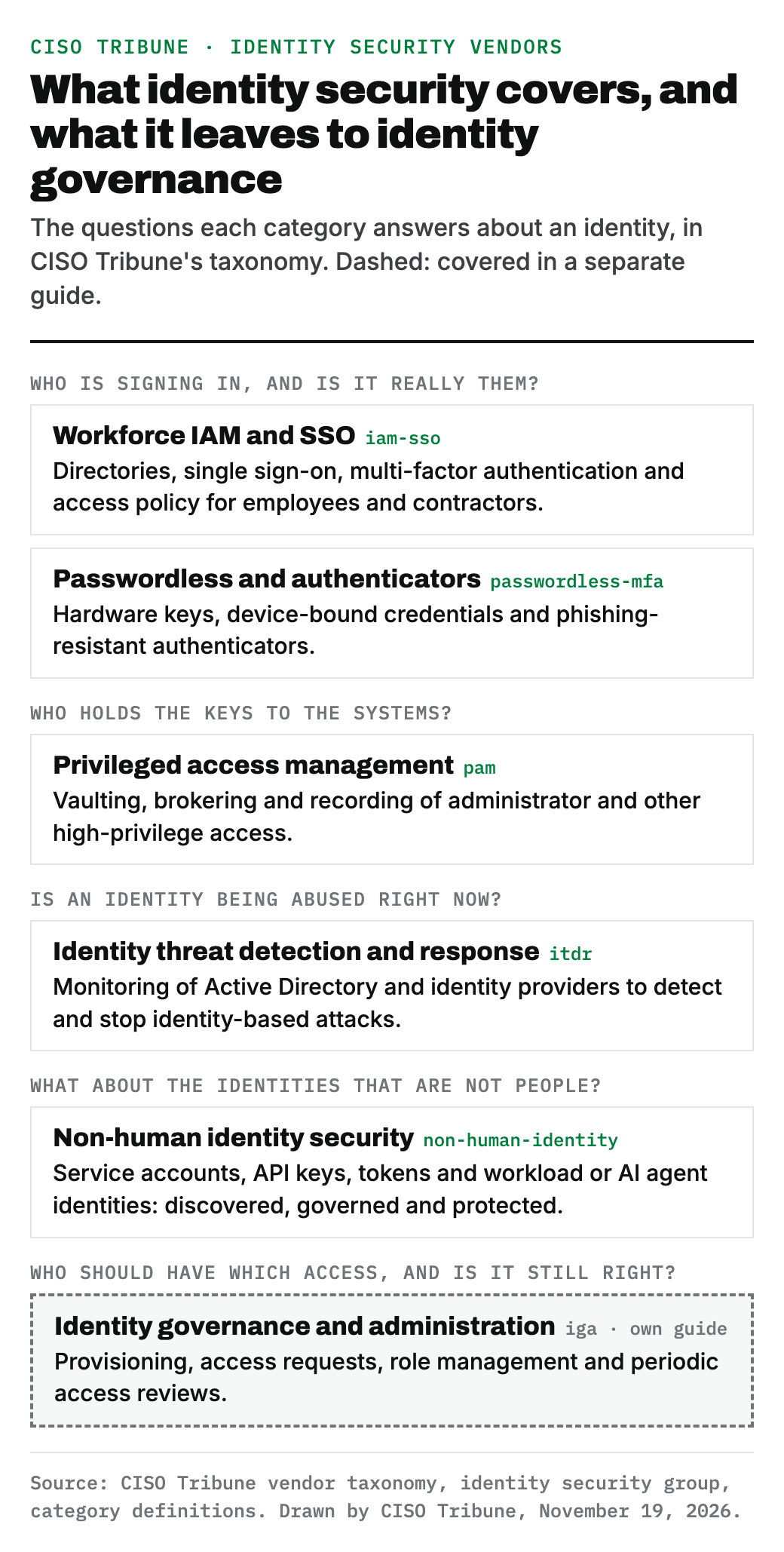
Workforce identity and access management (IAM) and single sign-on (SSO)
In our taxonomy, Workforce IAM and SSO covers directories, single sign-on, multi-factor authentication and access policy for employees and contractors. The Cybersecurity and Infrastructure Security Agency (CISA) says agencies should, where possible, integrate identity, credential, and access management solutions to enforce strong authentication, grant tailored context-based authorization and assess identity risk.
Passwordless authentication and authenticators
Passwordless authentication and authenticators covers hardware keys, device-bound credentials and phishing-resistant authenticators that replace or strengthen passwords. CISA describes FIDO2 as a set of protocols developed in collaboration by the Fast IDentity Online (FIDO) Alliance and the World Wide Web Consortium (W3C), designed to enable passwordless authentication.
Privileged access management (PAM)
Privileged access management covers the vaulting, brokering and recording of administrator and other high-privilege access to systems. NIST Special Publication 800-207 says access rules are made as granular as possible to enforce the least privileges needed to perform the action in the request.
Identity threat detection and response (ITDR)
Identity threat detection and response covers monitoring of identity systems such as Active Directory and identity providers to detect and stop identity-based attacks. NIST SP 800-207 says it is becoming possible to continually analyze and evaluate access requests to mitigate data exposure due to compromised accounts and other threats.
Non-human identity security
Non-human identity security covers discovery, governance and protection of service accounts, API keys, tokens and workload or AI agent identities. The Open Worldwide Application Security Project (OWASP) explains that production software environments hold applications which need to be identified, resulting in non-human identities, or NHI.
Neighbors with their own pages
In our taxonomy, Identity governance and administration covers provisioning, access requests, role management and periodic access reviews across applications. Customer identity and access management covers sign-up, login, consent and profile management for an organization's own customers. Machine identity and PKI covers certificate authorities and certificate lifecycle management for TLS, code signing and device identity. Password and secrets vaults for people covers password managers that store and share credentials for individuals and teams.
The same record files 12 vendors under identity governance and administration.
Related guide: Identity governance (IGA) vendors: who they are and how CISOs compare them.
By category, 26 are filed under workforce identity and single sign-on, 16 under passwordless authentication, 19 under privileged access management, 27 under identity threat detection and response, and 41 under non-human identity security; a vendor filed under more than one counts in each.
Source: CISO Tribune vendor record, counted November 19, 2026
| Label | vendors |
|---|---|
| Non-human identity | 41 |
| Identity threat | 27 |
| Workforce IAM and SSO | 26 |
| Privileged access | 19 |
| Passwordless | 16 |
Why CISOs buy it: stolen and abused identities in intrusions
What Mandiant saw in 2025
Mandiant's M-Trends 2026 figures rest on Mandiant Consulting investigations of targeted attack activity conducted between Jan. 1, 2025 and Dec. 31, 2025. Mandiant reports that the most common initial infection vector was exploits, at 32%, for the sixth consecutive year.
Voice phishing surged to 11% to become the second most commonly observed vector, according to Mandiant, while email phishing fell from 14% in 2024 to 6% in 2025. Mandiant writes that interactive attacks are significantly more resilient against automated technical controls and require different detection strategies.
Mandiant reports that financially motivated groups are aggressively targeting IT help desks with voice-based phishing, impersonating employees to bypass controls, gain initial software-as-a-service (SaaS) access and mine the environment for highly privileged keys. Mandiant also says interactive social engineering frequently bypasses traditional MFA.
Ask each vendor how its product would flag an MFA reset requested over the phone by someone posing as an employee.
The Snowflake customer intrusions
In 2024, Mandiant reported that UNC5537 was systematically compromising Snowflake customer instances using stolen customer credentials. Mandiant said those credentials were primarily obtained from multiple infostealer malware campaigns that infected systems Snowflake did not own. It found no evidence that the access stemmed from a breach of Snowflake's enterprise environment.
The impacted accounts were not configured with multi-factor authentication enabled, so a valid username and password was enough, Mandiant wrote. In many cases, it added, the credentials had not been rotated for as long as four years.
On May 22, 2024, after identifying a broader campaign, Mandiant immediately contacted Snowflake and began notifying potential victims. Mandiant and Snowflake notified approximately 165 potentially exposed organizations.
How ATT&CK names the technique
MITRE ATT&CK describes Valid Accounts (T1078) as adversaries that obtain and abuse credentials of existing accounts for Initial Access, Persistence, Privilege Escalation or Defense Evasion. It notes that adversaries may abuse inactive accounts, such as those of people who have left an organization.
Ask each vendor how it finds dormant accounts and credentials that have gone years without rotation.
Access management: single sign-on, MFA and phishing-resistant authentication
What NIST requires at each assurance level
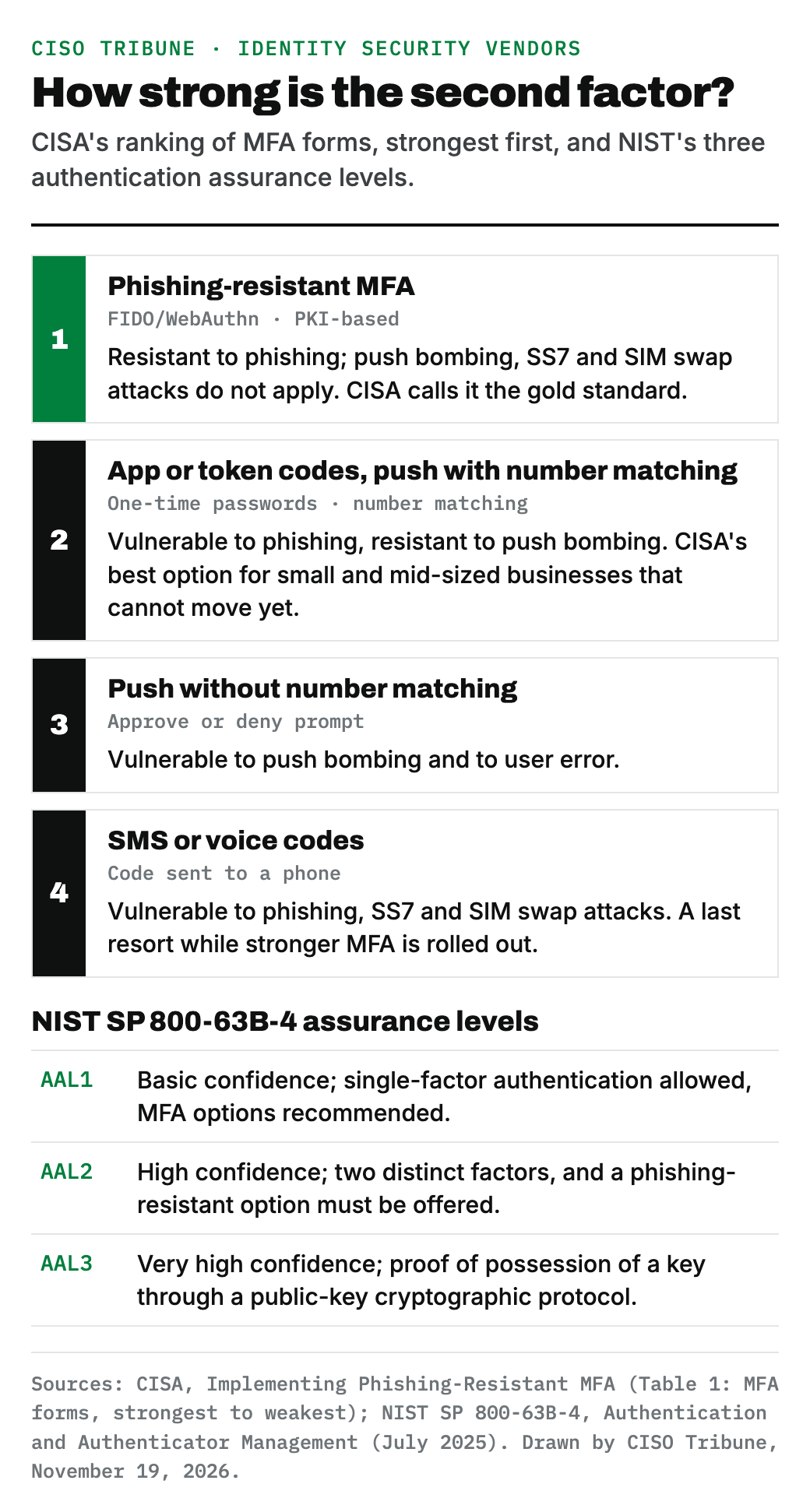
NIST published SP 800-63-4, its Digital Identity Guidelines, in July 2025, and it supersedes SP 800-63-3. Its authentication volume sets technical requirements for each of the three authentication assurance levels (AAL).
AAL1 requires only single-factor authentication, though NIST recommends that applications assessed at AAL1 offer multifactor options. At AAL2, proof of two distinct authentication factors is required, and applications must offer a phishing-resistant option. NIST says federal agencies shall require their staff, contractors, and partners to use phishing-resistant authentication on federal systems.
AAL3 requires a phishing-resistant authenticator with a non-exportable authentication key, and it rests on proof of possession of a key through a public-key cryptographic protocol.
NIST's blog on the release lists among the changes the integration of syncable authenticators (e.g., synced passkeys). The guidelines say syncable authenticators may be offered as a new option for applications that implement up to AAL2.
NIST also lists their risks. Some syncable authenticator deployments support sharing authentication keys with other users' devices, and NIST's mitigation is enterprise device management or managed profiles that block such sharing. Central revocation of the kind PKI offers is not available for syncable authenticators or any FIDO WebAuthn-based credentials.
How CISA ranks MFA
CISA warns that not all forms of MFA are equally secure. The threats it weighs them against are phishing, push bombing, SIM swaps and exploits of the Signaling System 7 (SS7) telephone network. Its fact sheet lists forms of MFA from strongest to weakest by their exposure to those threats.
- Phishing-resistant MFA. FIDO/WebAuthn and public key infrastructure (PKI) methods form what CISA calls the gold standard for MFA. CISA strongly urges system administrators and other high-value targets to move to it.
- App or token codes, and push with number matching. These are vulnerable to phishing attacks but resist push bombing, and CISA calls them the best options for small and midsize businesses that cannot move at once.
- Push without number matching. CISA says this form is vulnerable to push bombing attacks and to user error.
- SMS or voice. CISA says it should only be used as a last resort and lists it as vulnerable to phishing, SS7, and SIM swap attacks.
CISA tells organizations whose MFA is not phishing-resistant to employ additional prevention and detection controls, such as number matching. It adds that MFA can often be added to business applications through integration with enterprise identity and single sign-on (SSO) systems.
Passkeys
The FIDO Alliance says passkeys can be securely synced across a user's devices, or bound to one device. It also says passkeys can replace legacy multi-factor authentication flows such as password plus SMS one-time password (OTP). It warns that passkeys synced across devices are vulnerable to theft, and it describes device-bound passkeys as a hardware-backed root of trust.
Ask each single sign-on and passwordless MFA vendor which of these factors it supports for administrators and which it accepts for help-desk resets.
Privileged access management
What the guidance says
CISA sets out access management in the Identity pillar of its Zero Trust Maturity Model. The first step describes an agency that authorizes permanent access with periodic review for privileged and unprivileged accounts, and the next has privileged access requests that expire with automated review.
Further along, an agency grants session-based access, including for privileged access request, tailored to actions and resources. At the top, it uses automation to authorize just-in-time and just-enough access tailored to individual actions and resource needs. CISA describes the Optimal stage as including dynamic least privilege access (just-enough and within thresholds) for assets and their dependencies enterprise-wide.
NIST, in SP 800-207, says to grant only the minimum privileges needed to perform the mission. One of its zero trust tenets, as CISA lists them, is that access to individual enterprise resources is granted on a per-session basis.
MITRE ATT&CK warns that compromised credentials may also grant an adversary increased privilege to specific systems or restricted parts of the network. Overlapping permissions across local, domain and cloud accounts may let an adversary pivot across accounts and systems to reach domain or enterprise administrator. MITRE tells defenders to audit domain and local accounts and their permission levels routinely for paths to a privileged account.
What to test
Ask each privileged access vendor to grant an administrator rights for one task, remove them when the task ends, and play back the recorded session. Then have it vault a service account credential, rotate it, and show you which applications and scripts break.
Identity threat detection and response
Kerberos ticket abuse
MITRE ATT&CK, a public catalog of attacker techniques, describes how adversaries may attempt to subvert Kerberos authentication by stealing or forging Kerberos tickets. Technique T1558 has five sub-techniques, among them Golden Ticket, Silver Ticket, Kerberoasting, AS-REP Roasting and Ccache Files.
One of MITRE's detection analytics for this technique finds anomalous Kerberos activity, such as forged or stolen tickets, by correlating malformed fields in logon events.
Valid accounts
MITRE says adversaries may obtain and abuse credentials of existing accounts to gain initial access, persistence, privilege escalation or defense evasion. Attackers holding those credentials may choose not to use malware, which makes their presence harder to detect.
In identity provider logs, MITRE looks for geographic anomalies, impossible travel, risky sign-ins, and repeated multi-factor authentication attempts or failures.
Test before you buy
Run every shortlisted product against your own identity provider sign-in logs and Active Directory domain controller logs, not a vendor demo tenant. In a test domain, stage the techniques above, including Kerberoasting and a forged ticket. Record which alerts fire, how long each takes, and how much tuning each vendor needed. Ask each vendor to map every alert to an ATT&CK technique ID.
Non-human identities and AI agents
What OWASP means by non-human identities
OWASP explains that production software environments are composed of a large number of applications which need to be identified, resulting in "non-human identities," or NHI. It says application identities are often associated with secrets, which are used as credentials similarly to the way humans authenticate into computer systems.
OWASP adds that application secrets may authenticate into other applications within the trust domain and into third-party software as a service (SaaS) applications.
OWASP describes its NHI Top 10 as a comprehensive list of the most pressing security risks and vulnerabilities that non-human identities present to organizations. The 2025 list is ranked based on exploitability, prevalence, detectability, and impact.
The OWASP NHI Top 10 for 2025
The OWASP Non-Human Identities Top 10 - 2025 ranks ten risks in this order: Improper Offboarding, Secret Leakage, Vulnerable Third-Party NHI, Insecure Authentication, Overprivileged NHI, Insecure Cloud Deployment Configurations, Long-Lived Secrets, Environment Isolation, NHI Reuse and Human Use of NHI.
When you compare non-human identity vendors, ask each one to show how it detects and fixes every risk on this list.
Zero trust and the identity pillar
NIST says in SP 800-207 that zero trust assumes there is no implicit trust granted to assets or user accounts based solely on their network location or asset ownership. In its model, authentication and authorization (both subject and device) are discrete functions performed before a session to an enterprise resource is established.
NIST writes that access is granted through a policy decision point (PDP) and a corresponding policy enforcement point (PEP). One of the questions each decision answers is the level of confidence about the subject's identity for that unique request. In the identity-driven approach, enterprise resource access policies are based on identity and assigned attributes, and factors such as the device used and asset status may alter the final confidence level calculation.
The Identity pillar in CISA's maturity model
CISA's Zero Trust Maturity Model Version 2.0 sets stages that advance from a Traditional starting point to Initial, Advanced and Optimal. Each stage requires more protection, detail and complexity.
For authentication, a Traditional agency authenticates identity using either passwords or multi-factor authentication (MFA) with static access. At Initial, it authenticates identity using MFA, which may include passwords as one factor and validates entity attributes such as locale or activity. At Advanced, it begins to authenticate all identity using phishing-resistant MFA. At Optimal, it validates identity continuously with phishing-resistant MFA, not just when access is first granted.
For identity stores, an Initial agency mixes self-managed and hosted stores with minimal integration between the store(s). CISA's general Advanced criteria include centralized identity control and changes to least privilege based on risk and posture assessments.
Ask each vendor which Identity pillar function and which maturity stage its product delivers, and have it show the configuration that reaches that stage.
Who the identity security vendors on the record are
Of the 86, 12 are also filed under AI model and agent security, 11 under identity governance and administration, 11 under MDR and managed SOC, and 9 under identity verification.
Source: CISO Tribune vendor record, counted November 19, 2026
| Label | vendors |
|---|---|
| AI model and agent | 12 |
| Identity governance | 11 |
| MDR and managed SOC | 11 |
| Identity verification | 9 |
| Customer identity | 7 |
| EDR and XDR | 7 |
| SaaS security posture | 7 |
| Security consulting | 7 |
The record lists 11 of them as acquired, 17 as privately held and 8 as publicly traded.
Access management and single sign-on
Under Workforce IAM and SSO, HID describes a cloud-based authentication platform for regulated industries. JumpCloud sells unified endpoint management that runs desktop and mobile devices from one console. Okta says its single sign-on gives employees, partners and AI agents identities. Ping Identity sells PingOne for Workforce and the PingFederate federation server. RSA Security says RSA ID Plus includes single sign-on, multi-factor authentication (MFA) and directory services. SecurEnvoy says it combines MFA, single sign-on, conditional access and a universal directory.
Passwordless and authenticators
Under Passwordless authentication and authenticators, Beyond Identity offers single-device, passwordless MFA. HYPR says it turns a smartphone into a passkey. Oloid sells an AI agent that establishes employee identity for help desk requests. OneSpan sells DigipassONE, a platform for authentication and transaction security. Secret Double Octopus offers passwordless MFA across legacy, on-premises, cloud and air-gapped systems. Token makes biometric authenticators, one of them a wearable. Yubico sells the YubiKey 5 Series and the fingerprint-based YubiKey Bio Series.
Privileged access
Under Privileged access management, Apono, now owned by 1Password, applies just-in-time access to non-human identities. BeyondTrust, owned by Francisco Partners, sells Password Safe and Endpoint Privilege Management. Britive says it authorizes every AI agent action at runtime. CyberArk, now part of Palo Alto Networks, sells Modern PAM and Secrets Management. Delinea says Secret Server vaults secrets with automated rotation. HashiCorp, owned by IBM, sells Vault and Boundary. Keeper Security offers KeeperPAM for remote database access. P0 Security authorizes agent, user and machine actions at runtime.
Identity threat detection
Under ITDR, Permiso, now owned by Okta, inventories human, non-human and AI identities. Semperis sells Directory Services Protector and Active Directory Forest Recovery. Silverfort says it monitors every authentication and access attempt in a hybrid environment.
Non-human identity
Under Non-human identity security, Aembit validates identity on outgoing workload requests. Akeyless brokers just-in-time access without exposing credentials to the agent. Astrix Security, now owned by Cisco, keeps an inventory of AI agents and non-human identities. AuthMind protects AI agent identities across cloud, software-as-a-service and on-premises environments. Clutch Security combines identity, AI agent and secret security in one product. Cygrid holds humans, AI agents, tokens and resources in one graph. Infisical syncs, rotates and audits application credentials. NewCore issues short-lived, task-scoped access for agents.
The record also files CrowdStrike, SentinelOne and Vectra AI under ITDR, and Microsoft under Workforce IAM and SSO.
Security chiefs on the record
The record names Roger Hale as chief information security officer at 1Kosmos as of June 23, 2026, and Jacob DePriest as CISO & CIO at 1Password as of October 20, 2026. It names Sean Malone as chief information security officer at BeyondTrust as of October 28, 2026, and William Bengtson as CISO at C1.ai as of November 10, 2026.
At JumpCloud, the record names Roland Palmer as Chief Information Security Officer (CISO) and Vice President of Security as of March 2, 2026. It names Shane Barney as CISO at Keeper Security as of November 18, 2026, and John Podboy as chief information security officer at Semperis as of May 4, 2026.
Ownership and consolidation, 2025 and 2026
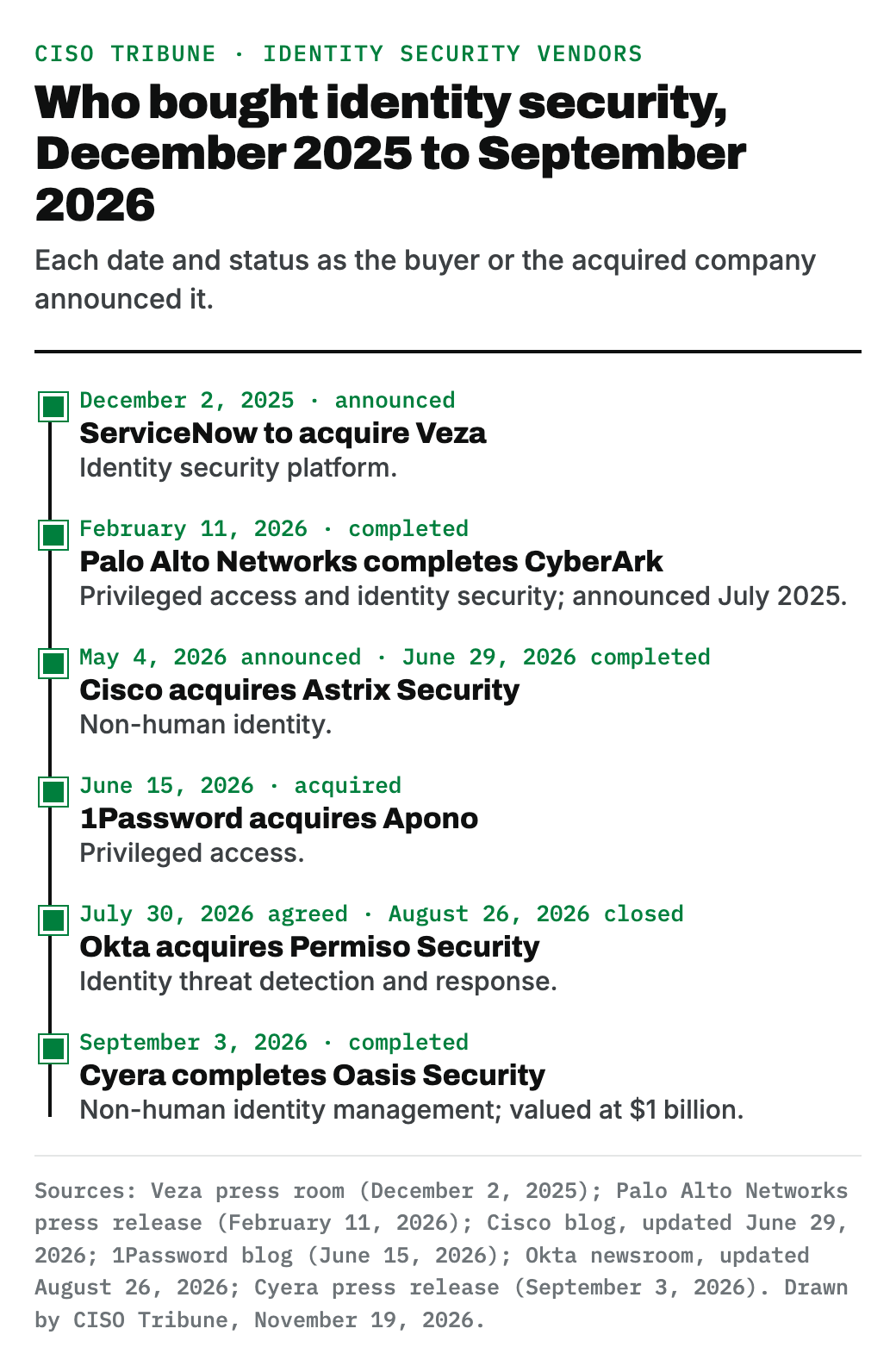
ServiceNow announced its intent to acquire Veza on December 2, 2025. That announcement says the deal is subject to customary regulatory approvals and closing conditions, and that Veza's identity visibility, intelligence and governance capabilities will be incorporated into ServiceNow's security portfolio after the transaction closes.
On February 11, 2026, Palo Alto Networks announced the completion of its acquisition of CyberArk. The company says CyberArk's Identity Security solutions will continue to be available as a standalone platform, while integration into the Palo Alto Networks security ecosystem is underway. It also says existing customers will experience no disruption.
Cisco announced its intent to acquire Astrix Security on May 4, 2026, describing it as a non-human identity (NHI) security company. An update on the same page, dated June 29, 2026, says Cisco has completed the acquisition. Cisco says it plans to integrate Astrix Security's capabilities into Cisco Identity Intelligence.
On June 15, 2026, 1Password wrote that it has acquired Apono. The company says Apono's just-in-time privileged access governance completes the picture for 1Password Unified Access.
Okta first announced a definitive agreement to acquire Permiso Security, then said in an update dated August 26, 2026 that it had closed the acquisition. Okta says that with Permiso's risk signals and detections, the Okta Platform will offer ITDR capabilities.
On September 3, 2026, Cyera announced the completion of its acquisition of Oasis Security. The company says the acquisition, valued at $1 billion, unites its AI and Data Security Platform with Oasis's NHI management capabilities. It says the Oasis platform will operate as Cyera Identity.
When a vendor you run is acquired, ask the new owner to put the product roadmap, support terms and any end-of-life dates in writing before your next renewal.
How CISOs compare identity security vendors
Phishing-resistant authentication for every user group
CISA strongly urges system administrators and other high-value targets to implement or plan their migration to phishing-resistant multifactor authentication (MFA). For an initial phase of that rollout, CISA suggests groups such as the help desk and IT system administrators.
NIST names recovery as the weak point in many authentication mechanisms, meaning the process followed when a subscriber loses an authenticator and needs to replace it. NIST adds that where authenticator recovery is human-assisted, social engineering attacks also pose risks.
Ask each vendor to show phishing-resistant enrollment for administrators. Have it walk through how a help desk reset verifies the caller.
Privileged access without standing privilege
In CISA's Zero Trust Maturity Model (ZTMM), access management starts where an agency authorizes permanent access with periodic review for both privileged and unprivileged accounts. At the far end of the model, the agency uses automation to authorize just-in-time and just-enough access tailored to individual actions and resource needs.
In the trial, ask each provider to remove a standing administrator role and grant it back for a single session.
Detection across Active Directory, cloud and SaaS
CISA says threat actors try to compromise identity servers like Active Directory, which would let them create new accounts or take control of user accounts. MITRE ATT&CK describes adversaries who subvert Kerberos authentication by stealing or forging Kerberos tickets. One of the analytics in its detection strategy for that technique works by correlating malformed fields in logon events, RC4-encrypted ticket-granting tickets (TGTs), or ticket-granting service (TGS) requests without corresponding TGT requests.
Map each vendor's detections to ATT&CK techniques for on-premises Active Directory, your cloud identity provider and your software-as-a-service (SaaS) applications. Ask which of the three each detection covers.
Non-human identity discovery, ownership and rotation
Ask how the product discovers service accounts and keys, assigns each one an owner, and rotates its secrets.
Integration with the SOC and identity governance
NIST says the assets that store access-decision data often do not have a common, open standard for exchanging information, which can lock an enterprise into a subset of providers.
Test alert export into your security operations center (SOC) tools during the trial. Confirm that access changes flow back to your identity governance system.
What the product sees on your data
NIST tells planners to identify all upstream resources, downstream resources and entities, including service accounts, that a workflow uses.
Run the trial on your own tenants. Compare the accounts the product finds against your inventory, and write down what it misses.
Proof of value and contract points
Record a baseline before the trial starts, then measure the same figures at the end. Run it on a defined pilot group.
Authentication
Count the share of the pilot group that enrolls a phishing-resistant multifactor authentication (MFA) factor, and how long enrollment takes per user. Count help-desk password and factor resets before and during the trial.
Have each vendor walk your own help desk through a lost security key, start to finish.
Privileged access and detection
Count the privileged sessions the tool brokers against the administrator accounts you know exist. In a test environment, run a simulated Kerberoasting attack and a session token theft, and time each one from first action to alert.
NIST warns that hijacking attacks on the session following an authentication event can have security impacts similar to attacks on the login itself.
Non-human identities
Count the service accounts, keys and secrets the tool finds that were missing from your inventory. Then count how many it can tie to a named owner.
Contract points
- Logs and recordings. Name the region where identity logs and privileged session recordings are stored and the retention period for each. Require export to your own security information and event management (SIEM) system.
- Vendor access to your tenant. Require a list of which vendor staff can reach your tenant and under what approval. Have that access logged where you can read it.
- Availability. Write a separate availability commitment for authentication, with service credits and an outage notification clock. Treat an authentication outage as a lockout of every user when you set the terms.
- Break-glass accounts. Keep emergency accounts that do not depend on the vendor's service. Put the testing interval in the contract.
- Exit. Require export of policies, role definitions and logs in a documented format. Fix a period of read access after termination.
What to ask, by size of organization
Small organizations
CISA names one-time password (OTP) codes from an app or token, or mobile push with number matching, as the best options for small and medium-sized businesses that cannot immediately implement phishing-resistant MFA. It says MFA codes sent by text or voice should only be used as a last resort.
CISA recommends that organizations identify systems that do not support MFA and plan to upgrade or replace them. It also recommends escalating any risks of any system that lacks MFA to the senior leadership team.
Ask each vendor which of your applications it can bring under MFA. Ask what it offers for the ones it cannot.
Mid-sized organizations
CISA notes that every organization has a small number of user accounts with additional access or privileges, and that a compromised system administrator account may reach any system and any data. For a first phase of phishing-resistant MFA, it suggests groups such as help desk and IT system administrators.
Ask who owns each privileged account and each service account, and who reviews it. Have the vendor show how its product finds service accounts with no named owner.
Large organizations
CISA's Zero Trust Maturity Model (ZTMM) describes a gradient of implementation across five distinct pillars, and Identity is one of them. In it, an agency moves from beginning to integrate some self-managed and hosted identity stores to integrating them across all partners and environments. Each pillar can progress at its own pace until cross-pillar coordination is required.
CISA calls MFA based on public key infrastructure (PKI) sensible for large and complex organizations. It adds that deploying it requires highly mature identity management practices.
Ask each vendor to list every identity provider and directory it connects to in production at your scale. Name the ZTMM stage you target for the identity pillar, and ask each vendor which functions its product moves toward that stage.
How identity security programs fail
Accounts left without MFA and credentials never rotated
In the Snowflake customer intrusions, Mandiant found that the impacted accounts were not configured with multi-factor authentication (MFA), so a valid username and password was enough to log in. In many cases, the credentials had not been rotated for as long as four years. Pull a list of every account that can sign in with a password alone, along with the age of its credential.
Weak MFA forms that stay in place
CISA rates push notification without number matching as vulnerable to push bombing attacks and user error. CISA says text message (SMS) or voice MFA should only be used as a last resort option. Count the users still on either method and set a date to move them.
Service accounts and secrets that outlive their owners
OWASP defines improper offboarding as the inadequate deactivation or removal of non-human identities (NHIs), such as service accounts and access keys, when they are no longer needed. OWASP warns that a long-lived breached secret provides attackers with access to sensitive services without any time constraints. Give every service account a named owner and every secret an expiry date.
Account recovery as the weak link
NIST writes that the weak point in many authentication mechanisms is the process followed when a subscriber loses control of authenticators and needs to replace them. Where recovery is human-assisted, NIST adds, social engineering attacks also pose risks. Run a test reset through your help desk and note what proof it asks for.
Valid accounts used for persistence
MITRE ATT&CK says adversaries may abuse credentials of existing accounts to gain initial access, persistence, privilege escalation or defense evasion. In some cases, adversaries may abuse inactive accounts, such as those of people who have left the organization. MITRE tells defenders to regularly audit user accounts for activity and deactivate or remove any that are no longer needed.
The vendors on the record
86 vendors file under these 5 categories on CISO Tribune's record, alphabetical within each category. A vendor filed in more than one of them appears once, under its primary category. Missing or misfiled companies go to /corrections.
Workforce IAM and SSO22 vendors
Directories, single sign-on, multi-factor authentication and access policy for employees and contractors.
How to build a Workforce IAM and SSO shortlist
Directories, single sign-on, multi-factor authentication and access policy for employees and contractors. Of the 22 vendors on the record, 7 list Workforce IAM and SSO as its primary category; 0 have a funding round on the record; 2 name customers with a source; 12 carry a review-site listing. Each company page lists its products, funding, customers and sources, and the comparison pages below set two vendors side by side.
- Amazon Web ServicesAmazon Web Services describes itself as designed for security, protecting workloads including government, financial services, and healthcare.Ownership not established · primary category
- AtosAtos delivers end-to-end technology services across the U.S Atos brings together global expertise and local presence.Ownership not established
- Auth0Auth0 provides access roles for apps and APIs, along with authorization mechanics for access control.Owned by Okta since 2021
- CyberTrust ConsultingCyberTrust Consulting is a boutique cybersecurity consultancy that sells consulting in PKI, Identity Security, Digital Identity and Post-Quantum Cryptography.Ownership not established
- CyboltCybolt sells end-to-end security and compliance services.Ownership not established
- CyderesCyderes sells Identity & Access Management (IAM), Exposure Management, and risk programs, and Managed Detection & Response (MDR) that integrates with existing tools.Ownership not established
- DescopeDescope sells the Descope customer and agentic IAM platform, which uses visual workflows, SDKs, and APIs to create and customize identity journeys for customers, partners, AI agents, and MCP servers.Ownership not established
- DXC TechnologyDXC Technology is an enterprise technology and innovation partner that helps global enterprises and public sector organizations run efficiently and modernize their systems.Public (NYSE: DXC)
- HIDHID sells identity solutions that connect billions of people, places and things.Ownership not established · primary category
- I-TRACINGI-TRACING says it supports organizations in mastering cyber risks and securing digital transformations, from strategic consulting to technical implementation and continuous optimization.Ownership not established
- IBMIBM Vault is offered for securing machine and agent identities.Ownership not established
- Judy SecurityJudy Security sells cybersecurity in which Judy combines advanced AI with real human expertise.Ownership not established
- JumpCloudJumpCloud sells a cloud-based directory service that connects user identities to the systems, applications, and networks that need to be accessed.Ownership not established · primary category
- MicrosoftMicrosoft Defender offers threat prevention, detection and response capabilities.Public (NASDAQ: MSFT)
- NametagNametag sells identity verification that combines cryptography, biometrics and AI to verify the real person behind high-risk account actions.Ownership not established
- NCSNCS provides cyber security services including cyber strategy and advisory, identity and access management, Essential Eight and NIST maturity assessments, threat mitigation using SIEM and AI-driven analytics, vulnerability management, and data classification and DLP advisory.Ownership not established
- OktaOkta sells a platform that secures identities, including the AI agents running across a business.Public (NASDAQ: OKTA) · primary category
- Ping IdentityPing Identity sells the Ping Identity Platform, an identity and access management platform for customer, workforce, partner and AI agent identities.Ownership not established · primary category
- RSA SecurityRSA Security sells identity and access management products, including RSA ID Plus, which includes SSO, MFA and directory services across cloud, hybrid and on-premises environments.Ownership not established · primary category
- SecurEnvoySecurEnvoy sells Access Management, Multi-Factor Authentication and Data Discovery solutions.Ownership not established · primary category
- WatchGuard TechnologiesWatchGuard Technologies sells a Unified Security Platform that combines network, endpoint, identity and cloud protection, purpose-built for MSPs servicing midsize companies and SMBs.Owned by Vector Capital since 2022
- WiproWipro offers Security Management Center, a security operations and orchestration product that helps deliver managed security services.Public (NSE: WIPRO)
Passwordless authentication and authenticators8 vendors
Hardware keys, device-bound credentials and phishing-resistant authenticators that replace or strengthen passwords.
How to build a Passwordless authentication and authenticators shortlist
Hardware keys, device-bound credentials and phishing-resistant authenticators that replace or strengthen passwords. Of the 8 vendors on the record, 7 list Passwordless authentication and authenticators as its primary category; 0 have a funding round on the record; 0 name customers with a source; 4 carry a review-site listing. Each company page lists its products, funding, customers and sources, and the comparison pages below set two vendors side by side.
- 1Kosmos1Kosmos sells a platform that combines identity verification and passwordless authentication, organized around KYC, KYE, and KYA use cases.Privately held
- Beyond IdentityBeyond Identity sells the Identity Defense Platform, which governs access across users, machines, and agents with identity that is cryptographically bound and credential-free.Ownership not established · primary category
- HYPRHYPR sells an identity security platform that unifies phishing-resistant passwordless authentication, adaptive risk mitigation and automated identity verification.Privately held · primary category
- OloidOloid sells identity and access tools for deskless workers and shared devices.Ownership not established · primary category
- OneSpanOneSpan sells advanced authentication and fraud prevention products that secure users, devices and applications, together with software that handles agreement preparation, signing and management through secure workflows.Public (NASDAQ: OSPN) · primary category
- Secret Double OctopusSecret Double Octopus uses patented ZeroPassword™ technology and is FIDO Alliance certified.Privately held · primary category
- TokenToken sells four products in more than a dozen form factors that deliver identity assurance, and every Token product binds access to the verified individual using biometric technology and cryptographic verification.Ownership not established · primary category
- YubicoYubico offers the YubiKey, a phishing-resistant, FIPS 140-3 validated key for multi-factor and passwordless authentication.Public (Nasdaq First North Growth Market Stockholm: YUBICO) · primary category
Privileged access management15 vendors
Vaulting, brokering and recording of administrator and other high-privilege access to systems.
How to build a Privileged access management shortlist
Vaulting, brokering and recording of administrator and other high-privilege access to systems. Of the 15 vendors on the record, 9 list Privileged access management as its primary category; 0 have a funding round on the record; 1 names customers with a source; 13 carry a review-site listing. Each company page lists its products, funding, customers and sources, and the comparison pages below set two vendors side by side.
- 1Password1Password sells software that secures human, machine, and agent credentials used in a business. 1Password Unified Access Platform contains Enterprise Password Manager, Device Trust, SaaS Manager, Credential Broker and Privileged Access.Ownership not established
- AponoApono is a cloud-native privileged access management platform that grants just-in-time access to humans, machines, and AI agents, then revokes it automatically.Owned by 1Password since 2026 · primary category
- BeyondTrustBeyondTrust sells privileged access management and identity security solutions, and says it discovers, onboards, secures, and right-sizes privileges across an enterprise.Owned by Francisco Partners since 2018 · primary category
- BritiveBritive sells a runtime privileged access platform that authorizes and enforces task-scoped access for AI agents, non-human identities and humans.Ownership not established · primary category
- C1.aiC1.ai gives agents policy-controlled access to models, tools, and credentials at runtime.Ownership not established
- CyberArkCyberArk sells the Idira Identity Security Platform, which brings together modern privileged access management (PAM), machine identity security and agentic identity security.Owned by Palo Alto Networks since 2026 · primary category
- DelineaDelinea is an identity security control plane that extends privileged access management (PAM) into continuous authorization across human, machine and AI identities.Ownership not established · primary category
- HashiCorpHashiCorp sells The Infrastructure Cloud, an integrated platform that turns Infrastructure Lifecycle Management and Security Lifecycle Management into code.Owned by IBM since 2025 · primary category
- Keeper SecurityKeeper Security sells a unified control plane for privileged access, secrets, remote connections, endpoints and databases within a single zero-trust platform.Ownership not established · primary category
- One IdentityOne Identity sells identity security software, including identity governance and administration products and privileged access management products.Ownership not established
- Orchid SecurityOrchid Security sells an identity-first security platform that discovers, analyzes, governs, and proves identity controls across applications.Ownership not established
- P0 SecurityP0 Security sells runtime access control that preserves identity and context while enforcing authorization as sensitive actions are attempted.Ownership not established · primary category
- SaviyntSaviynt sells an identity security platform for identity governance, privileged access and application security, including Zuma for AI agents and non-human identities.Privately held
- SSH Communications SecuritySSH Communications Security sells privileged access management solutions for tech-driven companies where software and dynamic infrastructure are core to competitive advantage.Ownership not established · primary category
- ThreatLockerThreatLocker sells an Application Control suite that includes Application Allowlisting, Ringfencing and Privileged Access Management, forming the core of its deny-by-default approach to cybersecurity.Ownership not established
Identity threat detection and response19 vendors
Monitoring of identity systems such as Active Directory and identity providers to detect and stop identity-based attacks.
How to build a Identity threat detection and response shortlist
Monitoring of identity systems such as Active Directory and identity providers to detect and stop identity-based attacks. Of the 19 vendors on the record, 3 list Identity threat detection and response as its primary category; 1 has a funding round on the record; 1 names customers with a source; 10 carry a review-site listing. Each company page lists its products, funding, customers and sources, and the comparison pages below set two vendors side by side.
- Abnormal AIAbnormal AI sells a behavioral security platform that protects email, identity, and AI.Privately held
- AcalvioAcalvio sells ShadowPlex, a deception platform built to operationalize 360 Deception at enterprise scale.Privately held
- Blackpoint CyberBlackpoint Cyber sells managed detection and response to organizations of all sizes around the world, along with the CompassOne platform.Ownership not established
- CayosoftCayosoft sells products for managing and protecting Microsoft environments, covering security and control across Active Directory, Azure AD, Microsoft 365 and Exchange Online.Privately held
- CrowdStrikeCrowdStrike sells the Falcon platform, a set of security products and services that the company says combines security data, AI intelligence, automation and expertise to stop breaches.Public (NASDAQ: CRWD)
- CyberKordCyberKord sells a service that answers security alerts day and night, without waiting for a person.Ownership not established
- GuardzGuardz sells an MSP-ready security platform that brings identity, endpoint, email, data, awareness, and exposure protection together.Privately held
- HuntressHuntress products are built to protect organizations of all sizes.Ownership not established
- MalwarebytesMalwarebytes sells antivirus, VPN, identity theft protection and scam detection software for personal devices such as computers, tablets and phones.Ownership not established
- Material SecurityMaterial Security is the company behind Material, an automated cloud workspace security platform for lean security teams that need to protect the email, files, and accounts that live in Google Workspace and Microsoft 365.Ownership not established
- MitigaMitiga sells Agentic Runtime Security for cloud, SaaS, identity, and AI.Ownership not established
- Obsidian SecurityObsidian Security sells real-time visibility, continuous governance and runtime enforcement over agents, identities and integrations across third-party apps.Privately held
- PermisoPermiso's Universal Identity Graph connects every identity to the credentials it owns, the machines it creates, the agents it runs and every action it takes in real time.Owned by Okta since 2026 · primary category
- SemperisSemperis is an identity-driven cyber resilience and crisis management company that protects critical identity systems from agentic and conventional cyberattacks.Ownership not established · primary category
- SentinelOneSentinelOne sells an AI-native platform with unified protection across endpoint, identity, AI, and cloud.Ownership not established
- SilverfortSilverfort sells an identity security platform that enforces identity security inline and at the moment of authentication across workforce users, privileged users, third parties, non-human identities and AI agents.Ownership not established · primary category
- Transmit SecurityTransmit Security states that customer facing applications are no longer accessed by just people, and that AI agents now discover, compare, automate, purchase, support customers and attack businesses.Ownership not established
- ValenceValence sells a platform that discovers and protects human, non-human, and AI agent identities across endpoint, cloud, and SaaS.Ownership not established
- Vectra AIVectra AI sells the Vectra AI Platform, a security platform that covers network, identity and cloud.Ownership not established
Non-human identity security22 vendors
Discovery, governance and protection of service accounts, API keys, tokens and workload or AI agent identities.
How to build a Non-human identity security shortlist
Discovery, governance and protection of service accounts, API keys, tokens and workload or AI agent identities. Of the 22 vendors on the record, 10 list Non-human identity security as its primary category; 1 has a funding round on the record; 2 name customers with a source; 10 carry a review-site listing. Each company page lists its products, funding, customers and sources, and the comparison pages below set two vendors side by side.
- AembitAembit enforces every agent access request through a verified identity, short-lived authorization, and a fully attributed compliance log.Privately held · primary category
- AkeylessAkeyless is an Identity Security Platform for securing machine, AI agent, and human identities across cloud, hybrid, and on-prem environments.Privately held · primary category
- Astrix SecurityAstrix Security sells software that maintains a real-time inventory of all AI agents, MCP servers, and NHIs, with context to understand risk and business usage.Owned by Cisco since 2026 · primary category
- AuthMindAuthMind sells an identity observability platform built for the age of agentic AI, securing what AI agents, NHIs and humans actually do, not just what policies intend.Ownership not established · primary category
- Clutch SecurityClutch Security sells a platform that treats every agent as a non-human identity with credentials and governs those credentials through their full lifecycle across 100+ integrations.Ownership not established · primary category
- CyeraCyera sells a unified platform to know, secure, and govern all data, identities, and AI agents in real-time.Privately held
- CygridCygrid sells a platform that finds shadow AI, over-scoped tokens and leftover admin rights across SaaS, checks every action by humans, service accounts and AI agents, and secures actions by applying customer policy.Ownership not established · primary category
- FlareFlare sells software that finds compromised identities across people, machines, and AI agents.Ownership not established
- GitGuardianGitGuardian sells a platform with continuous coverage across code, CI/CD, containers, developer endpoints, cloud IAM, vaults, AI coding tools, and collaboration platforms.Privately held
- Grip SecurityGrip Security sells a SaaS Security Control Plane that helps organizations pinpoint, prioritize, and mitigate SaaS identity risks, including shadow SaaS, shadow AI, and rogue cloud accounts.Ownership not established
- ImmutaImmuta sells software that connects to data platforms so customers can register their data and manage access controls on that data.Privately held
- InfisicalInfisical sells an all-in-one platform to manage application secrets, certificates, and privileged access across cloud, on-prem, and AI infrastructure.Privately held · primary category
- NewCoreNewCore sells an identity platform for governing access by AI agents, with Discover, Secure and Govern capabilities and an option that also manages people.Ownership not established · primary category
- Oasis SecurityOasis Security sells a platform that creates an inventory of all Non-Human Identities in a customer's environment.Owned by Cyera · primary category
- Onyx SecurityOnyx Security sells a secure control plane for AI agents and models.Ownership not established
- RecoReco sells the Reco Platform, which gives security teams visibility into their entire third-party ecosystem so they can discover risks, prioritize what matters, and fix it.Privately held
- SailPointSailPoint sells identity security software that discovers, governs and secures every human and non-human identity from a single platform.Public (NASDAQ: SAIL)
- SonraiSonrai sells identity, access, and permissions security for companies running on AWS, Azure, and Google Cloud platforms.Ownership not established
- Symmetry SystemsSymmetry Systems sells a Data + AI Security Platform that discovers, classifies, protects, and monitors sensitive data.Owned by Zscaler
- Token SecurityToken Security sells a platform that secures the identities supporting agentic AI deployments.Ownership not established · primary category
- Truffle SecurityTruffle Security is the company behind TruffleHog, an open-source security project.Privately held
- VezaVeza provides a unified Access Platform that brings together identities across systems for access search, actionable intelligence, automated access reviews and identity lifecycle management.Owned by ServiceNow since 2026
Frequently asked questions
- Who are the identity security vendors?
- As of November 19, 2026, CISO Tribune's record files 86 vendors under workforce identity and single sign-on, passwordless authentication, privileged access management, identity threat detection and response, or non-human identity security. They include Okta, Ping Identity and JumpCloud for single sign-on; Yubico and HYPR for passwordless authentication; CyberArk, BeyondTrust and Delinea for privileged access; Semperis and Silverfort for identity threat detection; and Aembit, Akeyless and Astrix Security for non-human identities.
- What does identity security cover?
- In CISO Tribune's taxonomy it covers five categories. Workforce identity and access management (IAM) and single sign-on (SSO) handle directories, SSO, multi-factor authentication (MFA) and access policy for employees and contractors. Passwordless authentication covers hardware keys and phishing-resistant authenticators. Privileged access management vaults, brokers and records administrator access. Identity threat detection and response monitors systems such as Active Directory for identity-based attacks. Non-human identity security protects service accounts, API keys, tokens and AI agent identities.
- What is the difference between identity security and identity governance (IGA)?
- Identity governance and administration (IGA) covers provisioning, access requests, role management and periodic access reviews across applications. Identity security, as this guide treats it, covers access management, passwordless authentication, privileged access management, identity threat detection and response, and non-human identity security. CISO Tribune's record files 12 vendors under IGA, and 11 of the 86 identity security vendors are also filed there. Confirm during a trial that access changes flow back to your governance system.
- What is phishing-resistant MFA?
- The Cybersecurity and Infrastructure Security Agency (CISA) calls Fast IDentity Online (FIDO) and WebAuthn and public key infrastructure (PKI) methods the gold standard for multi-factor authentication (MFA). It urges system administrators and other high-value targets to move to them. The National Institute of Standards and Technology (NIST) requires a phishing-resistant authenticator with a non-exportable key at authentication assurance level 3 and says federal agencies shall require staff, contractors and partners to use phishing-resistant authentication.
- What is non-human identity security?
- Non-human identity security covers the discovery, governance and protection of service accounts, API keys, tokens and workload or AI agent identities. The Open Worldwide Application Security Project (OWASP) explains that production software environments hold applications which need to be identified, resulting in non-human identities, or NHI, often tied to secrets used as credentials. Its NHI Top 10 for 2025 ranks Improper Offboarding first and Secret Leakage second.
- How do CISOs compare identity security vendors?
- Security chiefs test phishing-resistant enrollment for administrators and how a help desk reset verifies the caller. They ask privileged access vendors to remove a standing administrator role and grant it back for one session. They map detections to MITRE ATT&CK techniques across Active Directory, the cloud identity provider and software-as-a-service applications. They check how a product discovers service accounts, assigns owners and rotates secrets, test alert export into security operations center tools, and run trials on their own tenants.
Sources
- M-Trends 2026 Executive Edition · Mandiant (Google Cloud), November 19, 2026
- M-Trends 2026 Report: Executive Edition · Mandiant (Google Cloud), November 19, 2026
- SP 800-63-4, Digital Identity Guidelines · National Institute of Standards and Technology, July 31, 2025
- SP 800-63B-4: Authentication and Authenticator Management · National Institute of Standards and Technology, July 31, 2025
- Let's Get Digital! Updated Digital Identity Guidelines Are Here · National Institute of Standards and Technology, August 1, 2025
- Zero Trust Architecture (NIST Special Publication 800-207) · National Institute of Standards and Technology, August 11, 2020
- Implementing Phishing-Resistant MFA · Cybersecurity and Infrastructure Security Agency, October 31, 2022
- Zero Trust Maturity Model Version 2.0 · Cybersecurity and Infrastructure Security Agency, April 11, 2023
- Valid Accounts, Technique T1078 · MITRE ATT&CK, November 19, 2026
- Steal or Forge Kerberos Tickets, Technique T1558 · MITRE ATT&CK, November 19, 2026
- OWASP Non-Human Identities Top 10 · OWASP, November 19, 2026
- OWASP Non-Human Identities Top 10, 2025 · OWASP, January 1, 2025
- UNC5537 Targets Snowflake Customer Instances for Data Theft and Extortion · Google Cloud (Mandiant), June 10, 2024
- Passkeys · FIDO Alliance, November 19, 2026
- Palo Alto Networks Completes Acquisition of CyberArk to Secure the AI Era · Palo Alto Networks, February 11, 2026
- Okta acquires Permiso Security · Okta, July 30, 2026
- Securing the Agentic Workforce: Cisco Announces Intent to Acquire Astrix Security · Cisco, May 4, 2026
- Cyera Completes Acquisition of Oasis Security · Cyera, September 3, 2026
- Welcoming Apono to 1Password · 1Password, June 15, 2026
- ServiceNow to expand Security portfolio with acquisition of Veza · Veza, December 2, 2025
Writer
Hadass Liza Bitton is a writer at CISO Tribune covering security leadership: the people who take the top security seat, the ones who leave it, and what each move signals. Reach her at hadass@cisotribune.com.
The Briefing
Every verified CISO move of the week, in your inbox Friday.
Every verified CISO move and one piece of analysis, weekly.
Unsubscribe any time. See the privacy policy.