Vendor spotlight · Identity security
NewCore: who they are, what they sell and what CISOs should ask
NewCore sells enterprises identity for staff and AI agents. Based in Tel Aviv and San Francisco, founded by Zohar Alon, Amihai Neiderman and Erez Yarkoni.
What NewCore sells
NewCore sells an identity platform to enterprises that covers both employees and the AI agents acting for them. The SaaS News reported that the company was founded in 2025 by Zohar Alon, Amihai Neiderman and Erez Yarkoni and is headquartered in Tel Aviv and San Francisco. It is venture-backed.
The company describes the product as a single platform that discovers, secures and governs every identity, human and agent alike. Its site splits that into four parts:
- Discover maps people and agents into one identity graph. The company says it finds agents through read-only integrations. Its guide lists connections to HRIS, directories, IdPs, IGA, PAM, cloud, SaaS and AI platforms.
- Secure puts a gateway in front of the tools agents call. The company says every agent tool call passes through the gateway, which checks the action against policy. MCP server connections go into one registry, with an endpoint, owner and environment for each.
- Govern applies one policy engine to people and agents, with the outcomes allow, ask or deny. Risky calls go to a named approver in the NewCore App.
- Identity Foundation is the sign-in side. Its Secure Split Key, the company says, divides the signing key between NewCore's cloud and the customer's environment, so both shares are needed to sign a token. It also offers a visual MFA challenge, passkeys protected by the TPM or Secure Enclave, with no MDM or endpoint agent to deploy, and an authenticator inventory with strength scores.
For coding agents, the launch release said NewCore shipped an Agentic Skill package for Claude Code, Codex and Cursor. In June 2026 Neiderman, the CTO, wrote that NewCore supported the MCP Enterprise-Managed Authorization extension.
The service runs from NewCore's cloud. Its pages say it does not have to replace an existing identity provider. Its guide states that NewCore complements an existing identity provider and governance stack. The discovery page says nothing changes in how anyone signs in. The gateway page tells buyers to keep their existing AI gateway for routing and cost control. The home page offers a start with a read-only connection and nothing to migrate. Customers who want more can move further and manage people and agents together on NewCore. The company also says its agent identities are not service accounts in disguise.
Later that month Portal ERP reported that fewer than 10 customers were using the platform, alongside more than 10 design partners, and that the company expected to begin charging that summer.
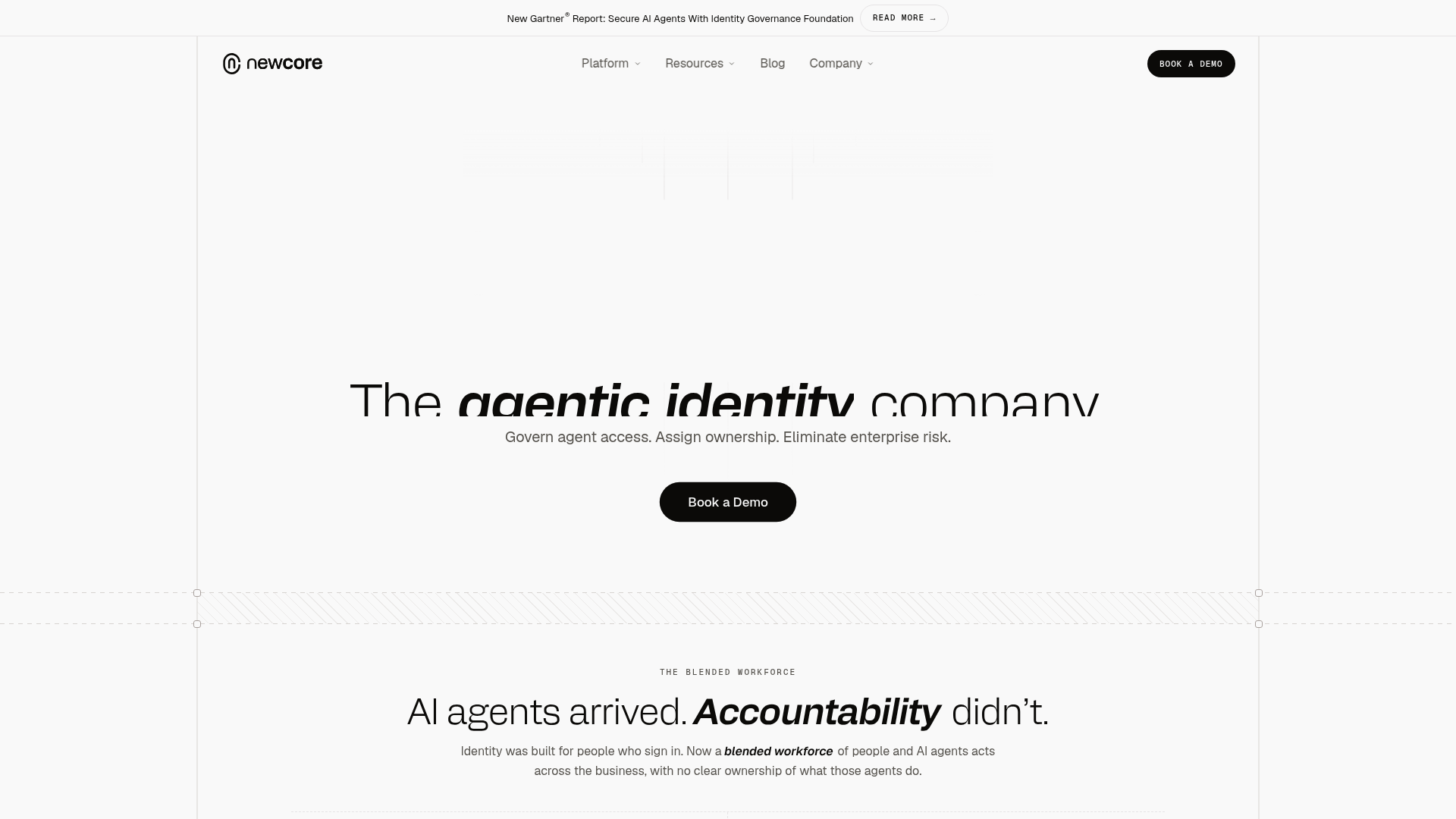
Figure: NewCore's home page, captured 2026-10-29. Source: The Agentic Identity Company | NewCore.
The founders
NewCore has three co-founders. The company's own pages give their backgrounds in short form.
Zohar Alon, CEO and co-founder, is described in the launch announcement as "a three-time cybersecurity founder with nearly 30 years in the industry" (NewCore). The same release says he founded and led Dome9, which Check Point acquired. Earlier in his career, it says, he built Provider-1, which the company calls one of Check Point's foundational enterprise products (NewCore). The company's about page also lists him as a former President of Cybereason (NewCore).
Amihai Neiderman, CTO and co-founder, founded Nym Health, according to the release. The about page describes him as a former CEO and founder of Nym (NewCore).
Erez Yarkoni, chief customer officer and co-founder, was previously CIO of T-Mobile USA and Telstra. The about page describes him as an "Enterprise buyer and operator." (NewCore).
On why the company exists, Alon told Portal ERP that the idea took shape in 2023. At the time he was reviewing the technology budget of a company that relied on an established identity provider (Portal ERP). He recalled telling the customer, "You must be extremely happy with them," and hearing back, "No, I'm not." The outlet reported that the exchange reinforced his view that identity management had become a large but stagnant market with limited competitive pressure on incumbent vendors (Portal ERP).
All three founders were bylined on a manifesto the company published on June 1, 2026 (NewCore). It put their reason plainly: "We started NewCore because we have been on both sides." It went on to say they had built security platforms, had "worked the attacker's perspective on identity infrastructure" and had "run large IAM program rollouts" (NewCore). Our reading is that those three lines line up with the three backgrounds above, one each. The manifesto itself does not assign them.
Neiderman has also written about a specific gap. In a June 24, 2026 post, he described himself as someone "who has been vocal about the authorization challenges baked into the MCP standard." He wrote that "the original per-user MCP authorization model had a serious security problem" (NewCore).
Alon framed the work as a question of timing: "It's inevitable. The question is whether we're going to build the guardrails in time." (Portal ERP). Other security executives on our record are listed under people.
What the product does
NewCore organises its agent product into three areas, Discover, Secure and Govern, and adds an Identity Foundation for human sign-in. The pages describe one workflow: find the agents, broker their access, then set and enforce rules on what they do.
Discover. The company says it finds agents "where they actually run, through read-only integrations" (Discover), so teams do not have to register them. Each agent is listed with its owner, who can invoke it and which tools and applications it can reach (Discover). A person's accounts across identity providers, directories and HR systems are resolved into one identity record, and that person's agents are linked to it (Discover). A company guide says the graph view surfaces high-risk access, offboarding gaps, dormant accounts and over-privileged users as working lists (guide). An assistant, Ask NewCore, answers plain-language questions from the identity graph (Discover).
Secure. MCP server connections go into one registry, with an endpoint, owner and environment recorded for each (Secure). Agents receive short-lived tokens scoped to the task and never hold the tool's own credential (Secure). Their access is bounded by the permissions of the person they act for (Secure). Every tool call passes through a gateway that identifies the agent and the person behind it and checks the action against policy before it reaches the tool (Secure). One agent's access can be cut off at the gateway without disabling its owner's account or other agents (Secure).
Govern. This is the company's AI agent governance layer: one policy engine for people and agents that decides whether each action is allowed, needs approval or is denied (Govern). Policies are written in plain language, and the page says a policy can be replayed against recent real sessions before it is saved (Govern). Flagged calls go to a named approver in the NewCore App (Govern). The approver can be the agent's owner, a manager or a designated person (Govern). The approver sees the agent, its owner and the requested action, and the page states: "An agent can never approve its own action." (Govern) Approval is confirmed with device biometrics, and a denied or expired request runs nothing (Govern). Tool calls, sessions and approvals land in one audit trail (Govern). The company tells teams to treat denied attempts as a threat signal (Govern).
Identity Foundation. For people, Secure Split Key divides token-signing authority between NewCore's cloud and the customer's environment, so both shares are needed to sign a valid token (Identity Foundation). The company says apps still receive standard SAML and OIDC tokens and need no changes (Identity Foundation). Sign-in uses VisualMFA, which the company says resists relay, replay and social engineering (announcement). It also uses passkeys bound to the device hardware and protected by the TPM or Secure Enclave, with no MDM or endpoint agent to deploy (Identity Foundation).
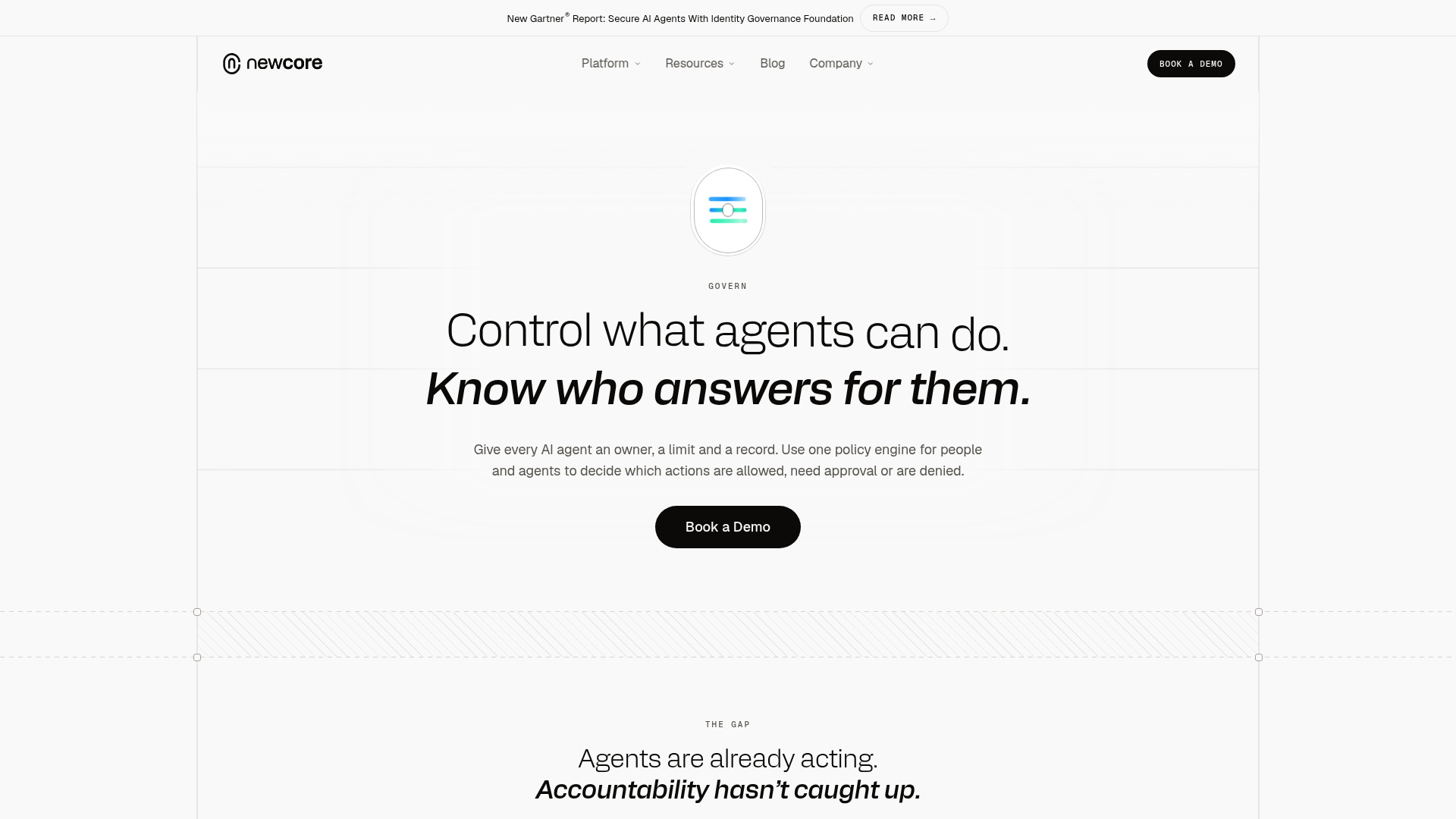
Figure: NewCore's product page, captured 2026-10-29. Source: AI Agent Governance & Runtime Guardrails | NewCore.
How it works and what it connects to
NewCore describes discovery as connector-based. Its identity security guide states that Identity Discovery connects HRIS, directories, IdPs, IGA, PAM, cloud, SaaS and AI platforms and indexes accounts, credentials and access relationships, including those outside the identity provider. The same page says NewCore complements an existing identity provider and governance stack and acts as a shared discovery layer across both.
The company lays out deployment in stages. The lightest path leaves the current identity platform in place: the homepage says customers start with a read-only connection and have nothing to migrate. A second path makes NewCore the IdP for high-risk apps or the admin team. A third path brings sign-in for people and governance for agents together on NewCore. On moving off an incumbent, the June 2026 launch announcement said customers move onto the platform in hours through an agent-driven coexistence model that preserves existing federations and policies. That was the company's claim. The sources contain no independent account of a migration.
On the agent side, the gateway is meant to work alongside existing infrastructure. The Secure page says supported agent workflows connect through NewCore's gateway while the current identity platform keeps handling employee sign-in. It also says a customer can keep an existing AI gateway for routing and cost control. The launch release described an Agentic Skill, an integration package for coding agents including Claude Code, Codex and Cursor.
For MCP, CTO Amihai Neiderman wrote that the Model Context Protocol team declared the Enterprise-Managed Authorization (EMA) extension stable on June 18, 2026, and that NewCore supports it. He explained that EMA works by obtaining an Identity Assertion JWT Authorization Grant during SSO and exchanging it for access tokens at each MCP server.
The sources name a few methods. The launch release said agents carry their own lifecycle, trust scoring and revocation path, but it did not explain how trust scores are computed. For people, the authenticator inventory scores each method from 1 to 10 and flags methods that are not phishing-resistant or were never used. Policy can require stronger authentication when an app is sensitive, an identity is privileged or the risk is high.
The company limits its own claims in one place: the Secure page refers to "supported" agent workflows rather than all of them. Several FAQ headings on the platform pages, such as which agents are covered and what happens to an issued token when a policy changes, have no published answers in the text we reviewed. Apart from the customer-held signing key share described earlier, the sources say nothing about where customer data is hosted, about data residency, or about security certifications.
Where it sits in the market
CISO Tribune's record files NewCore under three categories. Workforce IAM and SSO covers directories, single sign-on, multi-factor authentication and access policy for employees and contractors. Non-human identity security covers the discovery, governance and protection of service accounts, API keys, tokens and workload or AI agent identities. Identity governance and administration covers provisioning, access requests, role management and periodic access reviews across applications. NewCore sells into all three from one platform. In our reading, that is why its neighbours on the record come from several separate parts of the identity market.
The chart counts the companies on CISO Tribune's record in each of the three categories NewCore is filed under.
Source: CISO Tribune vendor record, as of 2026-10-29
| Label | vendors |
|---|---|
| Workforce IAM and SSO | 22 |
| Non-human identity security | 37 |
| Identity governance and administration | 10 |
The companies on the record that sell into one or more of those categories are, in alphabetical order: 1Password, Aembit, Akeyless, Amazon Web Services, Apono, Astrix Security, Atos, Auth0, BeyondTrust, Britive, Cayosoft, ConductorOne, CyberArk, CyberTrust Consulting, Cybolt, Cyderes, Cyera, Cygrid, Delinea, Descope, DXC Technology, GitGuardian, Grip Security, HashiCorp, IBM, Infisical, Judy Security, JumpCloud, Keeper Security, Microsoft, NCS, Oasis Security, Okta, Oloid, One Identity, Onyx Security, P0 Security, Permiso, Ping Identity, Reco, RSA Security, SailPoint, Saviynt, Secret Double Octopus, SecurEnvoy, Silverfort, Sonrai, SSH Communications Security, Symmetry Systems, Token Security, Truffle Security, Valence, Veza, WatchGuard Technologies and Wipro. More profiles are under /vendors.
NewCore's own material draws the line between itself and these products in a few places. Its newsroom describes the company as "the next-gen IdP for humans and agents". The manifesto the three co-founders published on June 1, 2026 aimed at how others package identity: "Bolting AI onto a 15-year-old architecture is not modernization. Selling four products as a platform is not convergence." The same text argued that human, agentic and workload identities belong in one graph, governed by the same policies. In a later post on MCP authorization, Neiderman wrote that the identity layer has to treat non-human identities as first-class citizens. He listed Agentic SSO, task-scoped tokens, real-time inventory and machine-speed security controls as the requirements.
Against governance tooling, the company's guide to the identity attack surface says access reviews cannot close exposure on their own. Its reason is that a review certifies only the entitlements that the governance product enumerates. The guide says NewCore instead starts from the identities no HR event created: service accounts, workload credentials and agents.
Against incumbent identity providers, Portal ERP reported that Okta and Microsoft's Entra had begun adding capabilities for AI agents. Alon argued that those additions sat on platforms designed for human employees. He told the outlet that the traditional vendors' agentic features were "on the side".
Funding, investors and growth
NewCore came out of stealth in June 2026 with $66 million in funding from Cyberstarts, Index Ventures and Evolution Equity Partners, the company says. Its own announcement named the three firms and the total but did not split the figure into rounds. The SaaS News reported that the money was raised across a $16 million pre-seed round and an expanded seed round, and that the funding brought the company's valuation to $300 million. Portal ERP also put the valuation at $300 million, describing it as post-investment. The valuation figure comes from press reports, not from NewCore's own pages.
The chart sets the reported $16 million pre-seed beside the $66 million figure announced with the seed round in June 2026.
Source: Portal ERP: NewCore raises $66 million to build identity management platform for AI agents
| Label | USD million |
|---|---|
| Pre-seed 2026 | 16 |
| Seed 2026-06 | 66 |
Chart data: The SaaS News; Portal ERP.
According to The SaaS News, Index Ventures and Cyberstarts led the pre-seed and Evolution Equity Partners led the seed. Angel investors in the seed round included Assaf Rappaport, Yevgeny Dibrov, Ofer Ben-Noon, Ofir Ehrlich, Sharin Fisher of Startpoint Capital and Yotam Segev, the same report states.
On use of funds, The SaaS News reported that NewCore planned to use the capital to support four years of operational runway and to scale its operations to compete against established identity management providers. The company's announcement said the product was available to enterprise customers on the day of the launch, and that NewCore would demonstrate the platform at Identiverse Las Vegas from June 15 to 18, 2026.
At launch, NewCore said it had more than 50 employees across Tel Aviv and the United States. Portal ERP gave an early picture of the commercial base: fewer than 10 customers were using the platform, alongside more than 10 design partners, and the startup expected to begin charging customers that summer. We found no later customer or headcount figure in the sources.
One investor spoke for the round in the launch release. Shardul Shah, a partner at Index Ventures, was quoted as saying: "Yesterday's identity platforms were built for a very different world."
After the round, the company added to its board. NewCore announced the appointment of Joy Chik to its Board of Directors. Her most recent role was President of the Identity and Network Access Business at Microsoft, and she brought 28 years of leadership experience, the company says. No further funding round appeared in the sources up to the date of this profile.
Customers, partners and public evidence
NewCore has not published a named customer or a case study in the sources available to this profile. Its homepage carries anonymous testimonials, each credited only to a role and a sector. One, attributed to a "Security leader, regional bank", reads: "We have not found a solution to date that lets us separate the human identity from the agent acting on its behalf and give it a different level of permissions. NewCore does." (NewCore). Another, from an "AmLaw 50 CISO", says: "It accelerates my speed to deploying agentic capabilities." (NewCore). Neither names an organisation, so we could not check them. The only adoption figure on file is the customer count reported at launch, covered in the funding section.
The outside commentary we found appeared inside the company's own launch announcement. It was a quotation selected by the company, not an independent assessment.
On awards, NewCore announced on October 8, 2026 that it had been named Identity Management Platform of the Year in the 10th annual CyberSecurity Breakthrough Awards (NewCore). The sources do not describe how either was judged.
The company's pages also carry a banner promoting a "Gartner® Report: Secure AI Agents With Identity Governance Foundation" (NewCore). The sources do not show what, if anything, that report says about NewCore.
The material reviewed for this profile contained no security certifications, cloud marketplace listings, reseller or partner programme, or public benchmark results. That may reflect the company's age rather than an absence. Buyers should ask NewCore directly for audit reports and reference customers. Other vendors in the same categories are listed on our vendor record.
Research, open source and public work
NewCore's public output so far has been written rather than coded: a founders' manifesto, blog analysis, white papers and a library of explainer guides.
The first piece, The New Identity Manifesto, appeared on June 1, 2026, two weeks before launch, and was signed by all three founders. It set out the company's thesis as a list of tenets. "Bolting AI onto a 15-year-old architecture is not modernization," the founders wrote. They argued that "One stolen signing key should not become a Golden SAML skeleton key to the enterprise," and that post-quantum work forces a protocol rebuild: "SAML cannot be patched into post-quantum safety.
On June 24, 2026, Neiderman published an analysis of Enterprise-Managed Authorization (EMA), an MCP extension the protocol team declared stable on June 18. He explained that EMA uses an Identity Assertion JWT Authorization Grant (ID-JAG) obtained during SSO and exchanged for access tokens at each MCP server. He named Anthropic, Microsoft, Asana, Atlassian, Figma and Okta among the implementers and said NewCore supports it too. The post carried the company's projection that non-human identities would grow by "roughly 100x relative to the number of humans" and that "Less than 1% of total identity activity will be human-generated." The post published no method or dataset for these figures.
It defined the surface as standing access, stating that it "measures standing capability, not account count," and argued that access reviews alone fall short because "a well-executed review can leave material exposure untouched and still produce a clean report." The guide drew on outside work, citing IBM's 2026 Cost of a Data Breach research for the finding that one in four malicious breaches were AI-enabled, and MITRE ATT&CK for how attackers consolidate access. The company says these guides offer "vendor-neutral guidance"; this one closes with a section on how NewCore's own product applies.
Other titles appeared on the company's site, though their contents were not in our sources: a white paper, The Architecture Changes Everything; a second white paper, Agentic Accountability: AI Agent Governance; and two analysis posts, "Control Agent Access When It's Used, Not When It's Reviewed" by Heather Mengarelli on October 21, 2026, and "Securing the Modern Workforce: People, Personal Agents, and Autonomous Agents" by Or Tsemah on October 28, 2026.
What a CISO should ask before buying
These questions are our reading of what a proof of concept should test. Each is tied to a claim NewCore makes about its own design. Most can be checked in a test tenant. The rest need answers in writing.
- Split signing key. The company says Secure Split Key divides token-signing authority "between our cloud and your environment, so both shares are needed to sign a valid token." Ask where your share lives and who holds it. Ask what happens to sign-in if your share is unavailable, and how the share is backed up and rotated.
- App compatibility. Its page states that apps receive standard SAML and OIDC tokens, with "No app changes and no extra steps at sign-in." Test that claim on your three hardest federated apps.
- Discovery coverage. NewCore says it finds agents "through read-only integrations." Ask for the supported platforms, the scopes each connector requests and how often the directory refreshes. Then compare its agent count with one you build by hand.
- Identity resolution. The discovery page says accounts across identity providers, directories and HR systems resolve into one record. Ask how it handles naming conflicts and contractors, and what it leaves for a person to adjudicate.
- Gateway path. The company says every agent tool call passes through the gateway, which checks policy before the call reaches the tool. Ask what happens to calls that route around it, and measure the latency it adds.
- Credential custody. Its page states that the agent "never holds the tool’s own credential." Ask where those credentials are stored and who at NewCore can reach them.
- Policy change mid-task. NewCore's own FAQ asks "What happens to a token already issued when a policy changes?" Get the answer, then test it by changing a policy while an agent holds a live token.
- Policy replay. The company says a policy can be replayed against recent real sessions before it is saved. Check how far back replay reaches, and whether its prediction matches what the gateway then enforces.
- Approvals. The governance page says approvers confirm with device biometrics and that a denied or expired request runs nothing. Ask for the default expiry and the fallback when an approver is away. Ask how the rule that "An agent can never approve its own action" is enforced.
- Revocation scope. NewCore says one agent can be cut off without disabling its owner's account or other agents. Time a revocation and check what the audit trail records.
- Migration. The launch release claimed customers move onto the platform "in hours" through a coexistence model. Ask for a cutover plan sized to your estate and a tested rollback path.
- References. Portal ERP reported in June 2026 that fewer than 10 customers were using the platform, alongside more than 10 design partners. Ask to speak with one running it in production at a scale close to yours.
Timeline
The record below runs from the idea in 2023 to an industry award in October 2026. Most of it comes from NewCore's own announcements, with two dates supplied by trade press. Each line gives the date and the source that carries it. The company's statements are reported as its claims.
The chart counts the dated milestones in this timeline by year.
Source: Milestones cited in this profile; most from prnewswire.com: NewCore Emerges from Stealth with $66M to Rebuild Workforce Identity for the Agentic Era · 7 dated events on the pages read for this profile, counted by the desk; a count of what the sources date, not of everything the company did.
| Label | milestones |
|---|---|
| 2023 | 1 |
| 2025 | 1 |
| 2026 | 5 |
- 2023: the idea. Zohar Alon told Portal ERP that the idea for NewCore took shape in 2023. He was reviewing the technology budget of a company that relied on an established identity provider.
- 2025: founding. The SaaS News reported that NewCore was founded in 2025 by Zohar Alon, Amihai Neiderman and Erez Yarkoni.
- 1 June 2026: the manifesto. The three founders published The New Identity Manifesto on the company blog two weeks before launch. Its subtitle read "The identity platforms we depend on are the risk we were never meant to own."
- 15 to 18 June 2026: first public demonstration. The launch release said the company would demonstrate the platform at Identiverse in Las Vegas over those four days.
The white papers and the October blog posts are covered in the research section above, so they are not repeated here.
In our reading, the dates show a short public history. The company existed for about a year before it said anything in public, and every dated milestone after founding fell within roughly five months of 2026. For a buyer, that means the evidence is thin on how the company has performed over time. The questions in the section above are a way to fill that gap directly with the company.
Frequently asked questions
- What does NewCore do?
- NewCore sells enterprises an identity platform that covers employees and the AI agents acting for them. The company describes it as a single platform that discovers, secures and governs every identity, human and agent alike. Its site splits the product into Discover, Secure, Govern and an Identity Foundation for human sign-in.
- Who founded NewCore?
- The SaaS News reported that Zohar Alon, Amihai Neiderman and Erez Yarkoni founded NewCore in 2025. Alon is CEO, and the company says he founded and led Dome9, which Check Point acquired. Neiderman is CTO and founded Nym Health, according to the launch release. Yarkoni is chief customer officer and was previously CIO of T-Mobile USA and Telstra.
- How much funding has NewCore raised?
- NewCore came out of stealth in June 2026 with $66 million from Cyberstarts, Index Ventures and Evolution Equity Partners, the company says. The SaaS News reported that the money came from a $16 million pre-seed round and an expanded seed round, and that the funding brought the valuation to $300 million. Portal ERP also put the valuation at $300 million, describing it as post-investment.
- How does NewCore work?
- The company says it finds agents through read-only integrations with HRIS, directories, IdPs, IGA, PAM, cloud, SaaS and AI platforms. It says every agent tool call passes through a gateway that checks the action against policy, and a single policy engine returns allow, ask or deny. For sign-in, its Secure Split Key divides the signing key between NewCore's cloud and the customer's environment, so both shares are needed to sign a token.
- How is NewCore different from other identity providers?
- In a manifesto published on June 1, 2026, the founders argued that human, agentic and workload identities belong in one graph governed by the same policies. Portal ERP reported that Okta and Microsoft's Entra had begun adding capabilities for AI agents, and Alon told the outlet that the traditional vendors' agentic features were "on the side". The company's guide says NewCore starts from the identities no HR event created: service accounts, workload credentials and agents.
- What should a CISO ask NewCore before buying?
- Ask where the customer's share of the split signing key lives, who holds it and what happens to sign-in if it is unavailable. Ask what happens to agent calls that route around the gateway, and what happens to an issued token when a policy changes. Portal ERP reported in June 2026 that fewer than 10 customers were using the platform, so ask to speak with one running it in production at a similar scale.
Sources
- NewCore Raises $66M Seed · The SaaS News, June 16, 2026
- NewCore Raises $66M to Rebuild Workforce Identity | NewCore · NewCore, June 15, 2026
- People & AI Agent Discovery in One Identity Graph | NewCore · NewCore, October 29, 2026
- Identity Attack Surface Management: Reducing Identity Risk · NewCore, October 14, 2026
- AI Agent Access Management & Security | NewCore · NewCore, October 29, 2026
- Identity Foundation for AI Agents | NewCore · NewCore, October 29, 2026
- Enterprise-Managed Authorization (EMA) | NewCore · NewCore, June 24, 2026
- The Agentic Identity Company | NewCore · NewCore, October 29, 2026
- NewCore raises $66 million to build identity management platform for AI agents · Portal ERP, June 30, 2026
- About NewCore | The Security-First Identity Platform · NewCore, October 29, 2026
- The New Identity Manifesto | NewCore · NewCore, June 1, 2026
- AI Agent Governance & Runtime Guardrails | NewCore · NewCore, October 29, 2026
- Joy Chik Joins NewCore Board of Directors · NewCore, September 15, 2026
- NewCore Emerges from Stealth with $66M to Rebuild Workforce Identity for the Agentic Era · prnewswire.com, June 15, 2026
- NewCore Named Identity Management Platform of the Year · NewCore, October 8, 2026
Writer
Hadass Liza Bitton is a writer at CISO Tribune covering security leadership: the people who take the top security seat, the ones who leave it, and what each move signals. Reach her at hadass@cisotribune.com.