Vendor guide
What CISOs trust when they choose network security: certifications, tests and vulnerability records
The evidence CISOs check before buying network security: FIPS 140-3 and Common Criteria certificates, independent lab tests, CISA's KEV catalog and directives, and vendor disclosure.
Choose network security on evidence that someone other than the seller produced: cryptographic validation under the Cryptographic Module Validation Program (CMVP), Common Criteria certificates, lab tests, and the vendor's entries in the Known Exploited Vulnerabilities (KEV) catalog. Then read how the vendor discloses its own flaws.
The CMVP is a joint effort between the National Institute of Standards and Technology (NIST) and the Canadian Centre for Cyber Security. Cryptographic and Security Testing Laboratories verify each module meets a set of testable cryptographic and security requirements.
Common Criteria is an international program in which accredited laboratories test IT products against cyber security specifications for technology classes.
The Cybersecurity and Infrastructure Security Agency (CISA) maintains the authoritative source of vulnerabilities that have been exploited in the wild, and says organizations should use the KEV catalog as an input to their vulnerability management prioritization.
Our network security guide sets out who the vendors are and what each category does.
As of November 22, 2026, CISO Tribune's record files 65 vendors under its network security categories, 38 of them with one of those as their primary category.
Why network security is bought on outside evidence
The federal directive on edge devices
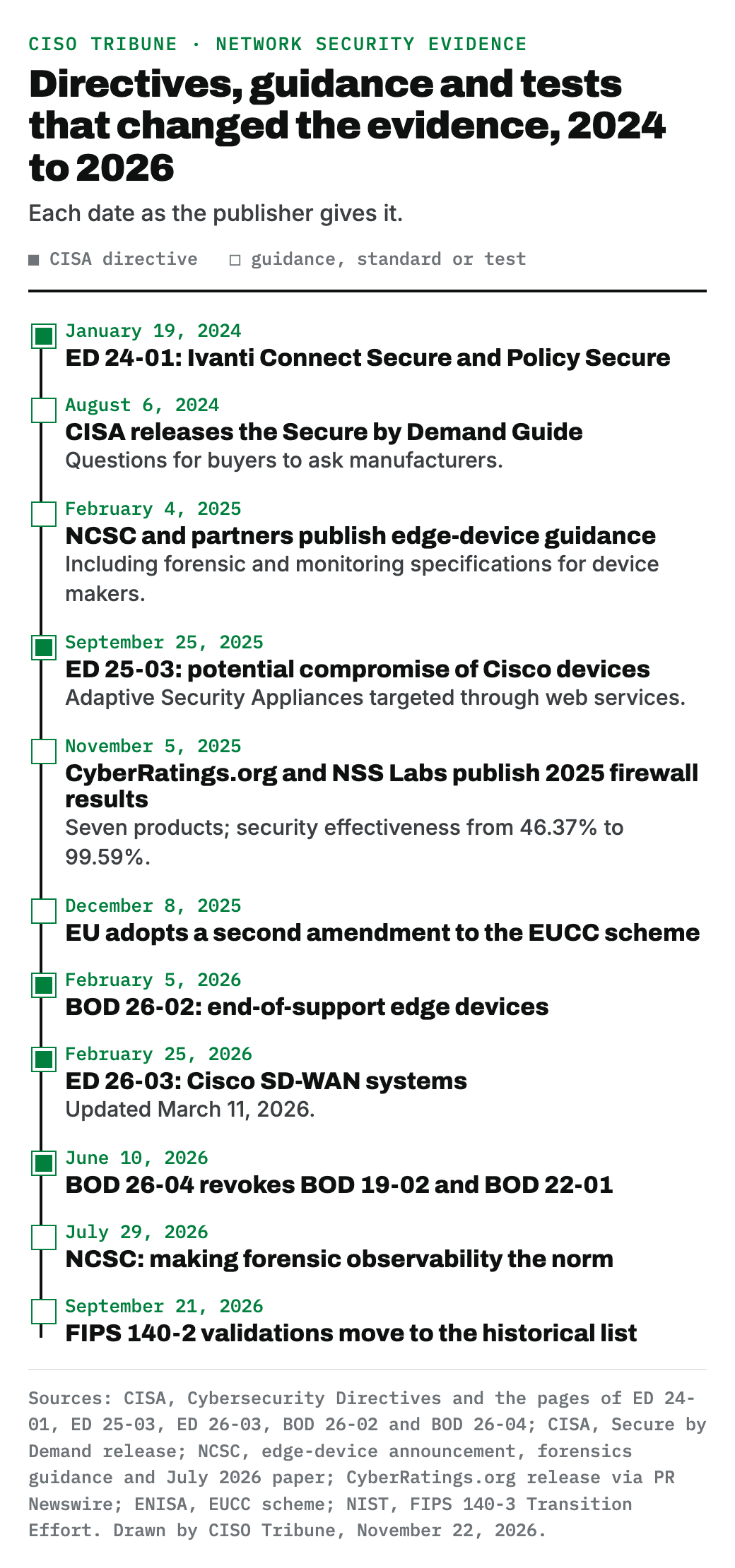
Binding Operational Directive 26-02, Mitigating Risk From End-of-Support Edge Devices, is dated February 5, 2026. In it, the Cybersecurity and Infrastructure Security Agency (CISA) writes that edge devices are attractive targets due to their extensive reach into an organization's network and integrations with identity management systems. Its list of such devices includes but is not limited to load balancers, firewalls, routers, switches, wireless access points and network security appliances.
The directive uses the term end of support for devices that are no longer maintained by their vendors. It requires federal agencies to use a CISA repository of devices that are already at end of support, or soon will be, to identify and remediate vulnerabilities within the first three months of the directive's issuance. Agencies are also to have decommissioned such devices on or before the date they reach end of support, and to report the decommission to CISA.
The joint guidance for manufacturers
Guidance dated February 4, 2025 covers digital forensics and protective monitoring specifications for producers of network devices and appliances. It was published by GCHQ's National Cyber Security Centre (NCSC) and cyber security agencies in Australia, Canada, New Zealand and the US.
The guidelines encourage device manufacturers to include and enable standard logging and forensic features that are secure by default. They also set out the minimum standards for forensic visibility to help network defenders secure organizational networks, both proactively and in response to a compromise.
The NCSC's announcement says the guidance gives manufacturers and their customers the tools to ensure products defend against cyber attacks and also provide investigative capabilities after an intrusion.
The Cisco emergency directive
Emergency Directive 25-03, Identify and Mitigate Potential Compromise of Cisco Devices, was first issued on September 25, 2025. CISA issued it in response to an ongoing exploitation campaign by a sophisticated threat actor which targets Cisco Adaptive Security Appliances via web services.
CISA's directive says the campaign is widespread. It says the activity involves exploiting zero-day vulnerabilities to gain unauthenticated remote code execution on the appliances, and manipulating read-only memory to persist through reboot and system upgrade.
What to rest the decision on
Do not plan on auditing a firewall's code yourself. Rest the decision on what test labs, certifiers and incident records say about the product. Ask of each piece of evidence which question it answers, and do not let one kind stand in for another.
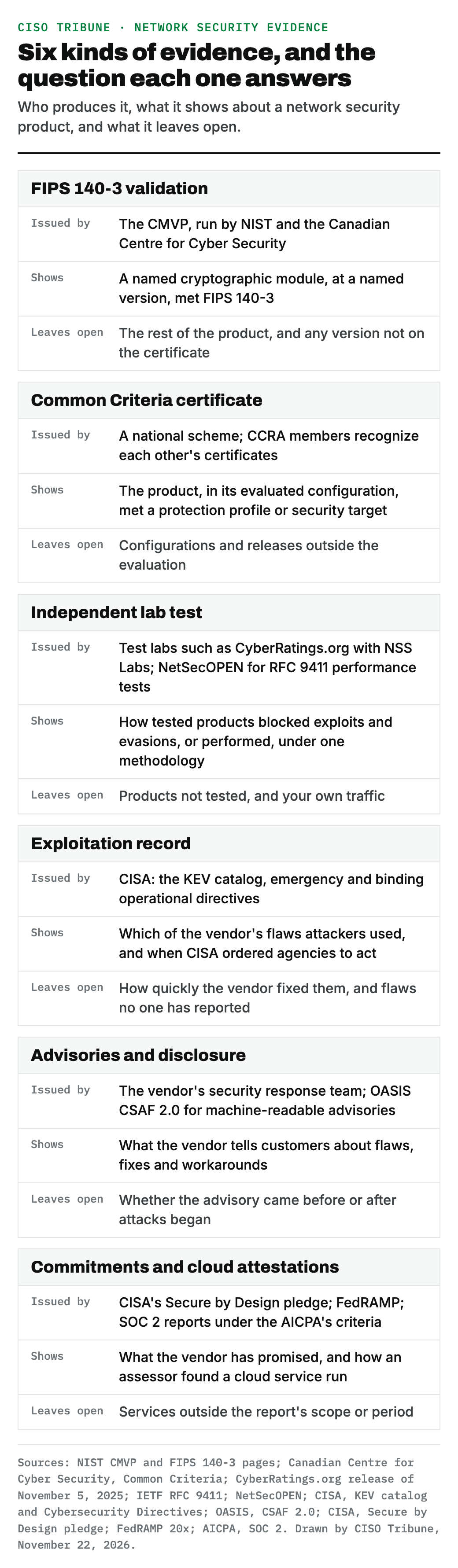
What FIPS 140-3 validation proves, and what it does not
The Secretary of Commerce approved Federal Information Processing Standards Publication (FIPS) 140-3 on March 22, 2019. It supersedes FIPS 140-2 and became effective September 22, 2019. Rather than set out the module requirements directly, FIPS 140-3 references ISO/IEC 19790:2012, and testing is in accordance with ISO/IEC 24759:2017.
The standard sets four increasing, qualitative levels of security, and its requirements cover the secure design, implementation and operation of a cryptographic module.
The program's goal is to promote validated modules and give federal agencies a security metric to use in procuring equipment that contains them.
The FIPS 140-2 cutoff
NIST's transition page gives September 21, 2026 as the date the FIPS 140-2 validations were to be moved to the historical list. The same page says that, even on the historical list, CMVP supports the purchase and use of these modules for existing systems.
Two lists to check
The modules in process list contains cryptographic modules on which the CMVP is actively working. Treat a module on that list as not yet validated, and ask the vendor for its schedule in writing.
NIST's search page has a basic option to search modules on the active validation list and an advanced search for the historical and revoked lists. Each result shows the certificate number, vendor name, module name, module type and validation date.
How two vendors present it
Fortinet says it validates products to FIPS 140-2/-3 Level 1 and 2. The company says a Level 1 certificate applies to effectively all the models supported by the certified build. It says a Level 2 certificate applies to the exact combination of the certified build(s) and hardware model(s).
Fortinet describes the FIPS Security Policy as the public document that states exactly what configuration(s) of the product are validated, such as hardware versions and firmware or software versions.
Palo Alto Networks' firewall documentation says that to enable FIPS-CC mode an administrator must first boot the firewall into the Maintenance Recovery Tool (MRT), then change the operational mode from normal mode to FIPS-CC mode. The company says that when the mode is enabled, the firewall will reset to the factory default settings and all configuration will be removed.
What a certificate leaves open
Read a certificate as a statement about the cryptographic module and nothing wider. Assess the product's other functions, such as traffic inspection, the management interface and the patch record, on separate evidence.
Check that the version you run is the version tested. Compare the hardware model and the firmware or software version on the certificate against what will sit in your rack, and repeat the check after each upgrade.
Before you sign:
- Ask for the certificate number for the exact module and version you will deploy.
- Look that number up on the active list yourself.
- Ask for the Security Policy document and read the validated configurations.
- Ask whether FIPS mode is on by default and what it switches off.
- Ask what happens to existing configuration when the mode is turned on.
- If the module is still in process, write the expected validation date into the contract.
Common Criteria and protection profiles: what a certificate covers
Recognition and protection profiles
Under the Common Criteria Recognition Arrangement, all member countries agree to recognize each other's Common Criteria certificates, the Canadian Centre for Cyber Security says.
A protection profile represents the baseline set of security requirements for a technology class. The Cyber Centre says a product evaluation against a profile covers the required security functionality and addresses the known security threats. It recommends that system architects match their needs to existing Protection Profiles.
The Cyber Centre says details about what was evaluated are in the product's Security Target and the Certification Report. Before a purchase, it recommends that organizations obtain a copy of the vendor's certificate and validate these certificates against the International list of certified products.
Germany and the European scheme
In Germany, the Federal Office for Information Security (BSI) says its certification report includes a description of the certified product from a security perspective, the details of the evaluation process and explanatory notes for the user.
The EU cybersecurity certification scheme on Common Criteria (EUCC) is voluntary: suppliers who want to show proof of assurance go through an EU commonly understood assessment process to certify their products. A second amendment was adopted on 8 December 2025 as regards definitions, product series certification and assurance continuity, among other points.
The European Commission says the scheme applies EU-wide and names firewalls (both hardware and software), routers and switches among the products it certifies.
How vendors present it
Cisco's government certifications page describes Common Criteria as global standards for evaluating information security products to meet security requirements for government deployments.
The page describes Commercial Solutions for Classified (CSfC) as part of the U.S. National Security Agency's commercial cybersecurity strategy, using approved Capability Packages and Protection Profiles that are approved by the National Information Assurance Partnership (NIAP). It describes Federal Information Processing Standard (FIPS) 140 as a U.S. and Canadian government standard specifying security requirements for cryptographic modules.
Palo Alto Networks says its Common Criteria certifications are hosted in two locations, the NIAP Product Compliant List website and the Common Criteria Portal, and asks readers to check both for the complete list of its compliant products.
The Common Criteria Portal publishes its certified products list with each product's category, protection profile and certification date, along with links to the certification report and the security target.
What to check on a certificate
- Read the security target. Find the target of evaluation and the configuration it was tested in.
- Check that the certified version and the protection profile match what you will run.
- Check the certificate's date against the product's release cycle.
- Ask the vendor which release it ships today and whether that release has been evaluated.
Independent lab tests: what they measure and how to read them
CyberRatings.org announced the results of its latest Enterprise Firewall (EFW) evaluation on November 5, 2025. The tests were conducted by NSS Labs and are available at no cost on the CyberRatings.org website.
NSS Labs evaluated seven enterprise firewall products using the Enterprise Firewall Test Methodology v3.0. Security Effectiveness ranged from 46.37% to 99.59%. Only three of seven products earned a Recommended rating.
The firewalls were tested under encrypted enterprise-grade workloads using 3,326 exploits, 11,311 malware samples, 5,752 evasion techniques spanning 53 evasion categories, 6,481 false-positive samples and 55 performance tests. CyberRatings.org reports that average exploit and malware block rates exceeded 96%, while three vendors failed critical evasion tests that reduced their effectiveness. It adds that some products showed marked performance degradation when inspecting encrypted traffic.
RFC 9411 and NetSecOPEN
The Internet Engineering Task Force (IETF) published RFC 9411, Benchmarking Methodology for Network Security Device Performance, in March 2023 as an Informational document that obsoletes RFC 3511. The document provides benchmarking terminology and methodology for next-generation network security devices, including next-generation firewalls (NGFWs) and next-generation intrusion prevention systems.
NetSecOPEN's site describes the consortium as the Authors of the RFC 9411 Methodology. The site menu lists Certifications, Specifications and Certification Reports. It also publishes the criteria and operational requirements a network security device must meet for NetSecOPEN Certification.
Effectiveness test or performance benchmark
Read a security effectiveness score and a throughput figure as answers to two separate questions, and ask for both on the same product.
RFC 9411 is primarily focused on performance benchmarking, and it recommends evaluating security effectiveness as a prerequisite for those benchmarking tests. The RFC warns that the optimal configuration for network security device performance may not be the most secure, and vice versa. It requires testers to configure devices with the same parameters and security features that would be used in the actual deployment or a typical deployment.
What to ask before you rely on a test
- Ask each vendor for the full report, not a summary or a quoted score.
- Ask for the test date and the firmware version tested, and compare both with the release you would deploy.
- Ask whether the product was tested in the configuration you would run, with decryption on.
- Replay your own traffic mix in the pilot, and measure blocking and throughput with the same policy enabled.
The public record: KEV entries, ransomware use and emergency directives
What the catalog holds
CISA's KEV catalog is also available in these formats: CSV and JSON. Each entry in the JSON feed names a vendorProject, a product and a dateAdded. Entries also carry a requiredAction, a dueDate and a knownRansomwareCampaignUse field.
The directives behind it
CISA established the Known Exploited Vulnerabilities catalog in 2021 under Binding Operational Directive (BOD) 22-01. BOD 26-04 supersedes and hereby revokes BOD 19-02 and BOD 22-01. CISA's directive page marks both older directives as revoked, each with the date June 10, 2026.
Read these emergency directives:
- Emergency Directive (ED) 24-01, Mitigate Ivanti Connect Secure and Ivanti Policy Secure Vulnerabilities, is dated January 19, 2024.
- ED 25-03, Identify and Mitigate Potential Compromise of Cisco Devices, is dated September 25, 2025.
- ED 26-03, Mitigate Vulnerabilities in Cisco SD-WAN Systems, was issued February 25, 2026.
What a CVE record holds
The CVE-2024-3400 record describes a command injection as a result of arbitrary file creation vulnerability in the GlobalProtect feature of Palo Alto Networks PAN-OS software.
CVE-2024-21762 is recorded as an out-of-bounds write vulnerability in Fortinet FortiOS, and the affected releases it lists include FortiOS 7.4.0 through 7.4.2.
CVE-2023-46805 is an authentication bypass vulnerability in the web component of Ivanti ICS 9.x and 22.x and Ivanti Policy Secure.
CVE-2025-20333 sits in the VPN web server of Cisco Secure Firewall Adaptive Security Appliance (ASA) Software and Threat Defense (FTD) Software, and the record says it could allow an authenticated, remote attacker to execute arbitrary code.
How to read the counts
Read entry counts with care. Before you compare counts, list how many products each vendor sells and how widely they are installed. Treat an empty record as a possible sign that a product attracts less attention.
Weigh three things for each entry: the kind of flaw, how fast a fix shipped, and whether the vendor told customers.
What to do with the record
- Pull the vendor's KEV entries from the JSON feed, filtered to the products you would buy.
- Read each linked advisory for the fix date, and compare it with the dateAdded value.
- Check knownRansomwareCampaignUse on each entry.
- Ask the vendor what changed in its engineering after each entry. Ask for the answer in writing.
Source: CISA, Known Exploited Vulnerabilities Catalog JSON feed, catalog version 2026.11.20 · Counted by CISO Tribune from vendorProject, A to Z. A count covers all of a vendor's products and grows with how many it sells and how widely they are installed.
| Label | entries |
|---|---|
| Arista Networks | 4 |
| Check Point | 6 |
| Cisco | 104 |
| Fortinet | 32 |
| Hewlett Packard Enterprise | 1 |
| Ivanti | 38 |
| Juniper Networks | 8 |
| Palo Alto Networks | 16 |
| SolarWinds | 11 |
| SonicWall | 20 |
| Sophos | 7 |
| Versa Networks | 2 |
| WatchGuard | 4 |
Source: CISA, Known Exploited Vulnerabilities Catalog JSON feed, catalog version 2026.11.20 · Counted from dateAdded. All vendors in the same years: 311, 555, 187, 186, 245, 306. The catalog began in November 2021; 2026 runs to November 20.
| Label | entries |
|---|---|
| 2021 | 33 |
| 2022 | 70 |
| 2023 | 18 |
| 2024 | 34 |
| 2025 | 36 |
| 2026 | 62 |
How a vendor handles disclosure: advisories, CSAF and CVE records
Vendor advisory pages
Fortinet's FortiGuard page carries a list of advisories for issues resolved in Fortinet products, and says its Product Security Incident Response Team (PSIRT) coordinates the resolution.
Palo Alto Networks' advisory page lists each entry with a summary and columns for versions Affected, Unaffected, Published and Updated.
Cisco's advisory listing points to its Security Vulnerability Policy, which it says contains instructions for obtaining fixed software and receiving security vulnerability information from Cisco.
CSAF 2.0
Common Security Advisory Framework Version 2.0, or CSAF, is an OASIS Standard dated 18 November 2022. The standard describes CSAF as a language to exchange Security Advisories formulated in JSON.
It says the language supports the creation, update and interoperable exchange of security advisories as structured information on products, vulnerabilities and the status of impact and remediation. It treats information on the presence or absence of workarounds as part of the security issue.
Each document carries a category, with example values that include csaf_security_advisory and csaf_vex, and the standard says the category is directly related to the profiles defined in its section 4.
What CISA calls bad practice
The Cybersecurity and Infrastructure Security Agency (CISA) calls it dangerous for the maker of products used in service of critical infrastructure to not issue CVEs in a timely manner, meaning Common Vulnerabilities and Exposures records, for at minimum all critical or high impact vulnerabilities.
CISA also lists as dangerous not having a published vulnerability disclosure policy that includes the product in its scope.
Where a manufacturer deems that an entry in the Known Exploited Vulnerabilities (KEV) catalog cannot be exploited in its product, CISA says the manufacturer should publicly publish written documentation acknowledging the entry and explaining how it is not exploitable.
Ivanti's open letter
Ivanti published an open letter from Ivanti CEO Jeff Abbott, its chief executive, last updated April 3, 2024.
The letter says Ivanti is making additional investments to support a risk-based approach that will reduce average time-to-patch for product vulnerabilities that pose the most risk to customer systems. It also says Ivanti is facilitating responsible disclosure with increased incentives around an enhanced bug bounty program.
What to check
- Check whether the vendor publishes its advisories in CSAF, and ask for the feed address.
- Check how far back the advisory archive goes. Pull the oldest entry for a product you run.
- Check whether each advisory gives fixed versions and workarounds together, on one page.
- Check whether the advisory states when a flaw was exploited before a fix existed. Read two or three past advisories to see how the vendor worded it.
- Ask each vendor for its published vulnerability disclosure policy and confirm the product you are buying is in scope.
Public commitments: the Secure by Design pledge and Secure by Demand
The Secure by Design pledge from the Cybersecurity and Infrastructure Security Agency (CISA) is a voluntary pledge focused on enterprise software products and services, including on-premises software, cloud services and software as a service. Signers pledge to make a good-faith effort to work towards the pledge's goals over the following year. CISA states that the pledge is voluntary and not legally binding.
What signers commit to
The pledge is structured with seven goals, each with core criteria that manufacturers pledge to work toward. Among them:
- Vulnerability classes: within one year of signing, demonstrate actions taken toward a significant measurable reduction in the prevalence of one or more vulnerability classes across the manufacturer's products.
- Disclosure policy: within one year of signing, publish a vulnerability disclosure policy.
- Vulnerability records: within one year of signing, demonstrate transparency in vulnerability reporting.
- Evidence of intrusions: within one year of signing, demonstrate a measurable increase in the ability for customers to gather evidence of cybersecurity intrusions affecting the manufacturer's products.
Network vendors on the signers page
CISA's signers page lists 402 companies as of November 22, 2026. Its signers include Check Point Software Technologies, Cisco, Cloudflare, Forescout, Fortinet and Gigamon. Hewlett Packard Enterprise, Infoblox, Netskope, Palo Alto Networks and SonicWall are on it too.
Progress reports
A manufacturer that makes measurable progress toward a goal should publicly document how they have achieved such progress within one year of signing. CISA keeps a page that lists progress reports from companies that have taken the pledge. CISA does not enforce nor verify adherence to the pledge.
Secure by Demand
CISA released the Secure by Demand guide on August 6, 2024. The guide lays out questions and resources that organizations buying software can use to understand a manufacturer's approach to cybersecurity. Its questions include these:
- Whether the manufacturer has taken the pledge, and what progress reports has the manufacturer published in line with its commitments.
- Whether the manufacturer supports integrating standards-based single sign-on (SSO) for customers at no additional cost.
- Whether the manufacturer has published a vulnerability disclosure policy that authorizes testing by members of the public on its products.
Read each vendor's progress report against each pledge goal, one goal at a time. Ask the vendor which products the report covers and which it leaves for later. Put the Secure by Demand questions in the request for proposal, and ask for written answers.
Cloud-delivered network security: FedRAMP, SOC 2 and the provider's own operations
FedRAMP 20x
The Federal Risk and Authorization Management Program (FedRAMP) calls 20x a new approach to cloud security assessment and authorization, one that moves beyond traditional compliance to focus on the security decisions that matter most.
FedRAMP says the full rules for FedRAMP 20x Certification are finalized for Class A, Class B and Class C. It defines Class C as covering cloud services that provide common enterprise services that are likely to be used in systems across an entire agency or that provide important government services.
One of the program's stated principles is that security should be continuously enforced, monitored, and reported rather than staged for a point-in-time audit. FedRAMP says it will stop accepting new Rev5 Certifications on June 11, 2027.
SOC 2
The AICPA describes System and Organization Controls (SOC) as a suite of offerings that certified public accountants (CPAs) may provide in connection with system-level controls of a service organization.
Its SOC 2 guide covers an examination of controls at a service organization relevant to security, availability, processing integrity, confidentiality or privacy.
The AICPA lists exposure drafts of proposed 2027 SOC 2 Trust Services Criteria and Description Criteria, dated November 16, 2026. It also says SOC services should be thoroughly evaluated by service organizations and CPA firms.
How three vendors publish it
Cisco's FedRAMP page tells customers they can find a list of providers that have achieved FedRAMP Authorization on the FedRAMP Marketplace. Each provider's page there, Cisco says, shows the date of the authorization, the sponsoring agency and the third-party assessor.
Palo Alto Networks' certifications page says the SOC 2+ report evaluates a service provider's controls over security, availability, processing integrity, confidentiality and privacy, and includes additional criteria.
Cloudflare says customers can access Cloudflare's compliance documentation through the dashboard.
What to ask
- Ask each provider for the SOC 2 Type 2 report itself. A badge or a summary letter is no substitute.
- Read the period the report covers, and ask for a bridge letter if that period ended months ago.
- Check which named services the report covers. Do the same for any FedRAMP authorization or 20x certification, and match those names against the services on your order form.
- Ask a secure access service edge (SASE) provider where traffic is decrypted, in which locations, and who at the provider can reach it there.
- Ask where logs are written, how long they are kept, and whether you can choose the region.
- Put the answers on decryption and logging locations in the contract.
Forensic access: what agencies now ask of device makers
The guidance from the UK National Cyber Security Centre (NCSC) outlines expectations for the minimum requirement for forensic visibility, and it encourages network defenders to consider these features when selecting new physical and virtual network devices. The NCSC published the guidance in 2025 to describe the capabilities that manufacturers should build into network devices and appliances.
It arrived as part of a coordinated series of complementary publications on edge device security, released in collaboration with agencies in Australia, New Zealand, Canada and the US.
What the guidance asks producers to build
- Authentication logging. The NCSC says devices should log authentication events, including username, method used, source IP address or hostname and session identifiers, for both successful and failed attempts.
- Remote logging. It says devices should come packaged with remote logging security features by default, and should warn network administrators if remote logging is disabled or misconfigured.
- Volatile data. It says devices should support volatile collection of the current running state through a local or remote privileged interface.
- Stored data. It says devices should support full non-volatile storage collection of the entire data storage capability of the device, ideally through standard interfaces.
Making forensic observability the norm
The NCSC paper of that name defines forensic observability as giving defenders reliable ways to understand what a device is doing, what it has done and whether it can still be trusted after an incident.
Its main point fits in one line. "Investigating a compromised device should not require discovering or exploiting vulnerabilities in the product itself," the NCSC writes.
The paper says defenders too often must rely on improvised techniques, reverse engineering, or even zero-day vulnerabilities to understand what happened on a compromised device. Its message to buyers is short: "If your edge devices don't have this feature, push for it."
What to ask before you sign
Ask each vendor whether the device exports logs off-box by default, and what an administrator sees if that export stops.
Ask whether your own investigator can take a memory image or verify firmware integrity without the vendor's help. Have the vendor show the procedure on a test unit during evaluation.
Ask how long the device keeps logs locally, and what it does when storage fills. Put the answers in the contract.
The network vendors on our record and the evidence on file for each
The table below sets out, for each network vendor on our record with at least one entry, what three public lists and one pledge page held on November 22, 2026.
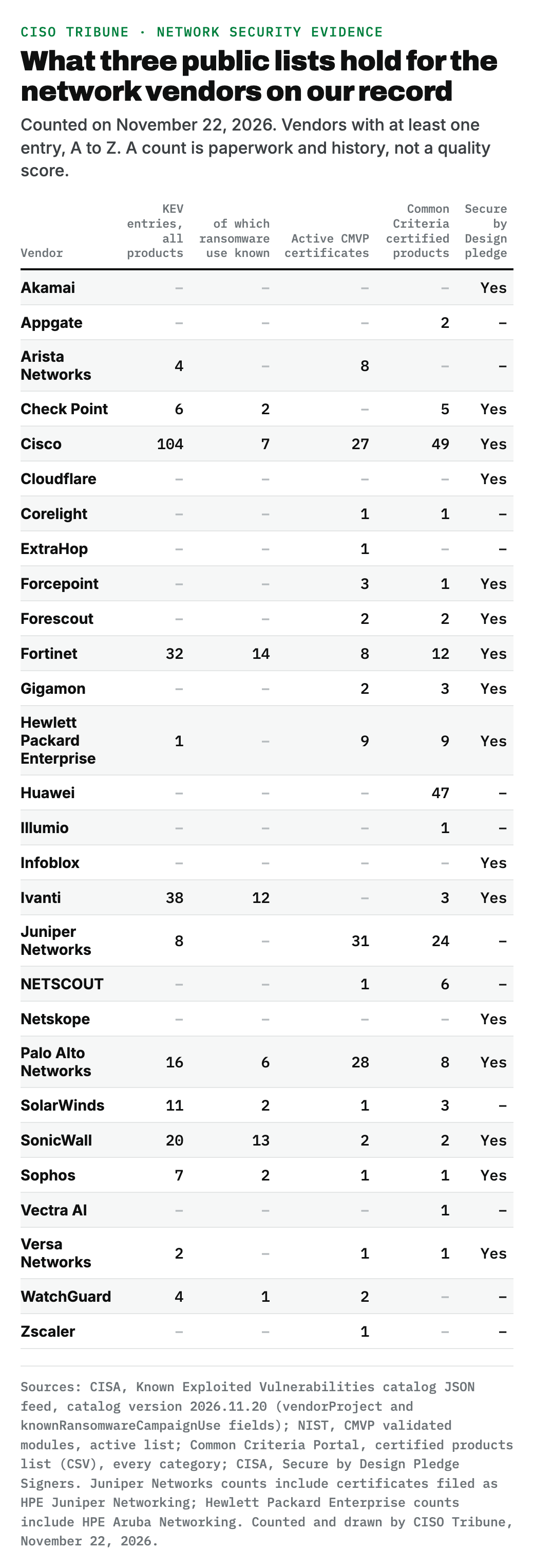
Read each count as a record of paperwork and history. Do not read it as a measure of product quality. For the full lists, open each category page:
- Firewalls and NGFW: hardware, virtual and cloud firewalls that enforce traffic policy by port, application, user and content.
- SASE and SSE: cloud-delivered bundles of secure web gateway, cloud access security broker and private access services, with or without SD-WAN networking.
- Zero trust network access: standalone services that grant users access to specific private applications after checking identity and device, in place of a network-level VPN.
- Network detection and response: tools that analyze network traffic and metadata to detect threats and support investigation and response.
For who these vendors are, see our network security vendor guide.
Peer signals: references and reviews
Ask each vendor for references that run the same product, at your size, in your configuration. Name the model, the software version, the throughput and the features you plan to turn on, then ask for customers who match.
Call the references yourself, without the vendor's account team on the line.
What to ask a reference
- Which upgrades failed, what broke, and how long the rollback took.
- How fast support responded during an incident, and whether a named engineer or a queue picked up.
- How the vendor told them about an exploited flaw: a direct notice, a published advisory, or nothing until the news broke.
- How long they waited between that first notice and a fix they could install.
The Cybersecurity and Infrastructure Security Agency (CISA) says organizations can build product security into the period after procurement by continually assessing software manufacturers' product security and security outcomes. Repeat the reference calls at each renewal, and ask what has changed since the last one.
Review sites
Treat a review-site score as a sample of people who chose to write. Read the text of each review before you look at the stars.
Peers in your sector
Ask peers in your sector's information-sharing group what they saw during the emergency directives listed above. Ask when the vendor's notice reached them, whether the mitigation steps worked as written, and whether they could pull the forensic data they needed from the device.
How CISOs weigh the evidence on a shortlist
The cryptographic module matches the version deployed
The National Institute of Standards and Technology (NIST) lets a buyer search modules on the active validation list with a basic search, and the historical and revoked lists with an advanced search. Ask each vendor for the certificate number, then match the module name and firmware version on the certificate to the build you will run.
The Common Criteria certificate matches the profile and version
Check the protection profile and the version evaluated against the release you plan to deploy, as set out above.
The independent test is recent and covers your configuration
Set aside any result you cannot map to your own deployment: the features enabled, the traffic mix and whether decryption was on.
The KEV history of the products in scope
The Cybersecurity and Infrastructure Security Agency (CISA) keeps the Catalog of Known Exploited Vulnerabilities (KEV), which counted 1,790 entries in the version released November 20, 2026. Under Binding Operational Directive (BOD) 26-04, CISA is to maintain the catalog and alert agencies of updates for awareness and action. Pull every entry for the products on your shortlist, then ask each vendor for the advisory date, the fix date and what it told customers in between.
Emergency directives and what the vendor published
CISA says it will provide additional guidance to agencies via the CISA website, emergency directives and individual engagements on request. For each directive that named a product in scope, ask the vendor for what it published during the event: advisories, indicators of compromise, fixed versions and the dates of each.
End-of-support dates and how they are announced
BOD 26-02 gives Federal Civilian Executive Branch agencies three months to inventory all devices listed in the CISA end-of-support (EOS) edge device list and send that inventory to CISA. Within 18 months they must decommission all identified EOS edge devices from agency networks, replacing them as needed with vendor-supported devices that can receive current security updates. Ask each vendor where it publishes end-of-support dates, how much notice it gives, and whether the dates cover software versions as well as hardware.
Machine-readable advisories
OASIS describes CSAF, the Common Security Advisory Framework, as a language to exchange Security Advisories formulated in JSON. Ask each vendor whether it publishes its advisories in CSAF. Then load one into the tool that matches advisories to your assets and see whether it resolves to the versions you run.
Write down which evidence decides the purchase before the vendors present. Give each of the seven items an owner and a pass condition, and hold every vendor to the same list.
Questions to put to every network security vendor
Paste these into the request for proposal and ask for a written answer to each, with documents attached.
- What are the certificate numbers, the certified models and the exact software versions for every certification you claim on the products in scope?
- Does the product ship with Federal Information Processing Standard (FIPS) mode on by default, and if it does not, which features change or stop working once we turn it on?
- Which Common Criteria security target does your certificate cover, and which features we plan to use fall outside it?
- What is the latest independent test report on this product, which lab ran it, on what date and against which software version?
- Which Known Exploited Vulnerabilities (KEV) catalog entries apply to the products in scope, and how many days passed between each disclosure and your fix?
- During the last exploited flaw in these products, how and when did you tell customers, and what did the first notice say?
- Do you publish security advisories in Common Security Advisory Framework (CSAF) format, and where is the feed?
- What is your end-of-support policy, and what are the end-of-sale and last security fix dates for each model and software version in this quote?
- Which logs can the product send off the box in real time, and which stay only on the device?
- What forensic access do we get during an incident, including memory, disk images and the underlying operating system, and does any of it require your support team?
- Can you provide your current System and Organization Controls 2 (SOC 2) report, and what type is it, what period does it cover and which services are in scope?
- Where does decryption of our traffic happen, on which hardware and in which locations, and who holds the keys?
Hold each answer against the certificate, report or advisory it names before you score the response.
Where the evidence misleads
A certificate for a different version, or an older standard
Read the module name and version on every certificate a vendor sends. Compare both with the hardware model and firmware you plan to deploy. If they differ, ask the vendor in writing which certificate covers your build, and when.
Check the standard as well, and whether a FIPS 140-2 certificate has moved to the historical list. Look up the current status of each certificate number yourself, and ask whether your use counts as an existing system or a new one under your own compliance rules.
One lab test read as a verdict on a market
Read each result as a statement about one model, under one methodology, at one point in time. Before you carry a score into a shortlist, check that the model and software version tested match what you would buy, and read the methodology for what it left out.
KEV counts read as a quality score
Use the catalog to set priorities. Do not rank vendors by how many entries carry their name, and do not treat a vendor with no entry as having a clean record.
For each entry that touches a product on your shortlist, ask the vendor when it learned of the flaw, when it shipped a fix, and when it told customers.
A pledge read as a result
Treat a signature as a commitment with a date on it. Ask each signer what it has published on progress since signing, goal by goal, and which products that progress covers. If a commitment matters to you, write it into the contract.
The vendors on the record
66 vendors file under these 9 categories on CISO Tribune's record, alphabetical within each category. A vendor filed in more than one of them appears once, under its primary category. Missing or misfiled companies go to /corrections.
Firewalls and NGFW13 vendors
Hardware, virtual and cloud firewalls that enforce traffic policy by port, application, user and content.
How to build a Firewalls and NGFW shortlist
Hardware, virtual and cloud firewalls that enforce traffic policy by port, application, user and content. Of the 13 vendors on the record, 9 list Firewalls and NGFW as its primary category; 0 have a funding round on the record; 5 name customers with a source; 10 carry a review-site listing. Each company page lists its products, funding, customers and sources, and the comparison pages below set two vendors side by side.
- Check Point Software TechnologiesCheck Point Software Technologies sells Check Point Workspace Security to secure the workforce, Check Point Cloud Security to secure the cloud, and Check Point Network Security to secure the network.Public (NASDAQ: CHKP) · primary category
- CiscoCisco sells security products that protect users, devices, apps, and data.Public (NASDAQ: CSCO) · primary category
- E-GuardianE-Guardian is a value-added distributor that connects organisations with cybersecurity, digital transformation and infrastructure solutions.Ownership not established
- Ecessa CorporationEcessa Corporation sells an SD-WAN product line that includes the WANworX Virtual Instance for Microsoft Azure.Owned by Communications Systems, Inc. since 2020 · primary category
- ForcepointForcepoint sells data security products covering DLP, DSPM, Secure Web Gateway and AI Data Security, with the same data classification, analytics and reporting across them.Ownership not established
- FortinetFortinet sells cybersecurity and networking technology to enterprises, service providers, and government organizations.Public (NASDAQ: FTNT) · primary category
- HuaweiHuawei provides information and communications technology (ICT) infrastructure and smart devices.Ownership not established · primary category
- Juniper NetworksJuniper Networks sells firewalls in physical, virtual and containerized forms, managed in a unified experience.Owned by Hewlett Packard Enterprise since 2025 · primary category
- Palo Alto NetworksPalo Alto Networks sells network security, security operations, cloud security, identity security, AI security and observability platforms, along with threat intelligence and incident response services.Public (NASDAQ: PANW) · primary category
- SonicWallSonicWall is a unified cybersecurity portfolio that helps SMBs, MSPs, and IT teams consolidate network, endpoint, cloud, and threat response across hybrid environments.Owned by Francisco Partners and Elliott Management since 2016 · primary category
- SophosSophos sells security solutions managed through Sophos Fusion, a single cloud-based platform for IT security protection.Owned by Thoma Bravo since 2020
- VodafoneVodafone is a telco that sells mobile and internet services, along with financial services, TV, cloud, security, Internet of Things (IoT) and business communications.Ownership not established
- WatchGuard TechnologiesWatchGuard Technologies sells a Unified Security Platform that combines network, endpoint, identity and cloud protection, purpose-built for MSPs servicing midsize companies and SMBs.Owned by Vector Capital since 2022 · primary category
SASE and SSE11 vendors
Cloud-delivered bundles of secure web gateway, cloud access security broker and private access services, with or without SD-WAN networking.
How to build a SASE and SSE shortlist
Cloud-delivered bundles of secure web gateway, cloud access security broker and private access services, with or without SD-WAN networking. Of the 11 vendors on the record, 8 list SASE and SSE as its primary category; 0 have a funding round on the record; 1 names customers with a source; 9 carry a review-site listing. Each company page lists its products, funding, customers and sources, and the comparison pages below set two vendors side by side.
- AryakaAryaka provides SD-WAN as a service that does not have any additional hardware requirements.Ownership not established · primary category
- AT&TAT&T sells business networking and security services, including AT&T Dynamic Defense with Palo Alto Networks, which delivers AI-driven threat prevention as a fully cloud-based service.Public (NYSE: T)
- Cato NetworksCato Networks sells the Cato SASE Cloud, a SASE platform built as a global cloud with a single-pass engine, a single data lake and single policy enforcement.Privately held · primary category
- Dispersive Stealth NetworkingDispersive Stealth Networking, from Dispersive Holdings, Inc., is a preemptive cybersecurity platform that makes data in motion invisible, resilient, and fully under an organization's control.Ownership not established · primary category
- Hewlett Packard EnterpriseHewlett Packard Enterprise sells networking, supercomputing, compute, storage, hybrid cloud and services products for enterprise and AI workloads.Public (New York Stock Exchange: HPE) · primary category
- IslandIsland sells an enterprise browser that provides a managed environment for secure application access.Privately held
- NetskopeNetskope sells a cloud-native platform, Netskope One, that converges security and networking services to enable fast and secure AI, cloud, and web access.Public (NASDAQ: NTSK) · primary category
- Skyhigh SecuritySkyhigh Security sells Hybrid Mesh SSE, which decouples policy management from enforcement location, so that a security policy authored once is enforced across a mesh of local gateways, virtual appliances, and global cloud points of presence.Ownership not established · primary category
- Versa NetworksVersa Networks sells Versa SASE, which integrates security, networking, SD-WAN, and analytics within a single software operating system.Privately held · primary category
- XcitiumXcitium sells a zero trust cybersecurity platform that protects endpoints, networks and cloud workloads from zero-day threats by isolating unknown files until they are analyzed and given a verdict.Ownership not established
- ZscalerZscaler sells a unified cybersecurity platform built on the Zero Trust Exchange.Public (NASDAQ: ZS) · primary category
Zero trust network access6 vendors
Standalone services that grant users access to specific private applications after checking identity and device, in place of a network-level VPN.
How to build a Zero trust network access shortlist
Standalone services that grant users access to specific private applications after checking identity and device, in place of a network-level VPN. Of the 6 vendors on the record, 2 list Zero trust network access as its primary category; 0 have a funding round on the record; 0 name customers with a source; 5 carry a review-site listing. Each company page lists its products, funding, customers and sources, and the comparison pages below set two vendors side by side.
- AppgateAppgate sells ZTNA that is designed to operate at the intersection of IT and OT.Privately held · primary category
- ClarotyThe Claroty Platform combines asset visibility, threat detection, exposure management, network protection and secure access.Privately held
- DispelDispel sells OT secure remote access, connecting vendors, OEMs, and operators to critical systems and data.Ownership not established · primary category
- IvantiIvanti offers IT service management software that scales from core service and asset management to ITSM Premium capabilities, with optional autonomous endpoint management add-ons.Ownership not established
- ThreatLockerThreatLocker sells an Application Control suite that includes Application Allowlisting, Ringfencing and Privileged Access Management, forming the core of its deny-by-default approach to cybersecurity.Ownership not established
- Xage SecurityXage Security sells the Xage Fabric Platform, which provides unified Zero Trust security across data centers, cloud, digital assets, cyber-physical systems, OT, LLMs, and AI agents.Ownership not established
Network detection and response8 vendors
Tools that analyse network traffic and metadata to detect threats and support investigation and response.
How to build a Network detection and response shortlist
Tools that analyse network traffic and metadata to detect threats and support investigation and response. Of the 8 vendors on the record, 5 list Network detection and response as its primary category; 0 have a funding round on the record; 1 names customers with a source; 5 carry a review-site listing. Each company page lists its products, funding, customers and sources, and the comparison pages below set two vendors side by side.
- Arista NetworksArista Networks builds scalable high-performance and ultra-low-latency networks for data center and cloud computing environments.Public (NYSE: ANET) · primary category
- CorelightCorelight sells the Open NDR Platform, which transforms network data into evidence.Ownership not established · primary category
- DarktraceDarktrace sells security for AI systems and agents, for network, cloud and OT environments, and for email and collaboration tools.Owned by Thoma Bravo since 2024 · primary category
- ExtraHopExtraHop sells RevealX, a platform that brings NDR, NPM, forensics, and IDS together.Ownership not established · primary category
- FidelisFidelis sells a range of solutions that includes XDR, NDR, EDR and CNAPP, offered for proactive cyber defense.Ownership not established
- GuardsixGuardsix is a European security company that sells a sovereign security platform for lean defenders, with products for SIEM, NDR, SOAR, fleet management and access governance.Owned by Summa Equity since 2023
- ThreatDefenceThreatDefence delivers a fully managed 24×7 SOC as a Service that combines its SecOps Platform with a team of cyber security experts who monitor, investigate and respond.Ownership not established
- Vectra AIVectra AI sells the Vectra AI Platform, a security platform that covers network, identity and cloud.Ownership not established · primary category
Microsegmentation6 vendors
Software that limits which workloads, devices and users can talk to each other inside a network to contain lateral movement.
How to build a Microsegmentation shortlist
Software that limits which workloads, devices and users can talk to each other inside a network to contain lateral movement. Of the 6 vendors on the record, 4 list Microsegmentation as its primary category; 0 have a funding round on the record; 0 name customers with a source; 3 carry a review-site listing. Each company page lists its products, funding, customers and sources, and the comparison pages below set two vendors side by side.
- Act SecurityAct Security sells a cloud security platform that eliminates unnecessary access at the infrastructure layer.Ownership not established
- AkamaiAkamai sells cloud computing, security and content delivery products.Ownership not established
- ElisityElisity sells identity-based microsegmentation for the network a customer already runs.Ownership not established · primary category
- FireMonFireMon is a network security company focused on firewall policy control for the hybrid enterprise.Ownership not established · primary category
- IllumioIllumio is a security company that sells the Illumio Breach Containment Platform, which includes Illumio Insights and Illumio Segmentation for hybrid and multi-cloud environments.Ownership not established · primary category
- Zero NetworksZero Networks automatically creates and enforces least-privilege controls across every asset, identity, and connection.Privately held · primary category
Network access control3 vendors
Systems that identify devices as they connect to wired and wireless networks and decide what each may reach.
How to build a Network access control shortlist
Systems that identify devices as they connect to wired and wireless networks and decide what each may reach. Of the 3 vendors on the record, 1 lists Network access control as its primary category; 0 have a funding round on the record; 0 name customers with a source; 1 carries a review-site listing. Each company page lists its products, funding, customers and sources, and the comparison pages below set two vendors side by side.
- AeonAeon builds cyber defence infrastructure for critical industries, offering products that secure networks, code, cloud and endpoints.Privately held
- ForescoutForescout sells the Vistaro platform, which delivers Universal Zero Trust Network Access, OT security, and continuous exposure management.Ownership not established · primary category
- OrdrORDR sells a device security platform that turns device intelligence into enforcement across IT, IoT, OT, and IoMT.Ownership not established
DDoS protection11 vendors
Services and appliances that absorb or filter distributed denial-of-service traffic before it overwhelms a target.
How to build a DDoS protection shortlist
Services and appliances that absorb or filter distributed denial-of-service traffic before it overwhelms a target. Of the 11 vendors on the record, 3 list DDoS protection as its primary category; 0 have a funding round on the record; 1 names customers with a source; 6 carry a review-site listing. Each company page lists its products, funding, customers and sources, and the comparison pages below set two vendors side by side.
- A10 NetworksA10 Networks sells security solutions, infrastructure solutions, and centralized management and automation solutions for applications and networks.Public (NYSE: ATEN) · primary category
- BlackwallBlackwall sells a web traffic management platform for the hosting market.Privately held
- BravaBrava sells business solutions that include network infrastructure under Brava Connect and cybersecurity under Brava Stronghold.Ownership not established
- CloudflareCloudflare sells one platform for apps, agents and workforce.Public (NYSE: NET) · primary category
- DataDomeDataDome sells bot protection for websites, mobile apps, APIs and MCP servers.Ownership not established
- FastlyFastly is an edge cloud platform that helps companies deliver fast, secure, and reliable digital experiences.Public (NYSE: FSLY)
- ImpervaImperva sells an Application Security Platform that protects against application and API attacks without impacting legitimate users.Owned by Thales
- NETSCOUTNETSCOUT sells observability, cybersecurity, and AIOps solutions powered by the NETSCOUT Data Platform.Public (NASDAQ: NTCT) · primary category
- NokiaNokia sells network security products, including NetGuard Cybersecurity Dome and Deepfield, which provide security monitoring, threat incident response, identity access management and DDoS detection and mitigation.Ownership not established
- SafeLineSafeLine sells a web application firewall that protects websites from attacks such as SQL injections, cross-site scripting and zero-day exploits, using a semantic analysis engine that looks at traffic behavior and context rather than relying only on known signatures.Ownership not established
- TeliaTelia sells cybersecurity services for businesses, including DDoS Protection, Telia Secure 24/7 monitoring, security for the IT environment, mobile security and backup for Microsoft 365 and Google data.Ownership not established
DNS security4 vendors
Protective DNS resolvers and DNS infrastructure products that block malicious domains and protect name resolution.
How to build a DNS security shortlist
Protective DNS resolvers and DNS infrastructure products that block malicious domains and protect name resolution. Of the 4 vendors on the record, 2 list DNS security as its primary category; 0 have a funding round on the record; 0 name customers with a source; 1 carries a review-site listing. Each company page lists its products, funding, customers and sources, and the comparison pages below set two vendors side by side.
- DigiCertDigiCert ONE is a platform that includes Trust Lifecycle Manager for organizations that require CA-agnostic certificate lifecycle management.Ownership not established
- doxx.netThe doxx.net platform is a parallel internet built on its own DNS root, IP space, encrypted mesh, and agent-driven networking.Privately held · primary category
- EasyDMARCEasyDMARC sells a platform that gives Security and IT the context to see what changed, understand what it affects, and act across infrastructure, authentication, legitimate sending, deliverability, and external threats.Ownership not established
- InfobloxInfoblox supplies networking and security offerings designed to improve performance and protection for organizations.Ownership not established · primary category
Network visibility and traffic brokering4 vendors
Taps, packet brokers and observability fabrics that deliver copies of network traffic to security and monitoring tools.
How to build a Network visibility and traffic brokering shortlist
Taps, packet brokers and observability fabrics that deliver copies of network traffic to security and monitoring tools. Of the 4 vendors on the record, 4 list Network visibility and traffic brokering as its primary category; 0 have a funding round on the record; 0 name customers with a source; 1 carries a review-site listing. Each company page lists its products, funding, customers and sources, and the comparison pages below set two vendors side by side.
- GigamonThe Gigamon Deep Observability Pipeline combines physical, virtual, cloud-native, and software-based components to provide visibility, intelligence, and control across hybrid cloud infrastructure.Ownership not established · primary category
- NEOX NETWORKSNEOX NETWORKS provides network visibility for IT and OT observability and security.Ownership not established · primary category
- Network CriticalNetwork Critical sells modular TAP and Packet Broker solutions for network visibility.Ownership not established · primary category
- SolarWindsSolarWinds sells monitoring, observability and service management capabilities on a platform offered in self-hosted and SaaS deployment models.Ownership not established · primary category
Frequently asked questions
- What evidence do CISOs use to choose a network security vendor?
- They trust evidence that someone other than the seller produced. That means cryptographic validation under the Cryptographic Module Validation Program (CMVP), Common Criteria certificates, lab tests, and the vendor's entries in the Known Exploited Vulnerabilities (KEV) catalog. Then they read how the vendor discloses its own flaws. Ask which question each piece of evidence answers, and do not let one kind stand in for another.
- What does FIPS 140-3 validation prove?
- Validation under Federal Information Processing Standards Publication (FIPS) 140-3 shows that a testing laboratory verified a cryptographic module against a set of testable cryptographic and security requirements, and that the Cryptographic Module Validation Program reviewed and validated the submission. Read the certificate as a statement about the cryptographic module and nothing wider. Assess traffic inspection, the management interface and the patch record on separate evidence.
- What is the difference between FIPS 140-3 and Common Criteria?
- Federal Information Processing Standards Publication (FIPS) 140-3 covers the secure design, implementation and operation of a cryptographic module, at four increasing levels of security. Common Criteria is an international program in which accredited laboratories test IT products against cyber security specifications for technology classes. A protection profile sets the baseline security requirements for a class, and member countries recognize each other's certificates.
- How should a CISO read a vendor's entries in CISA's KEV catalog?
- Read the counts with care. The Known Exploited Vulnerabilities (KEV) catalog, kept by the Cybersecurity and Infrastructure Security Agency (CISA), will show more entries for a vendor with many products and a large installed base. An empty record can mean a product attracts less attention. For each entry, weigh the kind of flaw, how fast a fix shipped, and whether the vendor told customers. Check the ransomware field too.
- Are independent firewall tests worth reading?
- Yes, with care. Read each result as a statement about one model, under one methodology, at one point in time. In the 2025 Enterprise Firewall evaluation run by NSS Labs, Security Effectiveness ranged from 46.37% to 99.59% across seven products. Ask for the full report, the test date and the firmware version tested, and check whether the product was tested in your configuration, with decryption on.
- What happened to FIPS 140-2 certificates in September 2026?
- The transition page of the National Institute of Standards and Technology (NIST) gives September 21, 2026 as the date FIPS 140-2 validations move to the historical list. The same page says the Cryptographic Module Validation Program still supports the purchase and use of these modules for existing systems. Look up each certificate number yourself, and ask whether your use counts as an existing system or a new one under your own compliance rules.
Sources
- Known Exploited Vulnerabilities Catalog · Cybersecurity and Infrastructure Security Agency (CISA), November 22, 2026
- Known Exploited Vulnerabilities Catalog (JSON feed), catalog version 2026.11.20 · Cybersecurity and Infrastructure Security Agency (CISA), November 20, 2026
- Cybersecurity Directives · Cybersecurity and Infrastructure Security Agency (CISA), November 22, 2026
- ED 24-01: Mitigate Ivanti Connect Secure and Ivanti Policy Secure Vulnerabilities · Cybersecurity and Infrastructure Security Agency (CISA), January 19, 2024
- ED 25-03: Identify and Mitigate Potential Compromise of Cisco Devices · Cybersecurity and Infrastructure Security Agency (CISA), September 25, 2025
- ED 26-03: Mitigate Vulnerabilities in Cisco SD-WAN Systems · Cybersecurity and Infrastructure Security Agency (CISA), February 25, 2026
- BOD 26-02: Mitigating Risk From End-of-Support Edge Devices · Cybersecurity and Infrastructure Security Agency (CISA), February 5, 2026
- BOD 26-04: Prioritizing Security Updates Based on Risk · Cybersecurity and Infrastructure Security Agency (CISA), June 10, 2026
- Cryptographic Module Validation Program (CMVP) · National Institute of Standards and Technology (NIST), November 22, 2026
- CMVP validated modules, active list · National Institute of Standards and Technology (NIST), November 22, 2026
- CMVP modules in process list · National Institute of Standards and Technology (NIST), November 22, 2026
- FIPS 140-3, Security Requirements for Cryptographic Modules · National Institute of Standards and Technology (NIST), March 22, 2019
- FIPS 140-3 Transition Effort · National Institute of Standards and Technology (NIST), November 22, 2026
- Certified products list (CSV) · Common Criteria Portal, November 22, 2026
- Common Criteria · Canadian Centre for Cyber Security, November 22, 2026
- Certification according to Common Criteria · Federal Office for Information Security (BSI), November 22, 2026
- EUCC Certification Scheme · European Union Agency for Cybersecurity (ENISA), November 22, 2026
- The EU cybersecurity certification framework · European Commission, November 22, 2026
- Global government certifications · Cisco, November 22, 2026
- Cisco FedRAMP · Cisco, November 22, 2026
- FIPS 140 certifications · Fortinet, November 22, 2026
- Common Criteria · Palo Alto Networks, November 22, 2026
- Certifications · Palo Alto Networks, November 22, 2026
- NGFW administration: certifications · Palo Alto Networks, November 22, 2026
- CyberRatings.org and NSS Labs Announce 2025 Enterprise Firewall Test Results · CyberRatings.org (PR Newswire), November 5, 2025
- RFC 9411: Benchmarking Methodology for Network Security Device Performance · Internet Engineering Task Force (IETF), March 1, 2023
- NetSecOPEN · NetSecOPEN, November 22, 2026
- Secure by Design Pledge · Cybersecurity and Infrastructure Security Agency (CISA), November 22, 2026
- Secure by Design Pledge Signers · Cybersecurity and Infrastructure Security Agency (CISA), November 22, 2026
- Secure by Design Pledge progress reports · Cybersecurity and Infrastructure Security Agency (CISA), November 22, 2026
- Secure by Demand Guide · Cybersecurity and Infrastructure Security Agency (CISA), August 6, 2024
- CISA Releases Secure by Demand Guide · Cybersecurity and Infrastructure Security Agency (CISA), August 6, 2024
- Product Security Bad Practices · Cybersecurity and Infrastructure Security Agency (CISA), November 22, 2026
- Common Security Advisory Framework Version 2.0 · OASIS Open, November 18, 2022
- PSIRT Advisories, FortiGuard Labs · Fortinet, November 22, 2026
- Palo Alto Networks Security Advisories · Palo Alto Networks, November 22, 2026
- Cisco Security Advisories · Cisco, November 22, 2026
- Our commitment to security: an open letter from Ivanti CEO Jeff Abbott · Ivanti, November 22, 2026
- CVE-2024-3400 record · CVE Program, November 22, 2026
- CVE-2023-46805 record · CVE Program, November 22, 2026
- CVE-2024-21762 record · CVE Program, November 22, 2026
- CVE-2025-20333 record · CVE Program, November 22, 2026
- Cyber agencies unveil new guidelines to secure edge devices from increasing threat · National Cyber Security Centre (NCSC), February 4, 2025
- Guidance on digital forensics and protective monitoring specifications for producers of network devices and appliances · National Cyber Security Centre (NCSC), November 22, 2026
- Making forensic observability the norm for network devices · National Cyber Security Centre (NCSC), July 29, 2026
- FedRAMP 20x · FedRAMP, November 22, 2026
- SOC 2: SOC for Service Organizations, Trust Services Criteria · AICPA & CIMA, November 22, 2026
- Compliance resources · Cloudflare, November 22, 2026
Writer
Hadass Liza Bitton is a writer at CISO Tribune covering security leadership: the people who take the top security seat, the ones who leave it, and what each move signals. Reach her at hadass@cisotribune.com.
The Briefing
Every verified CISO move of the week, in your inbox Friday.
Every verified CISO move and one piece of analysis, weekly.
Unsubscribe any time. See the privacy policy.